- The GBP/JPY continues its post-intervention recovery ahead of the US CPI report tomorrow, which could have a secondary impact on the pair.
Current Setup
The GBPJPY still retains the structural bullishness because of the interest rate differential that still exists between the British Pound and the yen. However, the overall risk-to-reward for this interest rate differential is no longer as one-sided as it was before the late July FX intervention by the Japanese financial authorities, followed by the Bank of Japan’s hawkish switch in monetary policy. However, the pair still retains its key macro divergence as the Bank of England still maintains its official bank rate at 3.75%, against the BoJ’s 1.0%.
The sudden switch to a more hawkish approach to monetary policy by Japanese authorities has triggered a round of strengthening in the last two weeks. Not only have Japanese financial authorities demonstrated a willingness to intervene in FX markets when required, but this has also been backed up by more hawkish messaging at last week’s BoJ monetary policy meeting.
The summary is clear. While the fundamentals of the carry trade continue to support a GBP/JPY uptrend, it is becoming riskier to keep chasing that trend at elevated price levels.
Macro Analysis of the GBP/JPY
1) The BoE-BoJ rate differential still favors the GBP
The rate differential remains the largest structural support for the GBP/JPY pair. Investors will therefore still choose to borrow the Yen (lower interest) and buy the Pound (earning higher interest); the so-called carry trade. As long as this differential remains, investors will remain incentivized to continue the carry trade.
The carry only collapses if the BoE reduces rates, or the BoJ fastens its tightening course. Otherwise, any interventions by the Japanese financial authorities will make it cheaper to get into the GBP/JPY uptrend, providing a dip-buying opportunity.
2) A More Hawkish BOJ is gaining market traction
Japan’s export-oriented economy depends on a weaker Yen relative to the other G10 currencies to make its products more attractive for other countries to import. But with the rise in oil prices due to the geopolitical tensions in the Middle East, it has become simply too expensive to use a gradually weakening Yen to fund oil imports. Japan is 100% dependent on imports of crude oil/refining derivatives for its fossil-fuel needs. The Yen’s weakness was starting to become an untenable situation. The Japanese financial authorities are no longer just threatening to intervene (verbal action). They actually consulted US authorities and performed a coordinated action to buy Yen and sell the US Dollar.
The message is clear, and BoJ Governor Ueda also sounded this at the last monetary policy meeting: the BoJ was prepared to use all means at its disposal to resist disorderly depreciation of the Yen and respond to any inflationary pressures brought on by wage growth. Estimates put the cost of the latest intervention at about ¥8.45 trillion. As is the culture, there are no official figures from the BoJ or Japanese Finance Ministry to this effect.
This is important because such an intervention usually leads to the yen strengthening across the board. Despite the USD/JPY being the primary target of this move, the GBP/JPY suffered collateral damage.

USD/JPY ↓ → JPY strengthens → GBP/JPY ↓
3) Intervention risk at elevated levels is now a credible factor
This is a major change for the macro fundamentals of GBP/JPY. There is now a risk of abrupt reversals without warning if the uptrend takes prices above 210.00. Maybe even lower. Trying to chase an additional upside move at that price level, or even trying to pre-empt an intervention, can quickly lead to severe losses if the trader’s account cannot handle the volatility.
4) The BoE is not straightforwardly dovish
The Bank of England’s pathway to rate cuts remains unclear and non-committal. UK inflation for June cooled significantly to 2.6% YoY. This should ordinarily be an impetus for a rate cut, but growth and employment data surprised to the upside, which is a sign that the UK economy presently does not need the BoE’s help via a dovish action.
The next UK inflation and employment data on 17-18 August 2026 are deemed as a key driver of the GBP/JPY’s near-term trend.
5) Risk sentiment
The GBP/JPY is more risk-sensitive than many major FX crosses. The pair gains when the market is risk-on, and loses ground when the market is risk-off. The geopolitical space has made risk sentiment an active determinant of intraday and ultra-short-term direction.
GBP/JPY Technical Outlook
The 4-hr chart shows that the price action has broken above the 214.62 resistance (2 July) en route to the 216.03 barrier and prior high of 1 July 2026. If the bulls push past this resistance, the 217.23 and 218.56 resistance levels come into the picture, with the latter being the 30 July high from where the BoJ intervention took place.
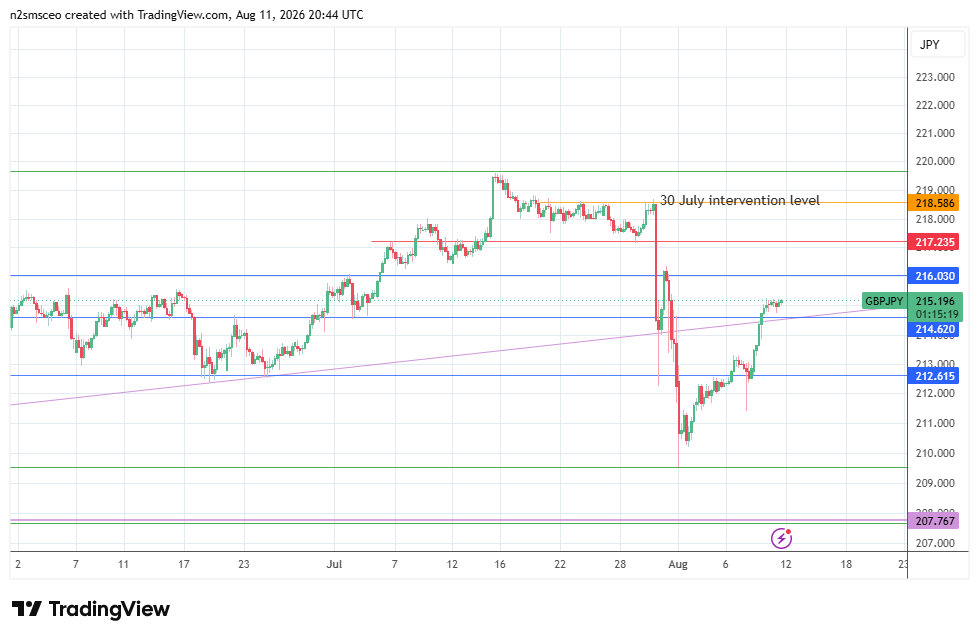
On the flip side, downside targets at 212.61 (24 June low) and 209.51 (2 August low and post-intervention trough) become available if the bulls fail to defend the 214.62 support mark.