



- The Japanese yen is gaining strength as the Bank of Japan continues to raise interest rates, while the Bank of England keeps rates unchanged, reducing the interest rate gap between the two currencies.
- GBP/JPY remains under downside pressure as investors unwind carry trades and stronger Japanese economic data boosts demand for the yen.
The GBP/JPY is experiencing aggressive fundamental crosscurrents. The currency pair is fluctuating around the 213.00-215.00 range, which is a dramatic macro tug-of-war. There are several catalysts shaping GBP/JPY, including:
- The Bank of Japan has decided to hike the short-term interest rate due to inflation pressures.
- Hawkish stance of the Bank of England, holding its benchmark rate at 3.75% for the fourth consecutive month.
- De-escalation of geopolitical shock and cooling global oil prices.
- The carry trade unwinds.
Before delving into these catalysts’ details, let’s take a technical look at the chart:
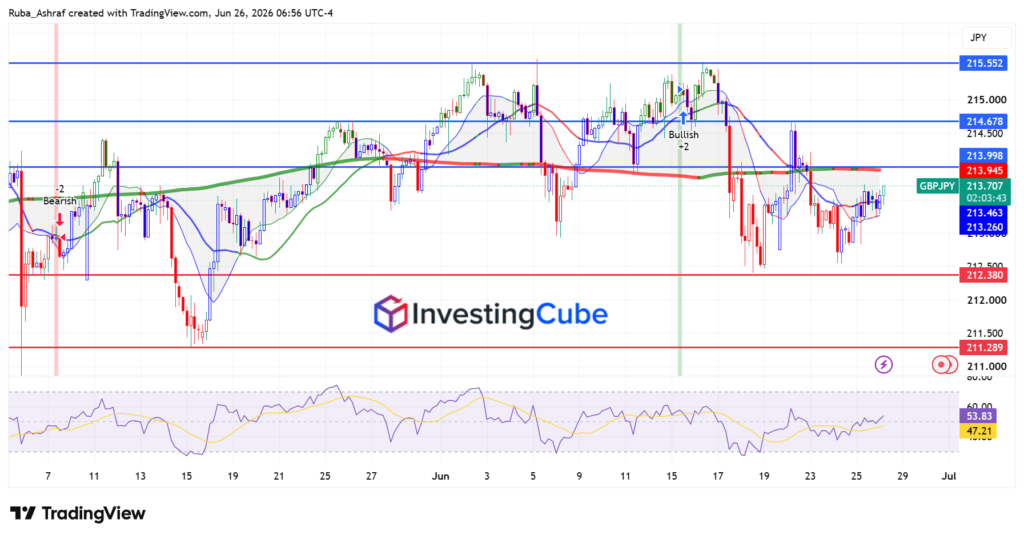
The GBP/JPY’s price action shows that the price is trading within a well-defined range after a sharp bearish move. The market appears to be in a consolidation phase rather than a strong trend, with buyers and sellers competing around an important equilibrium level near 213.95.
The most noticeable feature is the aggressive sell-off from the highs around 215.50. This aligns with the price breaking below the moving averages and falling rapidly to approximately 212.60. That decline changed the short-term market structure from bullish to bearish. Since then, however, sellers have not been able to continue making lower lows, and buyers have gradually pushed prices back toward the middle of the range. This suggests that bearish momentum has weakened, even though it has not yet been fully reversed.

the key areas of interest. 215.55 is the major resistance where the price has been rejected multiple times, making it the strongest ceiling on the chart. Below that, 214.68 is another resistance that aligns with previous swing highs and would likely attract selling if the price rallies.
Around 213.95, there is a significant pivot level that has acted as both support and resistance. The market is currently trading just below this level, near 213.62, indicating that buyers are attempting to reclaim it but have not yet confirmed a breakout. On the downside, 212.38 is the first major support and represents the recent swing low area. If that level fails, the next important support lies near 211.29.
The shorter-term averages have begun turning upward after the recent recovery, indicating improving short-term strength. However, the longer moving average remains relatively flat to slightly downward and is sitting around the 213.95 area. Meanwhile, the RSI is currently around 52, which is almost exactly in neutral territory. This indicates there is room for further upside if resistance levels break, while also indicating that momentum is not yet strong enough to confirm a sustained trend.
GBP/JPY Forecast: Main Catalysts Moving the Pound-Yen:
- The Japanese Yen is strengthening after the Bank of Japan raised interest rates from 0.75% to 1.00%, the highest level since 1995. The decision reflects stronger inflation and rising consumer prices. Higher interest rates make the Yen more attractive, increasing demand for the currency and putting downward pressure on GBP/JPY.
- On the UK side, the Bank of England kept its interest rate unchanged at 3.75% for the fourth meeting in a row. However, two policymakers voted to raise rates to 4.00%. This shows concerns that inflation, currently at 2.8%, could rise again later this year.
- This suggests UK interest rates may stay higher for longer, which continues to support the British Pound against the Japanese Yen.
- The Japanese yen is also influenced by global risk sentiment and oil prices. Recent signs of easing tensions in the Middle East, including progress toward a possible US-Iran peace agreement, have pushed oil prices lower. Cheaper oil reduces Japan’s import costs and inflation pressures, giving the Bank of Japan more confidence to continue raising interest rates. At the same time, lower geopolitical risks reduce demand for the Yen as a safe-haven currency.
- For many years, traders borrowed low-interest Japanese yen to buy higher-yielding British pounds, a strategy known as the carry trade. As the Bank of Japan continues to raise interest rates while the Bank of England keeps rates at 3.75%, the interest rate gap between the two countries is shrinking. This makes the carry trade less attractive, leading some investors to close their positions. As a result, GBP/JPY can experience sharp declines, especially when Japanese economic data comes in stronger than expected.