




- EUR/USD rebounds as the US dollar weakens on improved risk sentiment and lower Treasury yields.
- ECB inflation concerns provide some support for the Euro, but weak Eurozone PMI data limits upside momentum.
- The pair remains cautiously bullish above 1.1720, with 1.1800 as the key resistance to watch.
- A clear break above 1.1800 could open the door toward 1.1840, while failure may keep EUR/USD range bound.
Euro Gains on Dollar Drop, But Weak Eurozone Data Caps Upside Potential
EUR/USD is seeing stronger momentum during today’s trade session due to the dollar facing headwinds from improved risk appetite, reduced bond yields, and possible de-escalation of geopolitical conflicts. EUR/USD has returned near the 1.1750 to 1.1770 levels, driven more by dollar weakness than by a bullish move in the euro currency.
As per Investing.com, the price action for EUR/USD was at 1.1765, with today’s range between 1.1692 and 1.1771. In the near term, there will be some upside potential as long as EUR/USD stays above 1.1720. However, there could be no significant upside as long as EUR/USD fails to cross above the 1.1800 level.
Right now, traders not only need to keep an eye on developments from the Eurozone region but also monitor if the dollar could sustain its decline after improving global risk appetite.
EUR/USD Gained Back by Dollar Decline
The main driving force for today’s EUR/USD rise comes from the weakening US dollar. Market optimism rose following news that the US and Iran might be making progress towards a potential deal, thus causing reduced demand for the dollar as a safe haven asset. According to Reuters, global equities and bonds surged on hopes of progress in US-Iran talks, with the dollar falling as investors return to risky assets.
Declining US Treasury yields were another positive catalyst for EUR/USD. With US Treasury yields dropping, the value of the dollar tends to fall, as the interest rate from investing in dollars also falls. This leaves more space for the non-US currency to rise. In case US yields keep sliding and tensions dissipate further, the EUR/USD can maintain its uptrend in the short term.
It should be mentioned, however, that this is not just a euro factor. The euro is gaining only because of the dollar weakening, not due to the improvement of the euro area economy itself.
Inflation Worries from the ECB Provide Some Support for the Euro
Finally, the euro also receives some support due to increased worries that the European Central Bank will be forced to maintain its current level of tight monetary policy for an extended period of time. According to ECB board member Piero Cipollone, the probability of another rate hike by the ECB has risen due to the persisting inflation pressures. Reuters also reports that inflation in the Eurozone climbed to 3%, exceeding the 2% threshold set by the ECB.
It makes sense to note how this news affects the EUR/USD exchange rate. With increased expectations of future rate hikes from the ECB or delays in its monetary policies, the euro is likely to benefit in the long run. In turn, the EUR/USD pair might receive some additional support whenever it pulls back, provided that the Federal Reserve becomes less hawkish.
On the other hand, the European Central Bank has a rather challenging task in front of it. On the one hand, it has to contend with persistent levels of high inflation, while on the other hand, there have been several negative developments within the economy recently.
Eurozone Services and Composite PMIs Failed to Inspire Confidence in Upward EUR/USD Rally
The greatest threat to EUR/USD bulls is the lackluster performance of the Eurozone economy. The Eurozone services PMI fell to 47.6 in April, marking the first decline since May last year. Similarly, the Eurozone composite PMI dipped to 48.6, remaining below the 50 mark, which signifies the threshold between growth and contraction.
Moreover, Germany, the Eurozone’s largest economy, also displayed a worrying trend. The German services PMI slipped to 46.9, which indicated the most rapid contraction in over three years. This implies that low demand, expensive operational costs, and uncertainty continue to impact the economy adversely.
Consequently, this indicates that the euro is unlikely to stage an aggressive upward movement unless there is a change in Eurozone economic figures in the coming days. The weak economy might raise doubts among investors regarding the extent to which the ECB could raise interest rates before further harming the economy. Hence, even if EUR/USD rises in the near future, a sustained rally beyond 1.1800 will prove difficult.

US ADP Figures Continue to Be a Significant Short-Term Risk Factor
In terms of the USD, the ADP figures also continue to matter in this regard, specifically US private payrolls expanded by 118,000 in April, compared to the prior month’s reading of 62,000.
Positive developments in the job market can be beneficial for the greenback due to the higher chance for the FOMC to leave its current rates unchanged. In case investors assume that the central bank will maintain its conservative stance on rate cuts, the US currency might rebound, causing EUR/USD pairs to suffer further losses. Otherwise, if the incoming US figures start deteriorating, there is the possibility that the US dollar may continue falling, providing support for EUR/USD pairs at higher price levels. Therefore, US economic indicators can remain relevant factors behind the near-future developments for the pair.
Technical Outlook
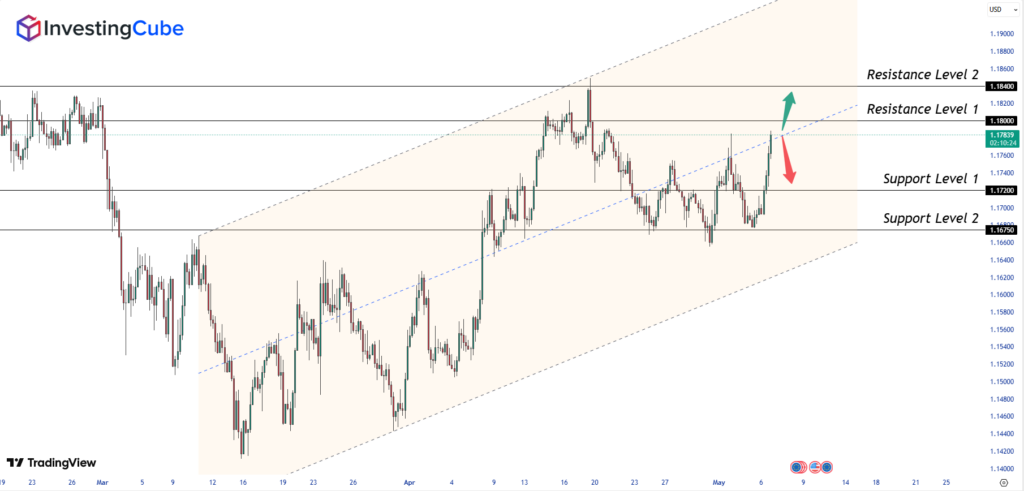
Technically speaking, EUR/USD attempts to bounce higher amid the consolidation process. The currency pair managed to approach the 1.1770 resistance level, approaching its intraday peak. The break above 1.1770 might enable EUR/USD to reach for 1.1800 and even 1.1840 further. The downside supports are led by 1.1720. Provided that the currency pair is capable of staying above 1.1720, then bulls can keep defending the recovery. The fall beneath 1.1720 would make the positive structure weaker and might pull EUR/USD toward 1.1675 and 1.1640.
Currently, the currency pair is cautiously bullish. However, the technical structure requires confirmation. Closing above 1.1800 would strengthen the bullish bias. On the contrary, repeated rejections below this level would mean that EUR/USD is trapped inside range-bound trading.
Technical Outlook
There is potential for further appreciation in EUR/USD with a mild bullish bias, provided that the USD stays weak and geopolitical concerns fade away. The key resistance levels to watch out for would be 1.1770 and 1.1800. Once the price breaches the level of 1.1800, it would open up the way for an upward move to 1.1840.
Nevertheless, a cautious tone should be adopted with respect to the upside.
- Weakness in the Eurozone PMI signals that the Eurozone economy still faces risks.
- Stronger numbers from the US labor market suggest the Fed will remain hawkish.
Failure to exceed 1.1800 would mean that EUR/USD resumes range-bound trading at 1.1720-1.1800.
Conclusion
There seems to be no doubt that EUR/USD is set to find some degree of support due to weakening US dollar and risk-on market sentiments and falling Treasury yields. Also, the anticipation of the need for the ECB to adopt a careful stance on the rising rates of inflation provides an extra level of support for the euro.
However, the weak Eurozone PMI numbers indicate that the economic strength of the Eurozone is somewhat delicate. As far as prices are concerned, EUR/USD is set to consolidate at 1.1720 to retain the uptrend. On breaking above the 1.1800 level, EUR/USD is seen moving towards the 1.1840 level. Failure to do so may lead to the continuation of consolidation within the range.
Frequently Asked Questions
EUR/USD is rising mainly because the US dollar is weakening. Improved risk sentiment, lower US Treasury yields, and hopes for easing geopolitical tensions have reduced demand for the safe-haven dollar.
EUR/USD could break above 1.1800 if the dollar continues to weaken and market sentiment remains positive. However, weak Eurozone economic data may limit the strength of the move.
The key resistance levels are 1.1770, 1.1800, and 1.1840. The key support levels are 1.1720, 1.1675, and 1.1640.