



2026 is shaping up to be a pivotal year for fintech stocks. After valuation resets, funding pullbacks and higher interest rates, the sector is entering a period where sustainable revenue and disciplined execution matter far more than rapid expansion.
A global fintech study by Boston Consulting Group and QED Investors estimates that financial technology revenues could grow five to six times and reach around 1.5 trillion dollars by 2030, which would give fintechs roughly 7 percent of global financial services revenue.
Investors looking at fintech stocks in 2026 will need to track not just growth numbers but the deeper industry trends influencing valuations. With consumer behaviour shifting toward cashless ecosystems and companies racing to modernise financial technology, the landscape has become far more competitive and innovation-driven than it was just a few years ago.
What Defines Fintech Stocks and Why They Matter in 2026
Financial technology, abbreviated as fintech, refers to the digital tools and platforms that streamline, automate or enhance financial services. It covers everything from mobile payments and neobanks to AI powered lending systems and blockchain based settlement networks, all designed to make financial processes faster, more accessible and more efficient for both consumers and businesses.
Their importance in 2026 is tied to scale and necessity. Financial services remain one of the largest parts of the global economy, and the migration from traditional systems to digital platforms is still underway. BCG describes fintech as the unbundling and rebuilding of financial services through software, a shift that continues to attract investment because the addressable market is so large.
Fintech stocks matter because they sit at the intersection of technology, regulation and consumer behaviour. They reflect how people now pay, borrow, save and invest.
Key Growth Drivers Shaping the Fintech Industry Next Year
1. AI Agents in Banking and Finance
AI agents represent the next evolution beyond chatbots, enabling automated multi-step workflows across the financial technology market. Banks are testing agents that reconcile transactions, perform compliance checks, and flag unusual activity in real time.
McKinsey’s 2025 global banking research notes that AI-driven process automation could remove billions in operating costs across the sector. Customer-facing AI agents will act more like personal financial assistants, comparing loan rates, managing budgets and adjusting portfolios through third-party fintech apps, showing how AI fintech companies are becoming central to daily financial decisions.
2. Bridging the Fintech Skills Gap
Even with rapid digital payments growth and expanding AI capabilities, the fintech sector faces a widening talent shortage. The World Economic Forum reports that financial institutions rank the skills gap as one of the biggest obstacles to digital transformation.
Demand is surging for AI engineers, cybersecurity analysts, blockchain developers and data scientists capable of building next-generation financial infrastructure. Without stronger recruitment and upskilling, many financial technology market initiatives will struggle to reach full scale, keeping this one of the defining challenges of 2026.
3. The Customer Experience Revolution
With consumers switching providers more easily than ever, fintech industry trends are shifting sharply toward hyper-personalized customer experience. Predictive analytics, faster onboarding and AI-powered service tools allow banks and neobanks to resolve customer issues without long wait times.
Studies from Accenture’s financial services division show that digital-first users reward frictionless design and multi-touchpoint continuity with higher loyalty. In 2026, CX becomes the competitive battlefield where fintech investments either scale or stall, making personalization a major driver of growth.
4. Breakthroughs in Quantum Finance
Quantum computing began limited testing in leading banks in 2025, with institutions such as JPMorgan and Goldman Sachs applying it to complex risk models and portfolio optimization.
Industry papers from IBM and HSBC highlight how combining classical and quantum computing could unlock major performance improvements in high-volume financial calculations.
In 2026, the focus shifts from experimentation to operational integration, with hybrid workflows powering faster simulations and more accurate modeling in capital markets.
5. Tokenized Assets Gain Traction
Tokenization is transforming how institutions and retail investors access new asset classes. Real-world assets, including commodities, property and even luxury goods, are being digitized and traded through blockchain fintech platforms, eliminating middlemen and simplifying settlement.
Tokenized asset markets reached roughly 25 billion dollars in 2025, a dramatic jump from early estimates in 2020. As financial firms tokenize bonds, securities and private credit, this segment is set to accelerate in 2026, creating new avenues for fintech investments.
6. Building Resilience in Volatile Times
With geopolitical uncertainty, shifting trade alliances and supply chain disruptions, financial institutions are prioritizing resilience across payments, lending and risk infrastructure. There is growing need for flexible regulatory systems and faster cross-border payment capabilities.
Fintech companies are responding with blockchain-enabled settlement, smarter fraud controls and adaptive infrastructure designed to withstand volatility.
For investors, these resilience-focused innovations may become a core driver of value in the financial technology market through 2026.
7. Stablecoins Move Into the Mainstream
Stablecoins gained regulatory momentum in 2025, supported by policy updates in the United States and Europe that clarified how digital assets fit within fintech regulation frameworks. Large banks including Bank of America and Citi began exploring settlement uses, helping push stablecoins from niche crypto products to practical financial tools.

As more countries adopt crypto-friendly rules, stablecoins could become a key layer of digital payments growth, particularly for cross-border transfers and treasury operations.
How Digital Payments and Cashless Trends Influence Market Performance
Digital payments growth remains the strongest pillar of the financial technology market. Mobile wallets, real time transfers and merchant acceptance are expanding rapidly worldwide.
Stocks tied to digital payment volume often trade at premium valuations because their revenue grows with every transaction cycle. Companies with strong merchant networks, fraud prevention systems and scalable cloud infrastructure tend to outperform during periods of high consumer spending.
The Role of AI and Automation in Boosting Fintech Company Valuations
- AI allows fintech companies to automate costly manual processes, improving margins and strengthening valuation multiples.
- Machine learning models enhance underwriting accuracy, reducing default risk for digital lenders and boosting investor confidence.
- Automation in fraud detection and compliance lowers operational overhead while meeting tighter fintech regulation standards.
- AI driven personalization improves customer experience, which increases retention rates for neobanks and payment platforms.
- Real time analytics help fintech firms scale efficiently, a key factor analysts look for when valuing high growth fintech stocks.
- Automated workflows support faster digital payments growth by minimizing transaction errors and speeding up settlement times.
- AI powered advisory tools create new revenue streams in wealth tech, strengthening long term fintech investments.
Fintech Regulation and Compliance Risks Investors Need to Watch
- Compliance complexity is rising because data-privacy rules differ across regions, and a recent analysis by Luthor.ai notes that inconsistent global standards make it harder for fintechs to scale securely.
- Anti-money laundering (AML), know-your-customer (KYC) and crypto-asset regulation continue tightening, raising compliance burdens especially for payment processors, neobanks and blockchain fintech services.
- Cybersecurity vulnerabilities, including data breaches, fraud, hacking and system outages.
- Regulatory uncertainty and rapidly evolving rules mean fintechs must constantly adapt: lack of agility or delayed compliance upgrades can lead to fines, loss of licence, or reputational damage.
Which Fintech Sectors Are Expected to Lead in Revenue and Innovation
The fastest growing sectors in 2026 include:
• Digital payments and merchant acquiring
• AI driven lending platforms
• Insurance technology (insurtech)
• Blockchain infrastructure providers
• Wealth tech and automated advisory platforms
BCG’s report indicates that payments and lending will remain the largest revenue contributors, while insurtech and blockchain fintech will grow fastest in innovation.
Are Neobanks Still Growing or Losing Momentum
Neobanks are still growing, but their momentum has become more measured as the market shifts toward profitability and stronger regulatory compliance. The largest digital banks continue to add users and expand lending and payments services, while smaller neobanks face pressure from rising costs and tighter fintech regulation.
In 2026, growth is driven less by hype and more by sustainable revenue models, making efficient neobanks well positioned within broader fintech industry trends.
Market Predictions Analysts Are Making for Top Fintech Stocks
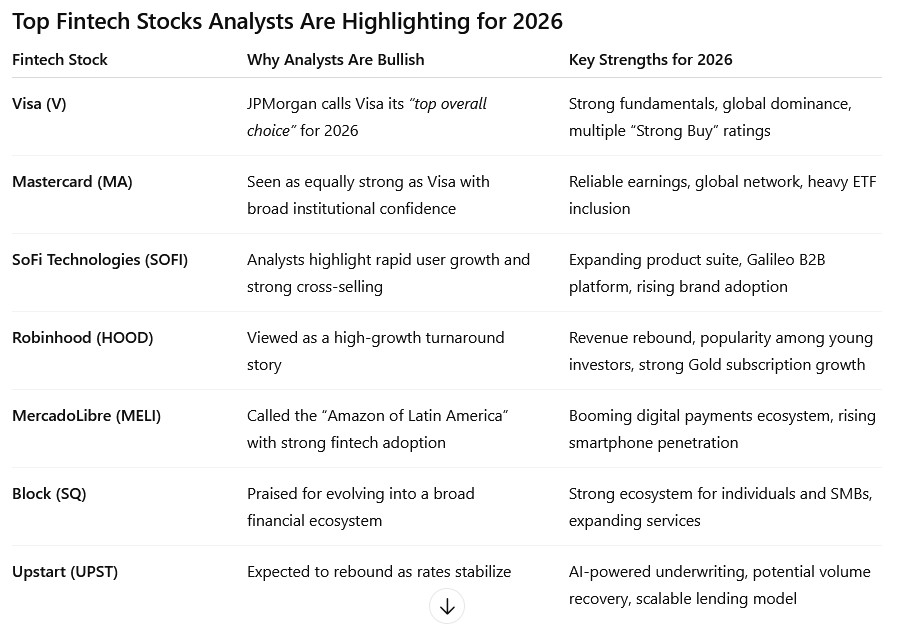
Analysts expect the strongest fintech stocks in 2026 to benefit from steady digital payments growth, wider AI adoption, and more stable regulatory frameworks. The consensus outlook points to established payment networks and fast-scaling digital platforms as the most resilient performers in the financial technology market.
Many forecasts highlight margin expansion for AI fintech companies as automation reduces operating costs and supports higher-quality revenue.
Fintech stocks can be a good investment for long-term growth, especially companies benefiting from strong digital payments demand, AI-driven automation and improving regulatory clarity.
The outlook for fintech in 2026 is broadly positive. Analysts expect revenue across the financial technology market to accelerate as consumer behavior continues shifting online.
SoFi – expanding rapidly through lending, digital banking and its Galileo platform.
MercadoLibre (Mercado Pago) – strong double-digit payments growth across Latin America.
Block (Square) – scaling Cash App and SMB financial services.
Stripe – rising global payment volumes and merchant adoption.
Revolut – fast user growth and expanding neobank services.
Upstart – expected rebound as AI-driven lending volumes recover.
AI is expected to boost fintech valuations by improving underwriting accuracy, lowering operating costs, enhancing fraud detection and creating new revenue streams in advisory and risk analytics.
Fintech stocks can carry higher risk due to regulatory changes, competition and rapid technology shifts.
AI, blockchain, real-time payments, biometric security and embedded finance are the core technologies shaping the future of fintech. These innovations are redefining how money moves, how credit is assessed and how digital financial services scale globally.
Only a few digital banks are consistently profitable today, but profitability is improving as neobanks expand lending products, optimize costs and increase customer engagement.
Fintech valuations are influenced by interest rates, regulatory updates, digital payments growth, customer acquisition costs and the success of AI-driven automation. Companies with strong unit economics and diversified revenue streams tend to maintain higher valuation stability.