



- Despite recent price declines, the Oracle share price has a good chance of recovery based on current OCI growth fundamentals.
Current Setup and Live Chart
Oracle is now considered an AI infrastructure stock and is subject to the same fundamentals and investor pressures as other AI stocks in the marketplace. This is because the company has now entered the mix of the AI data center and cloud infrastructure demand matrix currently playing out in that sector.
At the moment, investors are balancing out two opposing narratives:
Bullish: Oracle is a major player in providing AI cloud infrastructure. It is actively securing massive new orders and accelerating the growth of its Oracle Cloud Infrastructure (OCI).
Bearish: The company’s capex spend on data centers and new AI infrastructure has ballooned. This is putting pressure on free cash flow and raising the company’s debt profile. As with other AI stocks, investors are now questioning if this will all pay off in the long run.
The main near-term macro driver is the latest earnings report. The Oracle share price fell heavily after the company’s mixed earnings report for Q4 2026. Earnings per share came in at $2.11, beating the $1.96 expectation and topping the $1.70 EPS YoY. Revenue rose 21% for the year to $19.2 billion, slightly higher than the $19.1 billion market expectation.
The company’s earnings were hit by weakness in the software division, and Q1 2027 earnings guidance came in below expectations. Sales projection for the 2027 fiscal year stayed at $90 billion, while capex rose sharply from $21 billion in the 2025 fiscal year to $56 billion in the 2026 fiscal year.
Currently, the Oracle share price is down nearly 9% this year, after losing 8.53% on Thursday. It is currently down more than 1.46%. However, analysts see a 50% upside in the stock, as it still retains very sound fundamentals for any AI stock in the market today.
Near-term Oracle Share Price Catalysts
AI infrastructure demand: Demand for AI infrastructure is a key driver of the company’s bloated capex. Investors seek validation that this spending will translate into stronger OCI utilization, new contract awards, and higher backlogs. Headlines that showcase improvement in these metrics will boost sentiment on the stock.
Funding and balance sheet concerns: The increase in capital expenditure makes the stock sensitive to headlines about debt, equity financing, and cash burn rate. If there are indications that increased capex is starting to put pressure on the company’s financing, this could weigh on the Oracle share price.
Emerging Hyperscaler Competition: There is a plethora of emerging hyperscaler competition. Oracle must develop initiatives to maintain its market share in the AI cloud provider space. OCI is currently growing sufficiently to remain ahead of competitors, but the company must sustain this pace; otherwise, competitive concerns could emerge.

Oracle Share Price: Macro Drivers
1) OCI growth remains exceptional
The growth of the Oracle Cloud Infrastructure has been phenomenal, outperforming all expectations. OCI grew 93% YoY, putting it at the top of the list of fastest-growing large-cap cloud businesses. Demand from AI developers and hyperscaler customers is driving growth in this segment. The current sentiment around OCI is that it is a strong challenger in AI infrastructure, competing with similar cloud services from Amazon, Microsoft, and Google.
2) Surge in Capex Spooking Investors
Oracle’s capex projection for FY2026 is $50 billion, compared with revenue targets of $67 billion in FY2026 and $90 billion in FY2027. The company’s plan to raise $20 billion worth of new financing to bring the capex to $70 billion has got investors concerned. The key question is whether the surge in capex will produce greater earnings in the future.
3) Large AI Backlog
Oracle’s backlog of contracts has surged as customers are reportedly paying for years of AI computing capacity in advance. Analysts now view an increase in the order backlog as an important indicator of Oracle’s future earnings, as it provides a potential multi-year revenue boost.
Oracle Share Price Forecast Scenarios
Base case: constructive, albeit volatile, as investors continue to place the spending plans under scrutiny. The stock is expected to be in consolidation as investors evaluate the sustainability of current investment levels relative to AI demand.
Bull case: major contract awards and a faster pace of OCI acceleration are good catalysts. If cloud deployment momentum outpaces capital expenditures, investors will focus on the former rather than the latter. Currently, the market is pricing in revenue targets of $90 billion for FY2027. Quarterly earnings that are in sync with this target are supportive of the Oracle share price.
Bear case: if there are emerging concerns about capex sustainability, debt, slowing OCI growth, or accelerating hyperscaler competition, margin and valuation multiple compression could result. Investors have shown they will punish AI stocks facing these issues, and they look set to continue that trend.
Oracle Share Price: Technical Outlook
The recent decline was halted at the 177.34 support level, the former low from 17 December 2025. If the bears eventually overwhelm this price level, the 30 April 2026 low at 162.23 becomes the next support target. Below this level, an additional downside target and the 2026 lows at 135.45 come into the mix.
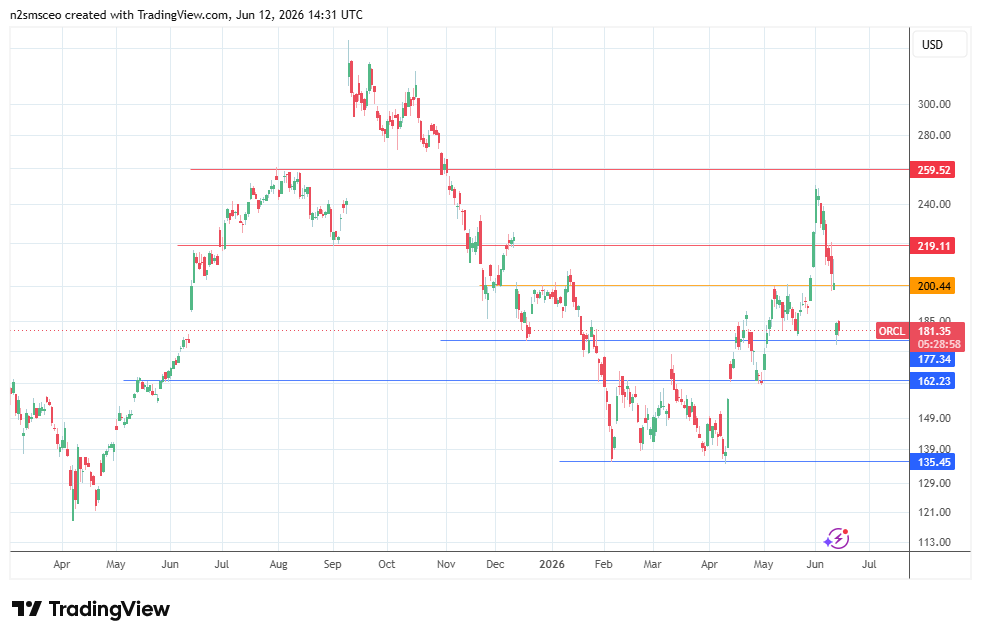
On the flip side, if the bulls inject momentum into the bounce at 177.34, the 200.44 price target and high of 10 December 2025 and 7 May 2026 could be tested. If this barrier is uncapped, the 219.11 resistance and the prior low of 2 September 2025 become the new target.