


- Lloyds share price remains in a bullish trend, but near-term headwinds exist which could initiate a potential reversal.
What happened with Lloyds’ share price this Monday, and how does this impact Lloyds’ share price forecasts?
Lloyds’ share price fell this Monday, along with several UK banking stocks. Lloyds’ share price fell from 106.75 to 104.80. It had traded as low as 103.96 before recovering some of the lost ground, but this was not enough to stave off losses on the day.
Live Chart
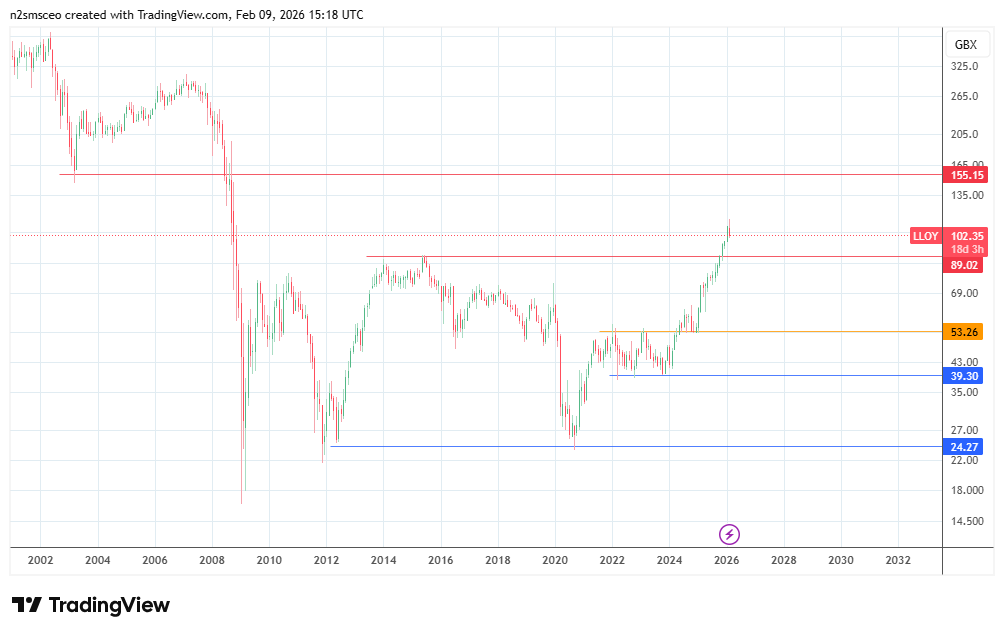
Despite the negative start to the new week, Lloyds’ share price remains in an uptrend following the break of the long-term resistance at 89.02. Two prior attempts to uncap this barrier in January 2014 and June 2015 failed. This break is therefore significant, as it gives the long-term bulls clear skies to push for the next major barrier at 155.15, which last held as a support in March 2023 before being broken during the global financial crisis of October 2008.
Lloyds Share Price Today: Macro Drivers
The main driver of the losing day was the UK banking sector’s de-risking following the repricing of Bank of England rate cuts last week. Last week’s BoE MPC vote was regarded as too close for comfort for those biased towards aggressive easing, and the current guidance is that continued cooling of UK inflation would ultimately lead to a drop in borrowing costs.
Also impacting bank stocks was the sectoral drag from the sharp decline in the shares of NatWest Group following the Evelyn Partners deal. NatWest sealed a 2.7 billion pound takeover deal for Evelyn Partners. Investors were generally unimpressed, and the concern is that the deal was priced too high (15 times Evelyn Partners’ 2025 EBITDA) and that it reduces capital for future buybacks. The high valuation could result in a 2% hit to earnings per share through 2028.
Another macro driver centred on the UK political scene, where the recent scandals emanating from the Epstein files that have enveloped key members of the UK Labour Party have put pressure on the government’s leadership. This situation has added a risk premium to GBP-denominated assets.
Macro drivers to watch for in 2026 include:
1) Interest Rates
Lloyds earns a portion of its revenues from mortgages and loans. Further easing by the Bank of England would put pressure on the bank’s Net Interest Margin (NIM).
2) Profit Guidance and Capital Returns
Lloyds recently upgraded its profit guidance and also unveiled a £1.75bn buyback initiative. Maintaining or surpassing this guidance would boost investor confidence.

3) Strategic Shift to Revenue that is Rate-Independent
Lloyds was reported by the Financial Times as actively mulling a strategy refresh, moving into corporate banking as it seeks to shift away from revenue tied to interest rates.
4) Litigation/Regulatory Issues
The major litigation confronting Lloyds Bank remains the UK Motor Finance Commission’s case. The bank’s ability to overcome the scandal, for which it had set aside nearly 2 billion pounds in compensation (>800 million pounds more than earlier segregated), would be a confidence booster for investors.
Lloyds share price forecasts for 2026
Shore Capital cut its rating for Lloyds stocks to sell after the break in the bullish run, even after lifting its initial price target from 84p to 91p.
Base case scenario: The base case is for Lloyds share price to gring higher towards the 120p price mark, with a lower boundary of 105p if the BoE delivers orderly rate cuts and credit remains stable. This scenario outlines with the cluster that sees Lloyds share price trading between 110p – 119p in 2026.
Bull case: The bull case scenario sees Lloyds share price trading towards the 125p-130p price range, as a consequence of the break of the 115p long-term barrier. This would need a calmer geopolitical climate in the UK and lesser involvement by the bank in litigations. Quicker resolutions of existing legal cases would also be a booster, as well as the elucidation of a strategy that would boost revenues from fee growth.
Bear case: The bear case scenario sees a slide to 100p, following the breakdown of the 103-105p lower band. More aggressive BoE rate cuts (which reduces the bank’s revenue from lending products), broader credit-based stress or expanded political risk premia could even send the stock towards the 84p-91p price range.
Lloyds Share Price Near-Term Analysis
The long-term trend has turned bullish following the uncapping of the major resistance at 89.02. This move follows the breakout from the 39.30 – 53.26 range. The price failed to convincingly break the 111.65 resistance level, which was formed by the 61.8% Fibonacci extension from the June 2025 low to the December 2025 high. The pullback has bounced off the 103.55 support formed by the 27% Fibonacci extension.
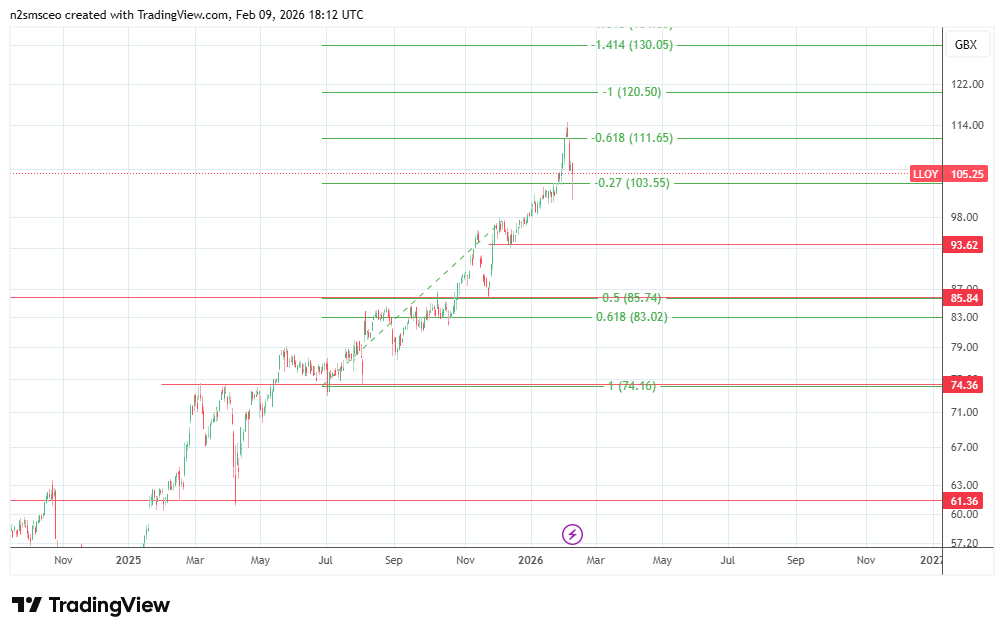
Further ascent requires the bulls to force a break of 111.65, which targets the next Fibonacci extension levels at 120.50 and 130.05, even as the bulls chase the 155.15 long-term target.
However, a breakdown of 103.55 forces a deeper pullback to the 12 December low at 93.62, followed by the 85.74 support and 50% Fibonacci retracement.