


- Can the BP share price withstand the political pressure from the US President amid the company's best quarterly profits in 4 years?
Current Setup
The BP share price is back in the spotlight following one of its strongest quarterly performances in years. Indeed, the company recently reported its best quarterly earnings performance since 2022, riding on the back of elevated oil prices and stellar trading performance. Profits and earnings per share easily trumped analysts’ forecasts, as the oil shock risk premium stemming from the US-Iran conflict has kept oil and energy derivatives prices high since March 2026.
The results have hardly surprised: the quarter under review has been marked by persistently elevated oil prices, reinforcing the earnings benefits that oil majors enjoy whenever a geopolitical risk premium boosts oil prices on the international market.
However, the earnings report has not escaped political scrutiny and scathing criticism. With Americans paying much higher gasoline prices than they have ever done in history, US President Donald Trump issued a scathing public criticism of the oil majors for making “excessive profits”. The comments were primarily directed at US oil producers Chevron and ExxonMobil, but BP (a British oil producer) is now coming under scrutiny over whether energy companies are profiting disproportionately from the misery of those living under wartime conditions and therefore facing higher living costs from rising oil prices.
The political pressure notwithstanding, investors are viewing the BP share price through the prism of improving operational performance, with specific emphasis on how the new management has driven its debt-reduction strategy and optimized its higher-return oil and gas assets.
BP Share Price: Macro Drivers
1) Better-than-Expected Quarterly Profits
BP reported profits of $5.73 billion for the latest quarter, beating analysts’ expectations of around $5.02 billion. This was also an increase of more than 100% on a YoY basis, with earnings riding on the back of higher oil prices and robust oil trading performance. The company also improved its refining margins and, coupled with more disciplined cost management, used these to advantage in delivering its most profitable quarter since the start of the Russia-Ukraine war drove oil prices higher in February 2022.
2) Ongoing Earnings Boost from the Middle East Conflict
The renewal of geopolitical tensions in the Middle East after a lull in April 2026 ensured that, for the quarter under review, oil prices consistently traded above $75 per barrel. This means that oil prices have consistently remained above pre-conflict levels, which had seen oil prices trading <$60 at some point in Q4 2025. Higher oil prices have boosted upstream earnings and improved cash flow. Furthermore, BP has been able to achieve higher revenues from trading activity.
3) Trump’s Criticism
Criticism from US President Trump following the stellar profits declared by oil majors in the current earnings season has brought political pressure on these companies. Trump’s comments suggested that the oil companies were making “too much money” from the current geopolitical crisis, with suggestions that some of the gains should have been used to cushion the impact of higher costs on consumers by lowering prices at the pumps. These comments introduce the potential for governments to apply windfall taxes, increase regulatory oversight, or take other measures that will force the oil companies to give you a portion of their declared profits via yet-to-be-named taxation loopholes.
4) Portfolio Restructuring

BP’s management continues to direct the refocusing of the company’s operational mandate by ditching poor-performing assets and directing capital to higher-return businesses. Some of these restructuring processes have included the sale of its US biogas operations and a planned offloading of its North Sea upstream portfolio. The company continues its debt reduction processes and is working on initiatives to improve capital discipline.
BP Share Price Catalysts (Near-term)
1) Oil prices: this factor remains the single most important catalyst behind BP’s valuation. Continued geopolitical tensions will keep oil prices elevated and produce stronger earnings expectations.
2) Geopolitics: The geopolitical situation in the Middle East will continue to be the focus of market participants, with emphasis on the state of military deployments and shipping activity around the Strait of Hormuz. All eyes are currently on the negotiations, and if a deal is signed before Friday, we could see a pullback in the BP share price. However, escalations will strengthen BP’s earnings outlook.
3) Political developments: Now that the US President has waded in on the profit performance of the oil majors, the markets will also be watching for any actions from the Trump administration in the direction of introducing any windfall taxes, or a regulatory action in response to raised oil and gasoline prices.
BP Share Price: Forecast scenarios
Base case: the base case remains bullish as long as oil prices stay well above the $70/barrel price mark. Higher prices continue to drive strong cash generation and earnings potential, which could keep the BP share price supported despite any political backlash.
Bull case: a renewal of tensions will drive oil prices above $80/barrel, boosting the outperforming indices currently reflected in the company’s fundamentals. This situation will drive higher earnings estimates for the next quarter and improve the company’s cash flow position, leading to a further boost in the BP share price.
Bear case: If the current negotiations lead to a rapid de-escalation of the geopolitical situation, and there is an accompanying drop in oil prices below $70 per barrel, this could reduce the earnings expectations for the next quarter and allow for enhanced profit-taking from the current BP share price levels.
BP Share Price: Technical Outlook
The Jan-April 2026 advance that forms the secondary uptrend remains intact, despite the retracement in place since April. The higher lows from July suggest a gradual return of buying interest, even though the current double top in evolution could portend near-term profit-taking.
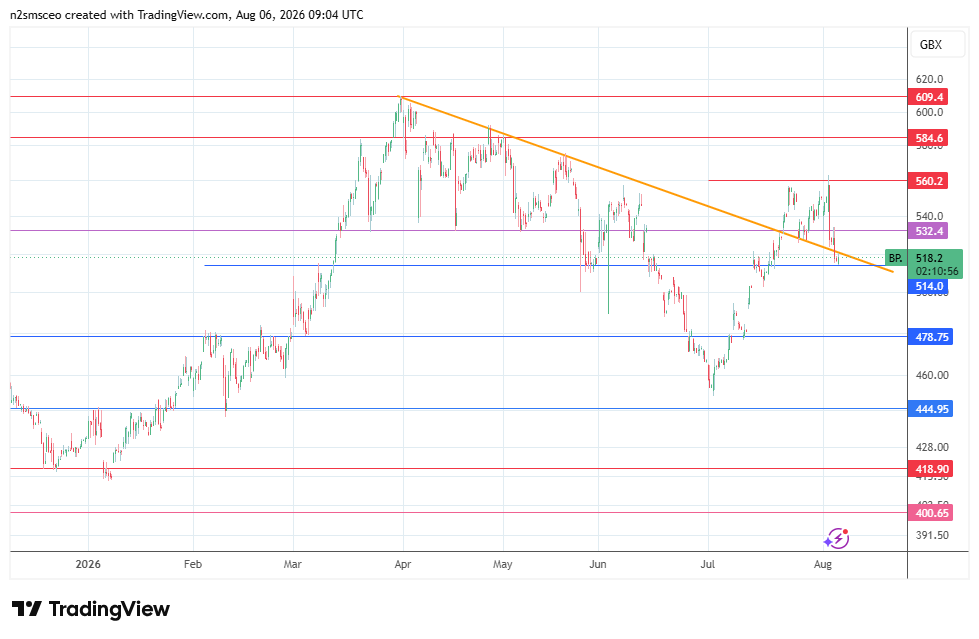
The 514.0 support is now being tested following the breakdown of the neckline at 532.4. If this price mark gives way, a further decline towards the 10 March and 3 June 2026 lows at 492.25 could be on the cards. Below this level, 478.75 is the low of 5 March/10 July and forms the next downside target.
However, a bounce on the 514.0 support that uncaps the 532.4 resistance allows for a reclaim of the 560.2 high of 4 August 2026. Above this level, the 584.6 resistance forms the next upside target, being the high of 19 March/1 May 2026.