


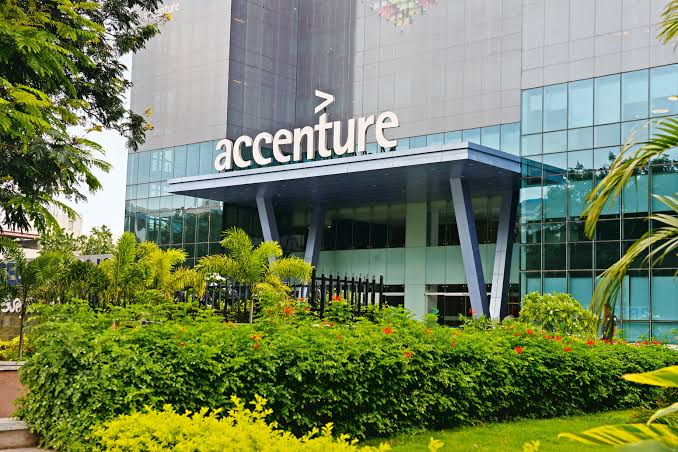
- Accenture Shares Plunge 18% After Guidance Cut Raises AI Demand Concerns
- Accenture Stock Price Falls to Decade Low as AI Spending Fails to Drive Growth
- Accenture Stock Crash Wipes Billions Off Market Value as AI Revenue Questions Grow
Accenture shares plunged nearly 18% on Thursday after the global consulting giant cut its revenue outlook and warned that clients remain cautious on technology spending despite growing enthusiasm around artificial intelligence.
The selloff pushed Accenture stock to its lowest level in almost a decade and triggered a broader decline across technology stocks globally, with Indian IT companies among the hardest hit.
The company’s disappointing guidance has renewed concerns that the AI revolution may not yet be translating into meaningful revenue growth for consulting and outsourcing firms.
Why Did Accenture Stock Fall?
Accenture reported third-quarter revenue of $18.72 billion, representing a 6% increase from a year earlier. While the results broadly met expectations, investors focused on weaker forward guidance and management commentary about slowing client spending.
The company narrowed its fiscal 2026 revenue growth forecast to 3%-4%, compared with its previous guidance of 3%-5%.
Accenture also disclosed that geopolitical disruptions in the Middle East reduced quarterly revenue by approximately $400 million, adding another layer of uncertainty to its outlook.
The combination of weaker guidance and regional disruptions prompted a sharp reassessment of the company’s near-term growth prospects.
AI Excitement Is Not Translating Into New Spending
One of the most closely watched comments from Accenture’s management involved artificial intelligence spending.
While demand for AI-related projects remains strong, the company said many clients are funding AI initiatives by shifting existing technology budgets rather than increasing overall spending.
That distinction has become increasingly important for investors.
For months, markets have been pricing in expectations that artificial intelligence would trigger a new wave of enterprise technology investment. Instead, Accenture’s latest update suggests many companies are simply reallocating existing budgets toward AI rather than expanding them.
The development raises questions about how quickly AI can become a meaningful growth driver for the broader technology services industry.
Outsourcing Weakness Raises Concerns For Indian IT Stocks
Perhaps the most worrying data point for investors was Accenture’s outsourcing business.
The company reported a 15% decline in outsourcing bookings compared with the same period last year.
That metric is particularly significant because outsourcing remains the core business model for many Indian technology firms, including Infosys, Tata Consultancy Services, Wipro, HCLTech and Tech Mahindra.
Following Accenture’s earnings release, Indian IT stocks came under heavy pressure.
Infosys, TCS, Wipro, HCLTech and Tech Mahindra fell between 3% and 6%, while mid-cap technology companies such as Coforge, KPIT Technologies, Sonata Software and Tata Elxsi also posted sharp losses.
At one stage, all of the biggest losers on the Nifty 500 index were technology stocks.
Why Investors Are Worried About The AI Trade
The broader concern extends beyond Accenture itself.

Technology stocks globally have been among the biggest beneficiaries of the AI boom over the past two years. Investors have rewarded companies expected to benefit from rising AI adoption, driving valuations sharply higher.
However, Accenture’s results highlight an emerging challenge.
While companies continue to discuss AI investments, many remain cautious about increasing total technology spending amid economic uncertainty and geopolitical risks.
Some analysts argue that businesses are still struggling to generate measurable returns on AI investments, leading executives to prioritize efficiency and cost control rather than aggressive new spending.
This dynamic could slow revenue growth across parts of the technology sector even as AI adoption continues to expand.
Global Technology Stocks Feel The Pressure
The negative reaction was not limited to Accenture.
Shares of several global technology and consulting firms declined following the earnings release.
Cognizant fell more than 10%, while IBM lost over 5%. European IT services giant Capgemini also recorded significant losses as investors reassessed growth expectations across the sector.
The selloff reflected growing concerns that enterprise technology demand remains weaker than many investors anticipated at the start of the year.
What Investors Should Watch Next
The key question now is whether Accenture’s warning represents a company-specific issue or an early signal of broader weakness across the global technology sector.
Investors will be closely monitoring upcoming earnings reports from Infosys, TCS, Wipro and other major IT firms for signs that enterprise spending remains under pressure.
Attention will also remain focused on AI-related deal activity, consulting demand and outsourcing bookings.
If businesses begin increasing overall technology budgets rather than simply reallocating existing spending, confidence in the AI growth story could strengthen again.
For now, however, Accenture’s results suggest the path to AI-driven revenue growth may be slower than investors had hoped.
The company remains a global leader in consulting and technology services, but its latest outlook serves as a reminder that enthusiasm around artificial intelligence does not automatically translate into higher corporate spending.
As markets digest that reality, technology stocks may continue facing pressure until clearer evidence emerges that AI is generating the growth investors have been expecting.
Accenture stock fell nearly 18% after the company cut its fiscal 2026 revenue growth forecast, reported a $400 million revenue hit from Middle East disruptions, and warned that clients remain cautious on technology spending.
Investors view Accenture as a bellwether for the global IT services industry. The company’s weak guidance and 15% decline in outsourcing bookings raised concerns about future demand for Indian IT companies such as Infosys, TCS, Wipro and HCLTech.
Not yet at the scale investors expected. Accenture said many clients are funding AI projects by reallocating existing technology budgets rather than increasing total spending, raising concerns about the pace of AI-driven revenue growth.