

- USD/TRY remains pinned near record highs as structural pressure on the Turkish lira persists
- Inflation, negative real yields, and policy credibility continue to cap any meaningful lira recovery
- With no major domestic catalysts this week, the path of least resistance remains higher
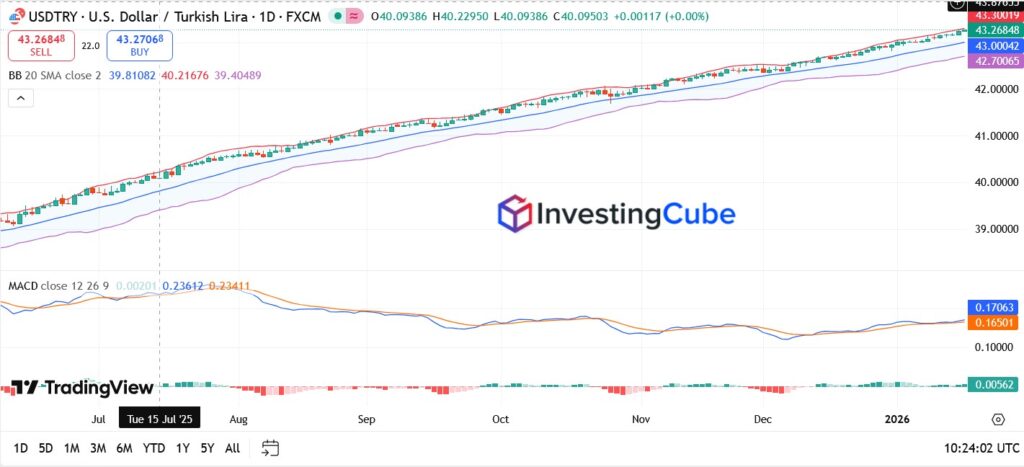
USD/TRY starts the new trading week holding firm above the 43.00 handle, with price action reflecting continued, orderly depreciation in the Turkish lira rather than disorderly volatility. The pair last traded near the 43.20–43.30 region, extending the gradual grind higher that has defined the trend since late 2025.
Notably, the move lacks sharp momentum spikes. Instead, the advance remains controlled, suggesting steady dollar demand driven by structural imbalances rather than speculative positioning. As markets reopen for the week, there is little in the immediate calendar to challenge the prevailing trend, keeping USD/TRY supported near record levels.
Inflation and Negative Real Yields Continue to Undermine the Lira
Turkey’s inflation backdrop remains the dominant driver of lira weakness. Consumer price growth stayed elevated throughout 2025, while real interest rates remain firmly negative despite prior tightening efforts. According to guidance from the Central Bank of the Republic of Turkey, disinflation is expected to be gradual and uneven into 2026, leaving confidence fragile.
Reuters has repeatedly highlighted that weak domestic purchasing power and limited policy flexibility continue to discourage sustained capital inflows. In the absence of a credible shift toward positive real yields, the lira remains structurally vulnerable even during periods of calmer global risk sentiment.
This dynamic keeps USD/TRY biased higher, with investors viewing the dollar as a relative store of value rather than actively attempting to fade the trend.
Dollar Stability Reinforces USD/TRY Upside Bias
On the US side, the dollar remains broadly stable as markets reassess the pace and timing of Federal Reserve easing. Recent US data have reinforced expectations that rate cuts, if delivered, will be measured rather than aggressive in early 2026.
Bloomberg analysis has pointed to persistent yield differentials as a key support for USD crosses against high-inflation emerging-market currencies. For USD/TRY, that divergence remains particularly pronounced, limiting downside potential even during quieter trading sessions.
With no major US data shocks expected early this week, the dollar’s steady footing continues to reinforce the broader USD/TRY uptrend.
USD/TRY Technical Outlook Remains Constructive
From a technical standpoint, the daily chart continues to reflect a clean bullish structure:
- Price remains above the 20-day, 50-day, and 100-day moving averages
- Bollinger Bands slope higher, confirming trend consistency rather than exhaustion
- MACD remains in positive territory, with momentum flattening but not reversing
The 43.00 level remains a key psychological pivot. As long as USD/TRY holds above this area, upside risks stay dominant.
Key levels to watch:
- Support: 43.00, followed by 42.70
- Resistance: 43.30, then 43.60
Outlook: Trend Intact as Structural Pressures Persist
Looking ahead, USD/TRY remains anchored by long-term fundamentals rather than short-term catalysts. Without a clear policy reset or a material improvement in inflation credibility, any pullbacks are likely to remain shallow and corrective in nature.
Reuters commentary continues to emphasize Turkey’s external financing needs and inflation outlook as ongoing vulnerabilities, while broader market pricing suggests little appetite to challenge the trend at current levels.
For now, the balance of risks continues to favor gradual USD/TRY appreciation into 2026 rather than a sustained lira recovery.
Writer’s Trade Idea My preferred strategy remains buying USD/TRY on pullbacks toward 43.00, targeting a move toward 43.60, with a stop-loss below 42.70.
USD/TRY remains elevated due to persistent Turkish lira weakness driven by high inflation, negative real yields, and limited investor confidence in policy durability.
Yes. The daily chart shows a clear bullish structure with higher highs and higher lows, supported by moving averages and trend-aligned momentum indicators.
Turkey’s central bank has continued to intervene indirectly through FX sales, liquidity tools, and macro-prudential measures, but these actions have so far slowed volatility rather than reversed the broader USD/TRY uptrend driven by inflation and policy divergence.