



- The persistent inflationary pressures in the UK are compelling the Bank of England to remain hawkish on the interest rates, which is providing structural support to the Pound versus the Rupee.
- High global crude oil prices expand India's current account deficit and pressure the Indian Rupee toward record lows, driving upward momentum for the GBP/INR cross-rate.
The British pound is trading almost at the same range amid slight weakness in US equities and a steady uptick in the US dollar. While the market is trading cautiously due to the ongoing US-Iran talks, rising crude oil prices are weighing on the risk appetite.
On the Indian side, the rupee dipped on Thursday, ahead of the Reserve Bank of India’s monetary policy review on Friday. Traders are widely anticipating actions to support the currency from falling further. The rupee’s close yesterday was at 96.7850 per US dollar, lowering from its previous open of 95.7050.
With that, GBP/INR is struggling around the 128.60 level to find direction, signaling a consolidation phase. The currency pair is awaiting the RBI’s monetary policy decision on Friday, as well as further clues regarding the Federal Reserve’s policy stance.
The GBP to INR Forecast & Key Technical Levels:
Looking at the 4-hour GBP/INR chart, you can see that the market remains broadly bullish in the medium term but is currently trapped in a consolidation phase. The currency pair waits for a catalyst to determine its next directional move.
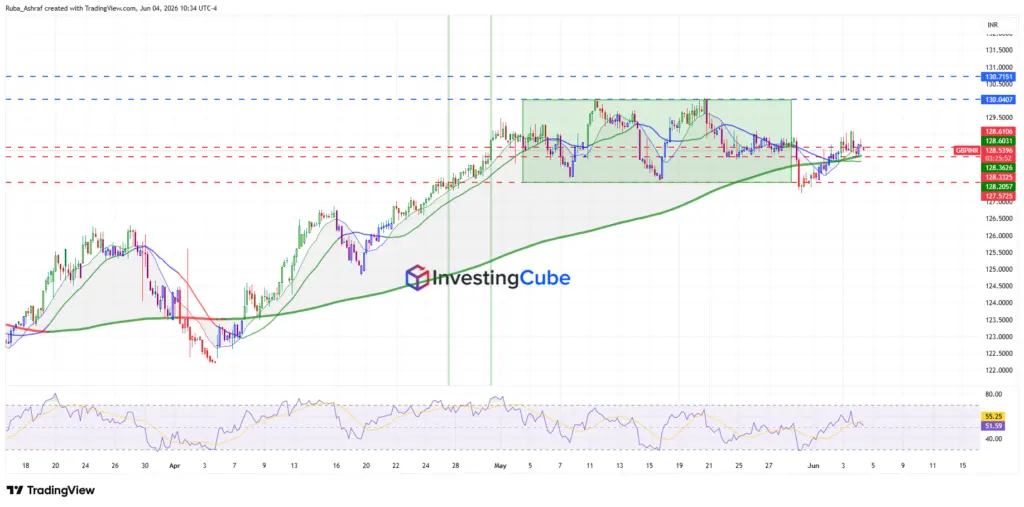
The pair rallied strongly from the 125.00-126.00 region before entering a sideways range between 128.33 support and 130.04 resistance, highlighted by the green rectangle. The GBP/INR has multiple tests to break above or below the two boundaries, but failed. This confirms that buyers and sellers remain in equilibrium. The recent rejection from the upper boundary near 130.04 and the following pullback show that bulls are still struggling to build enough momentum to cause a breakout.
From a trend perspective, the longer-term outlook remains constructive. Price continues to trade above the rising 200-period moving average, which is sloping upward and indicates that the broader trend remains positive. However, in the short term, GBP/INR is hovering around the short-term moving averages, reflecting a lack of clear directional conviction.
The RSI is currently around 53, close to the neutral 50 level. This indicates balanced momentum, neither buyers nor sellers holding a significant advantage.
GBP/INR Key Levels to Watch:
Resistance Levels:

- 128.61: Immediate resistance and current pivot area.
- 130.04: Major range resistance and recent swing high.
- 130.72: Next bullish target if a breakout above 130.04 occurs.
Support Levels:
- 128.33: Immediate support and lower boundary of the current consolidation zone.
- 128.20: Secondary support from the recent rebound area.
- 127.57: Critical downside support and bearish target if selling pressure accelerates.
Potential Bullish Scenario:
A successful break above 128.61 would see the pair regain upside momentum and test the major resistance at 130.04. A decisive break above 130.04 would confirm completion of the consolidation phase and likely open the door toward 130.72 with the possibility of extending gains beyond the current range highs.
Potential Bearish Scenario:
Failure to hold above 128.33 would suggest a weakening of bullish control and could expose 128.20 initially on the downside. A deeper break below this cluster of support could open the door to more selling pressure and shift focus to 127.57. This would be the first significant break of the broader bullish structure and would indicate the beginning of a larger corrective decline.
GBP/INR is overall in a medium-term uptrend, but the pair is consolidating in a well-defined range. Traders will want to watch 128.33 and 130.04 for a decisive break either way, which could determine the next big directional move.
India is one of the world’s largest net importers of crude oil, making its economy highly sensitive to energy prices. The rise in international oil prices due to geopolitical tensions is swelling India’s import bill, widening the current account deficit, and weakening the Indian Rupee (INR). On the other hand, the UK is less dependent on imported oil, so spikes in energy costs tend to hurt the rupee much more than the pound, pushing the GBP/INR cross-rate higher.
Diverging inflation and different interest rate hikes by the two central banks are moving investor capital. If UK inflation remains high, it forces the Bank of England to stay hawkish or even raise interest rates. This raises the British Pound (GBP). Conversely, if the Reserve Bank of India opts to keep rates steady to prioritize growth as domestic inflation picks up, the differential in real yields can lead to the rupee depreciating against the more hawkish pound.