



- GBP/INR trades near ₹121 as RBI policy allows gradual rupee depreciation, keeping the pair elevated despite central bank intervention and stable sterling.
The GBP/INR exchange rate is trading around ₹121.32 on December 30, keeping the pair near its highest levels of the year as India’s central bank maintains tight control over the rupee while allowing gradual depreciation.
GBP/INR strength is not being driven by UK outperformance. Instead, it reflects structural rupee weakness, shaped by the Reserve Bank of India’s managed FX regime, persistent dollar demand, and year-end liquidity dynamics.
GBP/INR Rises as RBI Allows “Crawl-Like” Rupee Depreciation
The key driver behind GBP/INR remaining elevated is policy design, not market disorder.
According to Reuters, the Reserve Bank of India has been operating a “crawl-like” exchange-rate regime, allowing the rupee to weaken gradually rather than defending a fixed level. This approach aims to balance inflation control, export competitiveness, and capital flow stability.
Under this framework:
- The RBI intervenes to smooth volatility
- It does not attempt to force rupee appreciation
- FX levels drift higher over time, especially against stronger currencies like the pound
As a result, GBP/INR remains supported even when spot USD/INR trading appears stable.
RBI Liquidity Injection Eases Stress but Does Not Strengthen the Rupee
In December, the RBI announced measures to inject roughly $32 billion into the banking system via FX swaps and bond purchases, responding to stress in forward markets and excess dollar liquidity.
The RBI’s intervention came after stress built up in rupee forward markets, where pricing distortions and offshore pressures pushed premiums to elevated levels. By injecting liquidity through FX swaps and bond purchases, the central bank succeeded in easing market friction and restoring orderly conditions.
However, the measures were aimed at stabilisation rather than strengthening the currency, reinforcing the view that policymakers are managing volatility while allowing the rupee’s broader trend to persist.
This distinction matters for GBP/INR. Stabilisation prevents sharp spikes, but it does not generate sustained downside in the cross.
Why the Indian Rupee Is Not Recovering Meaningfully
Despite rising foreign exchange reserves and active central bank management, the rupee continues to face structural headwinds:

- Persistent import-related dollar demand
- Portfolio flows favouring developed markets
- Limited real yield advantage versus peers
- RBI’s preference for export competitiveness over FX strength
Reuters has noted that India’s FX reserves give the RBI room to intervene, but policymakers are comfortable with gradual depreciation, especially while inflation remains above long-term targets.
This policy stance keeps GBP/INR elevated by design.
GBP/INR Technical Outlook: Upside Bias Remains
- Resistance: ₹122.00 (near-term), ₹124.00 (upper range / extension)
- Support: ₹120.00 (key psychological), ₹118.50 (major downside support)
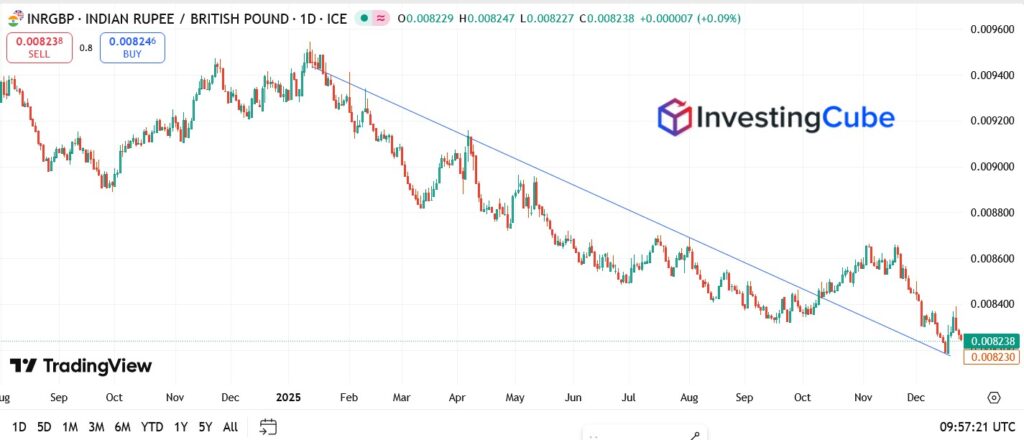
As long as the pair holds above ₹120, downside looks corrective rather than structural. A sustained break above ₹122 would signal renewed upside pressure, especially if dollar liquidity tightens again in early 2026.
GBP/INR Outlook: Policy, Not Sterling, Will Decide Direction
Looking ahead, GBP/INR direction will be driven far more by Indian FX policy than by UK macro developments.
Unless the RBI shifts toward actively strengthening the rupee, the cross is likely to:
- Remain elevated
- Trade in wide ranges
- Drift higher over time rather than collapse
For now, GBP/INR strength reflects controlled depreciation, not market stress.
GBP/INR is high because the RBI allows gradual rupee depreciation while intervening only to control volatility, keeping the cross supported.
The RBI is not targeting a weaker rupee, but it tolerates gradual depreciation to support exports and avoid inflation shocks.
A sharp fall is unlikely without a major shift in RBI policy or strong capital inflows into India.