



EUR/USD price action turned volatile on Wednesday as the pair struggled to hold early gains following the latest US Consumer Price Index (CPI) report, a key driver for Federal Reserve interest rate expectations and US dollar direction. The euro briefly surged on signs of cooling US inflation but quickly lost momentum as traders reassessed the broader policy outlook.
The currency pair initially climbed as high as $1.1563 immediately after the inflation release before reversing lower, highlighting the market’s indecision. At the time of writing, EUR/USD is trading around $1.1525, with the closely watched $1.1500 psychological level once again coming into focus as a key short-term support zone.
While US inflation data showed further moderation, typically a bearish signal for the US dollar, the reaction was muted. The CPI figures largely met expectations rather than delivering a significant downside surprise, limiting the scope for a sustained dollar selloff and keeping EUR/USD trapped within a tight intraday range.
US CPI Falls to 3.4% as Fed Rate Hike Expectations Ease
US consumer prices increased 0.1% month-on-month in July, following a 0.4% decline in June. On an annual basis, headline inflation eased to 3.4% from 3.5%. Core CPI, which excludes volatile food and energy prices, increased 0.2% during the month and slowed to 2.5% year-on-year.
Both readings were broadly consistent with market expectations. Nevertheless, the continued moderation in inflation strengthened the argument for the Federal Reserve to leave interest rates unchanged at its September meeting.
Interest-rate markets subsequently reduced the probability of a September rate increase to around 40%, compared with significantly higher expectations earlier this month. The combination of softer inflation and July’s weak employment report has made the case for an immediate rate increase considerably harder to justify. That should theoretically be negative for the US dollar and supportive of EUR/USD. Wednesday’s price action, however, shows that traders are not ready to abandon the greenback.
US Dollar Recovers as Oil and Middle East Risks Complicate Fed Outlook
The US Dollar Index initially dropped to approximately 99.61 following the CPI release but subsequently recovered toward the psychologically important 100.00 level. One reason is that the inflation outlook remains vulnerable to developments in energy markets.
Oil prices have remained volatile amid continuing tensions in the Middle East and uncertainty surrounding shipping through the Strait of Hormuz. A sustained increase in crude prices could feed back into US inflation, complicating the Federal Reserve’s path even as underlying price pressures moderate. The geopolitical backdrop has also maintained some safe-haven demand for the dollar.
As a result, traders appear reluctant to price out additional Fed tightening entirely. While a September move now looks less likely, markets still see the possibility of another increase later in the year if inflation proves persistent. For EUR/USD, this has created a tug-of-war between improving rate differentials for the euro and lingering demand for the US dollar.
EUR/USD Price Forecast: $1.1500 Becomes Critical Support
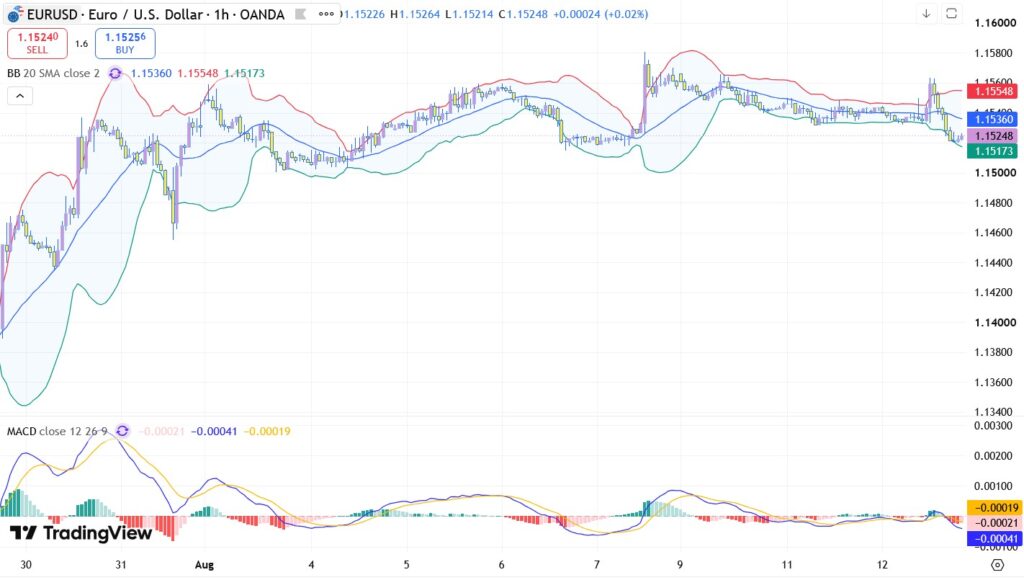
The one-hour EUR/USD chart shows a clear deterioration in short-term momentum following the rejection from the $1.1560 area. EUR/USD is currently trading around $1.1525, below the Bollinger Band 20-period moving average near $1.1536. The pair has also moved toward the lower Bollinger Band, currently around $1.1517, highlighting the increase in short-term selling pressure.

The MACD provides another warning for euro bulls. The MACD line has moved below its signal line and the histogram has turned increasingly negative, suggesting bearish momentum is building following Wednesday’s failed breakout.
The first level to watch is therefore $1.1500. This psychological level has repeatedly attracted buyers and remains important to the broader recovery structure. A decisive break below $1.1500 could strengthen the bearish correction and expose the $1.1465-$1.1470 area.
On the upside, EUR/USD first needs to reclaim $1.1535-$1.1540 to ease immediate selling pressure. Above there, the $1.1555-$1.1565 zone represents the more significant resistance area. A sustained break above $1.1565 would put $1.1600 back into focus.
EUR/USD Outlook: Can the Euro Hold Above $1.15?
The near-term EUR/USD outlook remains finely balanced following the US CPI report. Cooling inflation and weaker US employment data have reduced the probability of a September Fed rate hike, removing an important source of support for the dollar. However, Wednesday’s reversal shows that softer CPI alone may not be sufficient to push EUR/USD decisively higher.
Attention now turns to upcoming US economic releases, including producer prices and retail sales. Stronger data, particularly another sign of persistent inflation, could revive Fed tightening expectations and put $1.1500 under renewed pressure.
Conversely, further evidence that inflation and economic activity are cooling could push Treasury yields and the dollar lower, giving EUR/USD another opportunity to challenge $1.1565 and potentially $1.1600. For now, $1.1500 is the key dividing line. Holding above it keeps the euro’s broader recovery intact, while a convincing breakdown would shift the short-term EUR/USD price forecast increasingly in favour of sellers.
EUR/USD initially rose after US inflation eased but reversed as the dollar recovered. The CPI figures were broadly in line with expectations, while elevated energy prices and geopolitical uncertainty continue to create upside inflation risks.
Expectations for a September Fed rate hike fell after July CPI showed headline inflation easing to 3.4% and core inflation declining to 2.5%. Markets currently favour the Fed keeping rates unchanged, although another increase later in 2026 remains possible if inflation pressures intensify.
Immediate resistance sits around $1.1535-$1.1540, followed by the stronger $1.1555-$1.1565 area. A breakout could open the door toward $1.1600.