


- AUD/USD holds near 0.67 as the US dollar remains under pressure amid renewed concerns over Federal Reserve independence.
- Political tension between the Trump administration and Fed Chair Jerome Powell has increased uncertainty around US monetary policy, weighing on the greenback.
- RBA–Fed policy divergence continues to support the Australian dollar, with Australian inflation remaining above target and limiting the scope for near-term rate cuts.
AUD/USD is trading with a firm tone near the 0.67 handle, consolidating recent gains as renewed concerns over US Federal Reserve independence continue to weigh on the US dollar. While upside momentum has slowed, the pair remains supported after snapping a short losing streak earlier in the session.
Broad-based dollar weakness has followed reports of a US Department of Justice probe involving Federal Reserve Chair Jerome Powell, a development that has unsettled markets and raised questions around political pressure on US monetary policy. The episode has injected a fresh layer of risk into dollar positioning, benefiting currencies such as the Australian dollar that are supported by comparatively stable policy expectations.
Fed Independence in Focus as Dollar Sentiment Softens
Investor confidence in the US dollar has been dented by the escalating standoff between President Donald Trump and the Federal Reserve. Powell has pushed back against the allegations, describing the legal action as politically motivated and reaffirming the Fed’s commitment to data-driven policy decisions.
Markets have reacted cautiously, pricing in a higher political risk premium for US assets. This has limited the dollar’s ability to recover despite relatively resilient US data, keeping the US Dollar Index under pressure and allowing AUD/USD to stabilise near recent highs.
Attention now turns to US CPI data due Tuesday, which could either reinforce the current dollar softness or trigger a reassessment of Fed rate expectations.
RBA–Fed Policy Divergence Continues to Support the Aussie
AUD/USD remains underpinned by ongoing policy divergence between the Federal Reserve and the Reserve Bank of Australia (RBA). While the Fed is expected to ease policy gradually over the course of 2026, Australian rate expectations remain comparatively firm.
Recent inflation data in Australia continues to print above the RBA’s 2–3% target band, and RBA officials have signalled that further rate cuts are unlikely in the near term. Market pricing still reflects the possibility of future tightening should inflation prove sticky, offering yield support to the Australian dollar.
Although the Australian economic calendar is relatively light this week, upcoming data on consumer confidence and inflation expectations could help shape near-term AUD sentiment. Developments in China’s trade data will also remain on traders’ radar given Australia’s close economic ties with Beijing.
AUD/USD Technical Outlook: Consolidation Near Resistance
From a technical perspective, AUD/USD is consolidating within a rising structure on the daily chart. Price remains above the 20-day moving average, with Bollinger Bands expanding modestly, signalling controlled volatility rather than trend exhaustion.
- Immediate resistance: 0.6750–0.6760 (upper Bollinger Band)
- Initial support: 0.6680 (20-day moving average)
- Deeper support: 0.6600–0.6620 zone
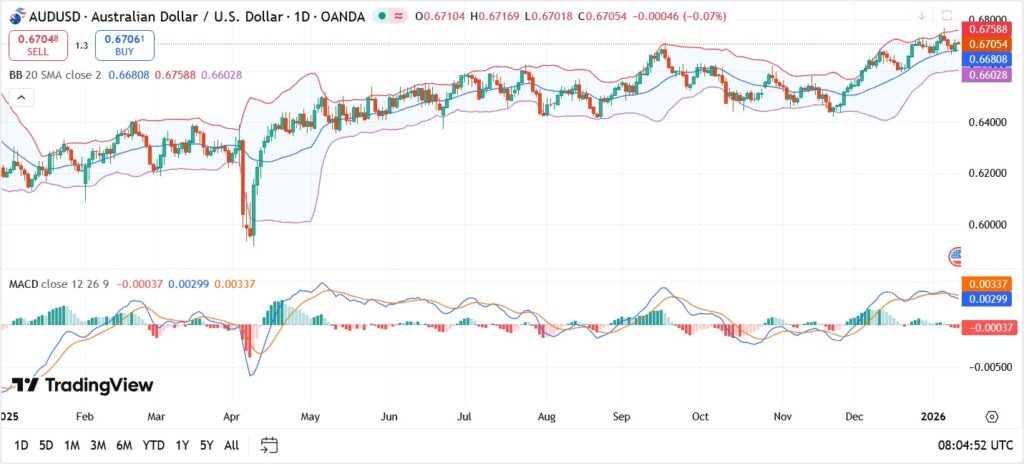
Momentum indicators remain constructive. The MACD is holding in positive territory, though flattening slightly, suggesting that while upside momentum has slowed, there is no clear bearish signal at this stage. A sustained break above 0.6760 would strengthen the bullish case, while a close below 0.6680 could expose a deeper pullback.
AUD/USD Outlook
The near-term AUD/USD outlook remains cautiously constructive as long as the pair holds above key support and US dollar sentiment stays fragile. While further consolidation is possible ahead of US inflation data, the broader bias favours resilience rather than a sharp reversal.
Writer’s Trade Idea: My preferred strategy is to buy AUD/USD on pullbacks toward 0.6680, targeting 0.6760, while placing a stop-loss below 0.6645.
AUD/USD is supported by US dollar weakness linked to Fed independence concerns and relatively firm Australian rate expectations.
US CPI data is the key near-term catalyst, alongside Australian consumer confidence and inflation expectations.
Support lies near 0.6680 and 0.6600, while resistance is seen around 0.6750–0.6760.