


The base case for the USD/SEK outlook in 2026 is for the pair to trend lower throughout the year. The gradual downside move depends on the Fed’s rate expectations being followed through with rate cuts, and on Sweden’s growth data not deteriorating.
However, the USD/SEK is also susceptible to risk sentiment, so any geopolitical actions or renewed risk-off shocks can trigger major shifts in the currency, irrespective of Sweden’s growth situation or the Fed rate expectations.
Live Chart
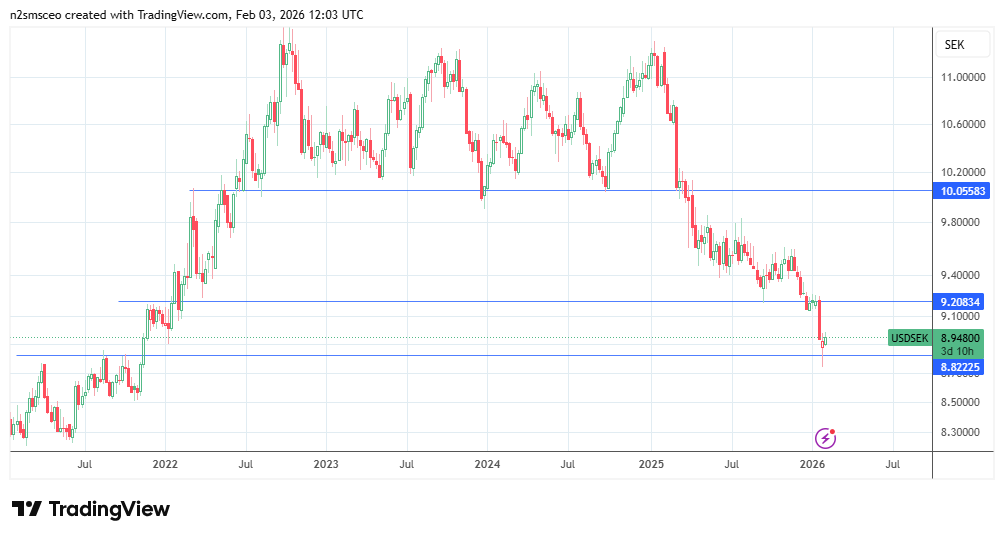
Today, the Swedish Krona is trading mildly higher against the greenback, following a brief recovery of the pair due to the short Dollar rally that followed the nomination of a new, pro-Trump candidate as Fed Chair. The USD/SEK is now trading at 8.9505.
USD/SEK Outlook 2026: Macro Drivers
With the USD/SEK now trading at 8.9505 and the sentiment being a gradual downside move for 2026, what are the macro drivers for the USD/SEK in 2026?
- Fed-Riksbank rate differential
- Global risk sentiment
- EU growth cycle (especially manufacturing)
1. The Fed-Riksbank Policy Rate Spread
Both central banks are expected to tow a path of easing in 2026. The question is: which of them will be more aggressive in delivering rate cuts? The fact that the Fed and the Riksbank are projected to cut rates in 2026 does not mean they will do so in equal measures. In any case, the reasons to cut rates are not the same in both countries. This scenario will produce a spread or a differential factor.
If the Fed cuts rates more aggressively than markets expect, US front-end yields will decline, and the greenback will naturally lose its appeal, leading to a downside move in USD/SEK. On the flip side, the Krona may find support if the Riksbank cuts less, stays relatively tighter, or maintains a rate-spread differential that permits a form of carry trade.
2. Global risk sentiment

The SEK is regarded as a pro-cyclical currency that tends to gain strength in risk-on conditions. In risk-off scenarios driven by geopolitics or market selloffs, the SEK comes under pressure. The USD/SEK can be traded on risk-on, risk-off sentiment, and currently, there is enough drive out there to cause swings between both scenarios.
3. EU growth
Sweden faces exposure to EU manufacturing and growth data. Better business conditions around manufacturing activity are supportive of the Krona. Similarly, sharp rises in crude oil prices stemming from geopolitical shocks can trigger a risk-off response and weaken the SEK.
USD/SEK Outlook for 2026: Institutional Targets
What are the institutional forecasts behind the USD/SEK outlook for 2026? Here are two of such forecasts, as presented by MUFG and UBS.
MUFG usually publishes quarterly forecasts for the currencies covered by its FX research team. MUFG’s research desk projects prices of 8.8330 in Q1, 8.6070 in Q2 2026, 8.3870 in Q3 2026, and 8.2400 in Q 2026. The price forecasts indicate MUFG’s base case that the USD/SEK will trade lower in 2026.
UBS is an investment bank and sell-side entity. It does not provide a direct USD/SEK forecast; instead, it publishes forecasts for EUR/USD and EUR/SEK. Therefore, the implied USD/SEK forecast is derived from the reference crosses EUR/SEK and EUR/USD (USD/SEK = EUR/SEK ÷ EUR/USD). Without going into too much detail of the implied value calculations, UBS’s end-quarter targets for 2026 are 9.00 for Mar 2026, 8.92 for June 2026, 8.83 for September 2026, and 8.75 for December 2026. So while UBS is also leaning towards a cheaper USD/SEK pair, its USD/SEK forecasts are less aggressive than MUFG’s.
USD/SEK Outlook: Technical Analysis
The primary trend in USD/SEK is bearish, as the multi-year downtrend from the 2024-2025 peak at 11.2854 is now approaching a significant support level at 8.8222. This follows distribution at the top end of the 2023-2024 range, with repeated failure of the breakout attempt at the 11.2854 upper boundary. This ushered in a sharp bearish leg that broke down several support levels.
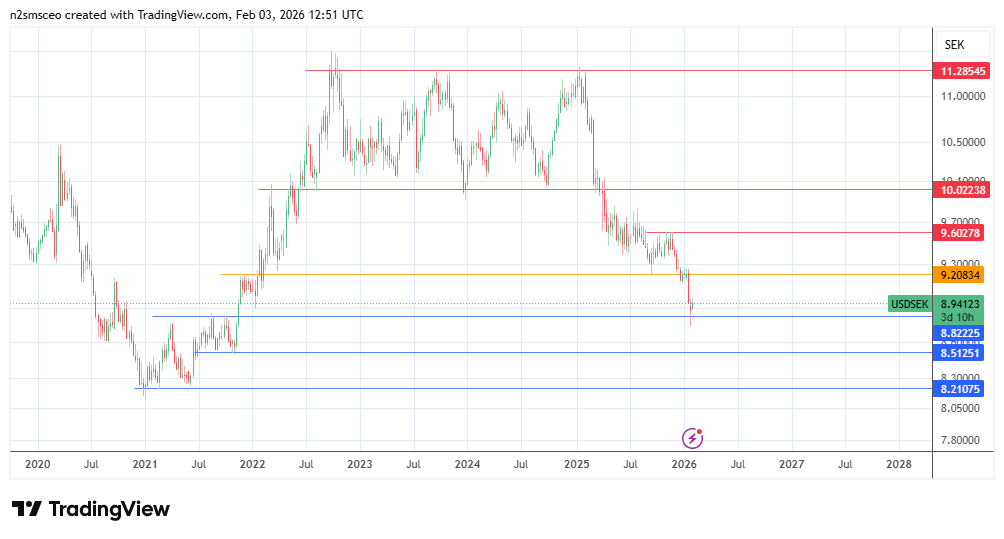
Historically, the current support has served as a bounce area. A technical bounce here will rediscover the 9.21 price barrier as the initial rebound target. If the upside momentum clears this point, 9.603 comes into the picture. These are to be seen as corrective rallies within the downtrend. Only when 10.022 is recovered can a trend reversal be on the cards, leaving the 11.2854 resistance as the next upside target.
On the flip side, failure to recover above 9.21 leaves downside targets at 8.822 (weekly close) and 8.513 as the following viable support levels. 8.211 becomes available on a much deeper decline.