



Current Setup and Live Chart
Reliance Industries is India’s largest listed stock by market capitalization. However, Reliance Industries’ share price is in a downtrend and is currently trading at multi-month lows. Concerns about energy market volatility, missed telecom monetization timelines, and broader market risk-off sentiment have all contributed to the stock’s current weakness. However, the long-term outlook on the stock from major analysts remains largely supportive.
This outlook stems primarily from the company’s highly diversified product base, which is expected to provide some insulation against underperformance in certain sectors.
Reliance Industries Share Price: Macro Drivers
1) Oil-market disruption could support O2C earnings
Reliance’s Oil-to-Chemicals (O2C) business is expected to benefit from elevated volatility in crude oil prices and global supply disruptions caused by the Hormuz blockade. On the strength of this macro driver, Motilal Oswal has assigned a Buy rating to the stock, citing potential earnings growth from stronger refining margins due to the shipping blockade.
2) Bullish Institutional Targets
Institutional bias toward Reliance Industries’ share price remains strong despite the recent price weakness. The current Reliance Industries share price makes the stock relatively attractive compared to the price targets set by several institutional analysts. For instance, the stock’s closing price as of 11 June 2026 is ₹1263.00. Compare this with the price targets of Morgan Stanley (₹1803), Motilal Oswal (₹1750), and CLSA (₹1800), and this fact is self-evident. The weakness in the stock is not deemed structural but rather cyclical.
3) Jio and consumer businesses remain key value drivers
Investors are looking to the future unlocking of value in Jio Financial Services Limited (Reliance’s financial services subsidiary) through its telecom and digital asset products. Market expectations continue to see Jio’s unlocking of potential and the consumer business as major bullish drivers of Reliance Industries’ share price.

Price Catalysts for the Near Term
1) Refining margins: Reliance’s earnings outlook stands to gain from improved refining margins. This will depend on the oil shock risk premium and Hormuz blockade continuing for a while.
2) Institutional sentiment: Institutional sentiment remains bullish in the long term. The current Reliance Industries share price remains well below institutional price targets. The presence of positive price catalysts could drive increased demand for the stock at current levels, giving the share price good room to appreciate.
Reliance Share Price Forecasts: Forecast Scenarios
Base case: the stock has a recovery bias, and the base case scenario is for the price to stabilize above the recent lows. This will allow investors to reassess the developments in the energy market even as institutional support remains upbeat.
Bull case: if data points to continued strength in refining margins, a boost in optimism around Jio’s future unlocking value, and improvements in the broader Indian equities market sentiment, we could see the Reliance share price start to push towards the institutional targets of ₹1,700-₹1,800. New business such as the partnership with Meta to build a new data centre in India improves the bull case scenario.
Bear case: the downtrend continues if refining margins show signs of softening. Also, deterioration in broader market sentiment towards Indian equities could trigger a new round of selloffs. This could keep the stock trading near recent lows, or even open the door for further declines below ₹1,260.
Reliance Industries: Technical Outlook
The latest decline in the share price is a leg lower from the breakdown of the head-and-shoulders pattern, triggered by the breakdown of the 1309.95 neckline support. The measured move seeks completion at 1160, the low of 5 March 2025. However, this move must take out the next support target at 1203.50 (the 12 February 2025 low) to be complete.
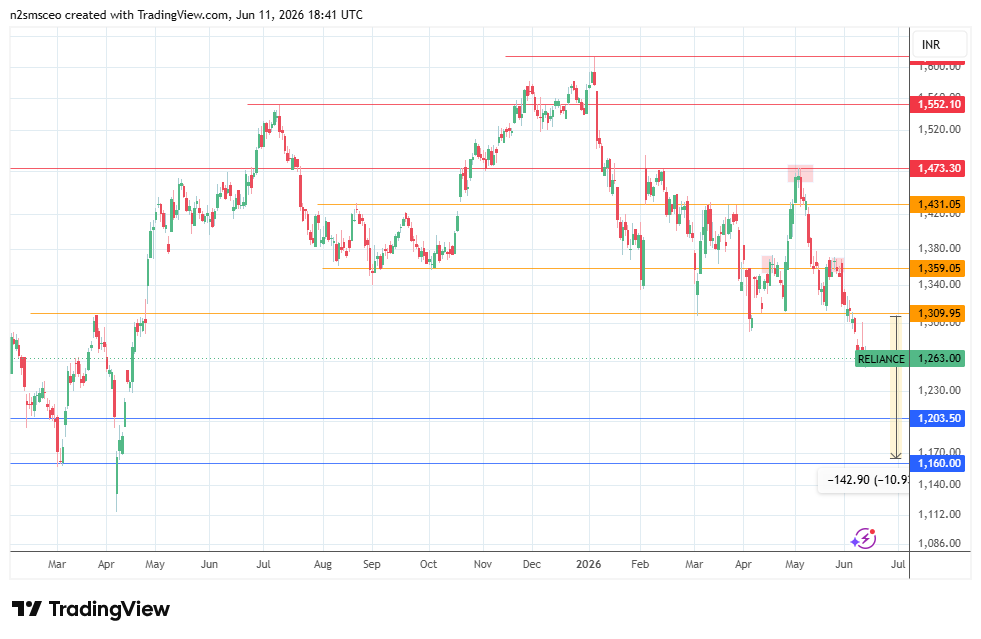
On the flip side, the bulls need to force price action above the neckline and the 1359.05 shoulder to target the 21 August 2025 and 10/25 March 2026 highs at 1431.05. A break here makes a case for reclaiming the 1473.30 head resistance. Further northside targets at 1552.10 (9 July 2025 high) and 1611.80 (5 January 2026 high) only become available if the 1473.30 resistance is uncapped.