


- Gold prices surge 65% in 2025, holding near record highs as geopolitical risks and Fed policy support demand.
Gold prices have cooled after one of the strongest rallies in modern market history, with XAU/USD pulling back from record highs near $4,552 reached earlier this week. Despite the near-term reversal, bullion remains up roughly 65% in 2025, marking its best annual performance since the late 1970s.
The latest pullback reflects profit-taking and shifting expectations around US monetary policy rather than a breakdown in gold’s broader bullish structure.
Why Gold Rose So Sharply in 2025
Gold’s explosive rally this year was driven by a rare alignment of macro and geopolitical forces.
The Federal Reserve’s pivot toward rate cuts has been central. The US central bank lowered interest rates by 25 basis points at its latest meeting, reinforcing expectations that real yields will remain under pressure into 2026. Lower real yields typically increase the appeal of non-yielding assets such as gold.
At the same time, geopolitical risk intensified. Tensions in the Middle East, alongside renewed strain between the US and Venezuela, pushed investors toward safe-haven assets. According to Bloomberg, central bank gold buying also remained elevated through the second half of the year, adding structural demand beneath prices.
Federal Reserve Rate Cut Expectations Ease, Slowing Gold’s Short-Term Momentum
While gold’s long-term fundamentals remain supportive, short-term enthusiasm has faded.
Market pricing now suggests a lower probability of an immediate follow-up rate cut in January. Futures data tracked by CME FedWatch shows expectations for near-term easing have dropped sharply, which has helped trigger the current consolidation phase.
This shift has not reversed gold’s uptrend, but it has reduced the urgency of fresh buying after record highs.
Geopolitical Risk Continues to Support Gold Prices Despite Emerging Headwinds
Gold continues to find underlying support from global uncertainty, but several factors are now limiting upside momentum:
- Higher margin requirements on gold futures, increasing the cost of holding leveraged positions
- Widespread profit-taking after a parabolic rally
- Signs of diplomatic progress in parts of Eastern Europe, which could reduce safe-haven demand if sustained

Together, these elements have shifted gold from a momentum-driven surge into a more technical, level-driven phase.
Gold Technical Outlook: $4,250 Is the Line to Watch
From a technical perspective, gold has slipped below short-term momentum indicators but remains within a broader bullish structure.
Key levels to watch:
- Resistance: $4,350, then $4,450
- Support: $4,250, followed by $4,180
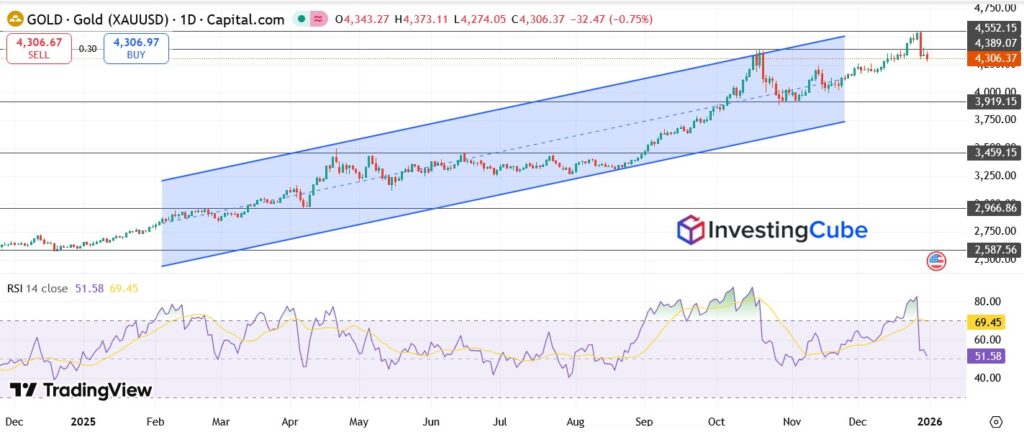
A sustained hold above the $4,250 area would keep the longer-term uptrend intact. However, a decisive break below that zone could open the door to a deeper correction toward $4,180 without invalidating the broader bull market.
Gold Outlook Heading Into 2026
Gold’s 2025 rally has reset long-term expectations. While near-term volatility is likely as markets reassess rate paths and geopolitical risk, the combination of lower real yields, central bank demand, and structural uncertainty suggests gold’s bull case remains firmly intact.
The next move now hinges less on headlines and more on whether key technical support levels can hold as the market transitions into the new year.
Gold can still act as a portfolio hedge, but after a sharp rally, prices may see periods of consolidation or pullbacks before the next major move.
Further US rate cuts, renewed geopolitical shocks, a weaker dollar, or increased central bank purchases could drive gold to new highs.
Gold prices are high in 2025 due to aggressive Federal Reserve rate cuts, elevated geopolitical tensions, central bank buying, and strong safe-haven demand.