


- Gold trades below $4,450 as profit-taking continues ahead of the US Nonfarm Payrolls report, keeping near-term sentiment cautious.
- Despite the pullback, rising geopolitical risks and dovish Fed expectations continue to limit downside pressure.
- The broader uptrend remains intact, with key support near $4,400 likely to determine the next directional move.
Gold prices remain under mild pressure on Thursday, January 8, 2026, with XAU/USD trading below the $4,450 level after extending losses for a second consecutive session. The pullback appears driven by profit-taking rather than a shift in fundamentals, as traders reduce exposure ahead of Friday’s highly anticipated US Nonfarm Payrolls report.
Despite the near-term weakness, downside momentum remains contained. Expectations for Federal Reserve rate cuts later in 2026 continue to weigh on the US dollar, while persistent geopolitical risks are helping to cushion losses in the precious metal.
Why Gold Is Pulling Back Despite Supportive Fundamentals
The current decline in gold lacks a clear bearish catalyst. Instead, it reflects cautious positioning as markets wait for fresh macro signals.
Investors remain broadly aligned with the view that the Federal Reserve is approaching the next phase of its easing cycle. Recent US labor data has been mixed, reinforcing expectations that rate cuts could resume as early as March. That outlook limits the dollar’s upside and reduces the opportunity cost of holding non-yielding assets like gold.
At the same time, geopolitical tensions continue to simmer. Uncertainty surrounding Eastern Europe, the Middle East, and US foreign policy rhetoric has kept safe-haven demand alive, preventing deeper sell-offs in XAU/USD.
This balance explains why gold is correcting gradually rather than breaking down aggressively.
Market Focus Turns to US Nonfarm Payrolls
Friday’s US Nonfarm Payrolls report is the key event risk shaping short-term gold direction.
Traders are looking for confirmation that the US labor market is cooling without slipping into outright weakness. A softer-than-expected jobs print would likely reinforce rate-cut expectations and revive upside momentum in gold. Conversely, a strong payrolls number could temporarily lift the dollar and pressure bullion toward lower support levels.
Until then, trading conditions remain cautious, with limited conviction on either side.
Gold Technical Analysis: Uptrend Intact Despite Short-Term Weakness
From a technical perspective, gold remains in a well-defined rising channel on the daily chart, even as prices consolidate below recent highs.
Key technical levels to watch:
- Immediate resistance: $4,450–$4,470
- Channel support: $4,390–$4,410
- Deeper support: $4,300 psychological zone
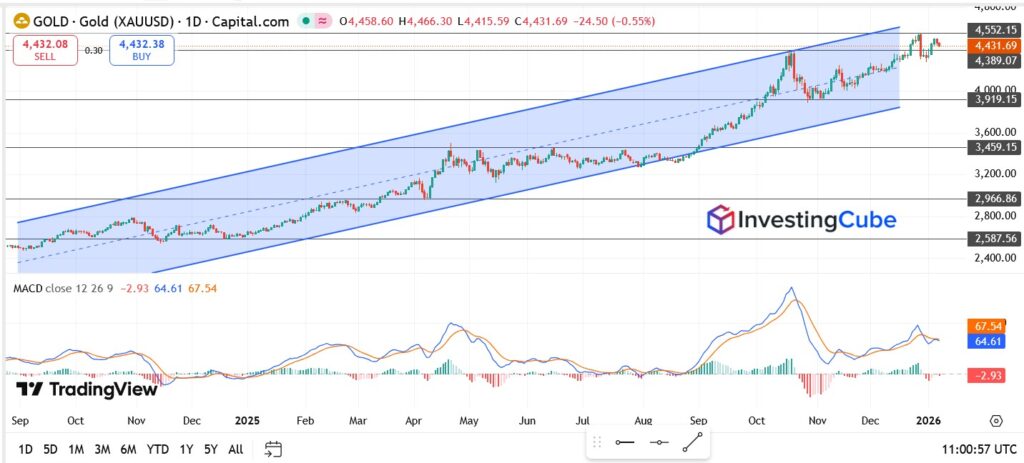
Momentum indicators show cooling but not reversal. The MACD has crossed lower from elevated levels, reflecting loss of upside momentum rather than trend exhaustion. As long as prices hold within the rising channel, the broader bullish structure remains intact.
A daily close below $4,390 would expose the lower boundary of the channel, while a rebound above $4,470 would signal renewed buying interest.
Gold Outlook: Correction or Pause Before the Next Leg Higher?
In my view, this pullback looks more like a controlled consolidation than the start of a trend reversal. Gold entered 2026 near record highs, and some digestion was inevitable after the strong late-2025 rally.
Unless US data materially alters the rate outlook, dips toward channel support are likely to attract buyers rather than trigger panic selling. A decisive break above $4,500 later this quarter would reopen upside toward new highs, while sustained weakness below $4,300 would be needed to challenge the bullish thesis.
For now, gold remains structurally supported, with near-term direction hinging on US labor data and central bank expectations.
Gold is easing due to profit-taking ahead of the US Nonfarm Payrolls report, not because of a shift in its broader bullish fundamentals.
Yes. Gold remains in a rising channel on the daily chart, and the broader uptrend holds as long as prices stay above key support near $4,400.
US jobs data and Federal Reserve rate-cut expectations will be the main drivers, with weaker labor data likely to support further upside in gold.