


- Gold prices climbed above $4,100 after a pause in US-Iran hostilities pushed oil prices and the US dollar lower.
- A weaker-than-expected US durable goods report added to expectations that the Federal Reserve could remain cautious on interest rates.
- Traders are now watching this week's Federal Reserve meeting for fresh clues on the direction of gold prices.
Gold prices moved back above the $4,100 mark on Monday as easing geopolitical tensions in the Middle East weakened the US dollar and reduced inflation concerns, improving demand for bullion ahead of this week’s Federal Reserve policy meeting.
Spot gold traded around $4,075 at the time of writing after earlier touching an intraday high above $4,110, recovering from last week’s sharp sell-off. US gold futures also advanced as investors rotated back into precious metals following a steep decline in crude oil prices.
The rally comes as markets reassess the outlook for US interest rates after weaker-than-expected economic data and a temporary pause in fighting between the United States and Iran.
Why Is the Gold Price Rising Today?
The biggest driver behind Monday’s recovery was a sharp decline in both the US dollar and oil prices. Brent crude fell nearly 10% after Washington and Tehran refrained from launching fresh attacks for a third consecutive night, easing concerns over disruptions to oil exports through the Strait of Hormuz.
Lower oil prices immediately reduced fears of another inflation shock, leading investors to trim expectations for more aggressive Federal Reserve tightening. At the same time, the US Dollar Index weakened, making dollar-denominated gold more attractive to overseas buyers.
The combination of a softer dollar, lower Treasury yields and reduced inflation expectations provided the ideal backdrop for bullion to recover above the psychologically important $4,100 level.
How Did US Durable Goods Orders Affect Gold?
Fresh US economic data also supported precious metals. The Commerce Department reported that durable goods orders rose just 0.3% in June, well below economists’ expectations of a 1.6% increase.
The weaker reading reinforced signs that US manufacturing activity continues to lose momentum. Slowing economic growth typically benefits gold because it can reduce pressure on the Federal Reserve to raise interest rates. Lower interest rates decrease the opportunity cost of holding non-yielding assets such as bullion.
Although gold’s immediate reaction to the data was relatively modest, the report added to the broader narrative that US economic momentum is cooling.
Will the Federal Reserve Move Gold Prices This Week?
Investor attention is now firmly focused on Wednesday’s Federal Reserve interest rate decision.

Markets broadly expect policymakers to leave interest rates unchanged. However, traders will closely analyse comments from Fed Chair Kevin Warsh for any indication of whether another rate increase remains likely later this year.
The outlook for monetary policy has become increasingly complicated. While softer economic data argues for a more cautious approach, inflation remains above the Federal Reserve’s long-term target, even after the recent decline in oil prices.
If the Fed adopts a less hawkish tone than markets currently expect, gold could extend its recovery. Conversely, renewed warnings about inflation could strengthen the US dollar and limit further gains.
Gold Technical Analysis: Can Gold Hold Above $4,100?
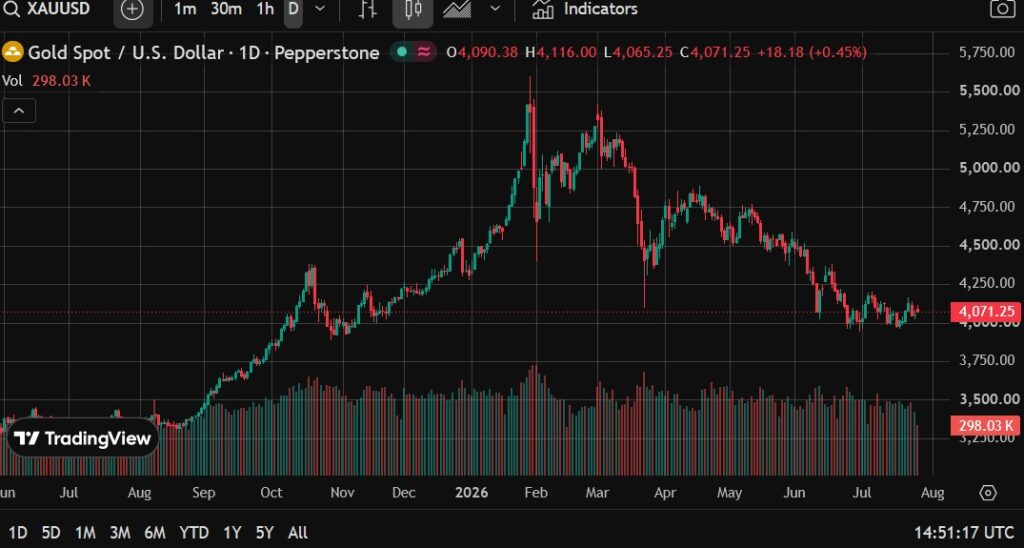
Gold Price Analysis: Gold is attempting to stabilize near $4,070 after a sharp correction from its 2026 peak above $5,400. The broader trend remains bearish, with lower highs still dominating the daily chart, but recent price action suggests selling momentum is beginning to ease.
Immediate resistance is seen around $4,120, while $4,000 remains the key psychological support. A sustained move above resistance could strengthen the case for a broader recovery, while a break below $4,000 would expose the recent swing lows and signal that sellers remain in control.
Gold Price Forecast
The near-term gold price forecast remains closely tied to the direction of the US dollar and expectations for Federal Reserve policy.
The recent pause in US-Iran hostilities has eased immediate inflation fears by sending oil prices sharply lower, creating a more supportive environment for precious metals. At the same time, softer US economic data is strengthening expectations that the Fed could adopt a more cautious tone.
If the dollar continues to weaken and policymakers avoid signalling additional interest rate increases, gold could make another attempt to reclaim $4,100 and extend its recovery. However, any resurgence in geopolitical tensions or a more hawkish Fed could quickly revive dollar demand and pressure bullion once again.
Gold prices are rising because the US dollar weakened after a pause in US-Iran hostilities reduced oil prices and inflation concerns. Weaker US economic data has also increased expectations that the Federal Reserve may adopt a more cautious approach to interest rates.
Gold climbed above $4,100 as lower oil prices eased inflation fears, the US dollar weakened and investors positioned ahead of the Federal Reserve’s policy decision. The combination improved demand for non-yielding assets such as gold.
The Federal Reserve remains the biggest near-term catalyst for gold. A less hawkish policy outlook could weaken the US dollar and support bullion, while signals of further interest rate increases may limit gains in gold prices.