



- Gold remains resilient, consolidating near $5,050 as the critical $5,000 level holds firm despite a "risk-on" mood in global equities.
- The nomination of Kevin Warsh as the next Fed Chair has shifted market expectations toward a more hawkish "strong dollar" policy, challenging the long-term rate-cut narrative.
- Technical indicators suggest XAU/USD is completing the C-D leg of a Gartley pattern, with analysts eyeing a breakout toward the $5,340 area.
Gold Holds the $5,000 Fortress Amid Dollar Depreciation
Gold prices are showing quiet resolve this Wednesday, trading near the $5,050 area during the New York session. While the global market appetite for risk has increased following Prime Minister Sanae Takaichi’s victory in Japan, the precious metal is benefiting from a third consecutive day of US Dollar depreciation. The US Dollar Index (DXY) continues to wobble as traders digest weak employment forecasts from White House advisers and brace for a week of high-impact economic releases.
For Gold, the $5,000 psychological level has transformed into a formidable fortress for bulls. While the “endless rate cut” euphoria that drove Gold to $5,600 in January has cooled, the underlying trend remains bullish as the market re-evaluates the Federal Reserve’s independence under a looming leadership change.
The “Warsh” Pivot: How Federal Reserve Politics are Shaping XAU/USD
The most significant headwind for Gold in February has been the nomination of Kevin Warsh to succeed Jerome Powell as Fed Chair in May 2026. Markets view Warsh as notably more hawkish, prioritizing inflation control and a robust US Dollar over aggressive monetary easing. This “Warsh Pivot” has forced gold bugs to reassess the timing of future rate cuts, acting as a ceiling near the $5,100 resistance zone.
However, this political shift is a double-edged sword. While a stronger dollar typically hurts Gold, any hint of political interference during Warsh’s Senate confirmation hearings could spark a fresh flight to safety. Furthermore, the People’s Bank of China (PBoC) has continued its gold-buying spree for the 15th consecutive month, reinforcing a long-term global floor regardless of short-term Fed hawkishness.
As the Lunar New Year approaches (February 16–23), traders should expect a temporary drain in Asian liquidity, which often leads to increased price volatility.
Gold Technical Analysis: Is a Breakout to $5,340 Next?
Gold’s structure remains tightening but biased to the upside. The 100-period SMA on the 4-hour chart is providing dynamic support near $4,970, while the RSI sits at a neutral-to-bullish 57.

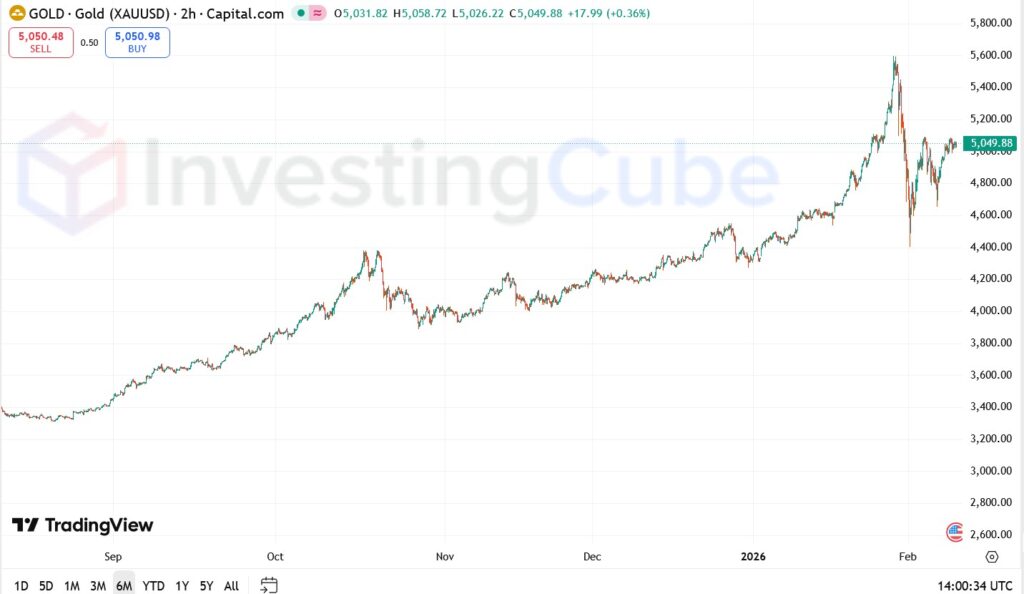
- The Gartley Pattern: Current price action suggests XAU/USD is in the final stages of a bullish Gartley pattern. If Gold can decisively clear the Fibonacci resistance at $5,138, the next major target is the 78.6% retracement level near $5,340.
- Support Levels: On the downside, a break below the February 6 low of $4,655 would invalidate the current bullish outlook. In the near term, the 50-period moving average at $5,020 serves as the first line of defense for buyers.
- Silver Correlation: Interestingly, Silver (XAG/USD) is facing a steeper uphill battle, compressing near $82 as it tests a major downward trendline. This suggests that Gold is currently outperforming its peers as the preferred hedge against geopolitical uncertainty.
Conclusion: The Road to Friday’s CPI Verdict
Gold’s 7.8% recovery from its January lows has successfully “calmed the tape,” but the ultimate verdict will be delivered by this week’s US data “triple-header.” The US Retail Sales figures today will provide the first clue, followed by the highly anticipated Nonfarm Payrolls (NFP) on Wednesday and the CPI Inflation report on Friday.
If Friday’s CPI data reveals tariff-driven inflation, the Fed may be forced to keep rates high, potentially challenging Gold’s hold on the $5,000 level. Conversely, an NFP print below 50,000 could reignite the March rate-cut narrative and propel XAU/USD toward its $5,318 target. For now, the “coiling” price action suggests a major breakout is imminent.
Gold is benefiting from a weakening US Dollar and persistent long-term demand from central banks, notably China, which offset the “risk-on” sentiment in the stock market.
With major Asian markets closing from February 16 to 23, the reduction in physical buying creates a “liquidity drain”. This often leads to erratic price swings because smaller trades can move the market more easily, making Gold more vulnerable to sudden spikes during the New York session.
The delayed NFP report is a massive “market mover.” If job growth comes in below 50,000, it will likely reignite hopes for a Fed rate cut in March, weakening the Dollar and potentially propelling Gold toward the $5,340 Fibonacci target.