- Reports that OpenAI is seeking alternatives to Nvidia chips for AI inference workloads triggered a slide in NVDA shares earlier this week.
- Nvidia CEO Jensen Huang dismissed rumors of a "rift" as "nonsense," though he confirmed the massive $100 billion investment plan was "never a commitment".
Nvidia (NVDA) shares are trading near $186.50 pre market after a volatile “reality check” session that saw the world’s most valuable company lose nearly 3% of its market cap. The primary driver of the current “Nvidia Reset” is a growing focus on AI inference, the process of serving real-time answers, as opposed to model training.
As reported by Reuters, OpenAI has sought alternatives to Nvidia’s latest chips for specific inference needs since last year, citing dissatisfaction with the speed at which hardware returns answers. While Nvidia remains the unchallenged leader in the training market, this shift toward specialized inference hardware from rivals like AMD, Cerebras, and Groq introduces a new competitive front.
The move has not broken Nvidia’s longer-term uptrend, but it has interrupted the stock’s recent momentum after a strong rally into late January.
Why OpenAI’s Chip Review Matters for Nvidia
Nvidia’s dominance has been built on more than hardware. Its strength lies in the integration between GPUs, software, and developer tooling. Any signal that a flagship AI customer is reviewing alternatives introduces headline risk, even if near-term revenue impact is limited.
OpenAI’s concerns are focused on inference efficiency, not Nvidia’s training accelerators. That distinction matters. Training large-scale AI models still overwhelmingly depends on Nvidia’s high-end GPUs, where competition remains thin.
Inference, however, is becoming the next battleground. As AI moves from experimentation to deployment, cost, latency, and power efficiency are under sharper scrutiny.
Nvidia Pushes Back as Market Prices Narrative Risk
Nvidia has pushed back against suggestions of a strategic rift. Noting that there was never a binding $100 billion chip commitment from OpenAI and emphasized that large AI customers routinely evaluate multiple vendors, as reported by straitstimes.com.
This clarification helped limit downside follow-through, reinforcing the view that today’s move reflects expectations reset rather than structural damage to Nvidia’s AI positioning.
Switching away from Nvidia at scale however, remains complex due to the company’s software ecosystem and developer lock-in.

Nvidia Technical Outlook
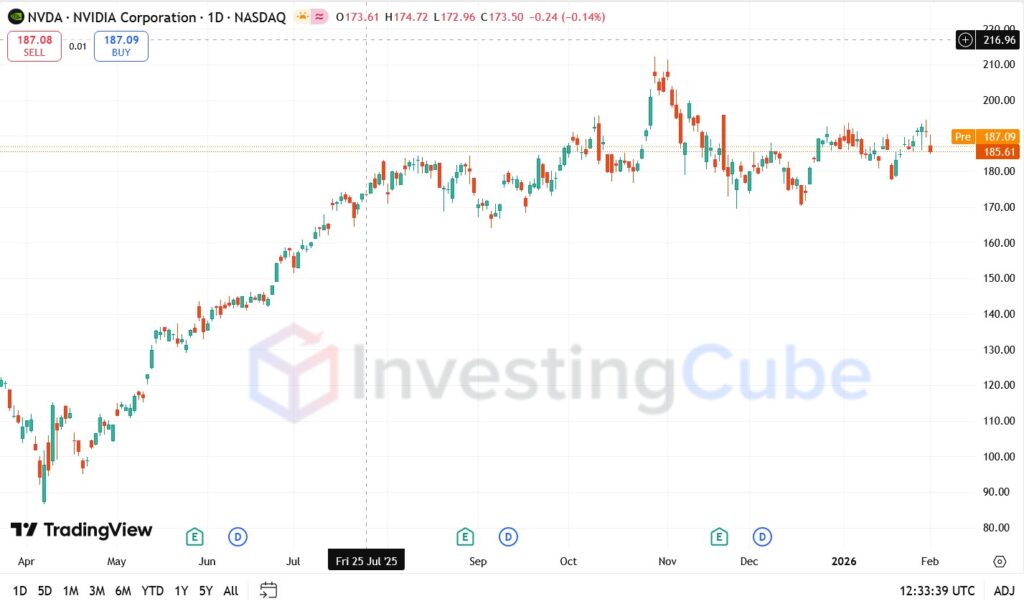
The Nvidia stock forecast has shifted toward a “consolidation regime” as investors digest these supply chain questions:
- Key Support ($180.00): This psychological level is the immediate target for bears. A break below this could see the stock retreat toward its November lows near $165.
- Resistance ($195.00): This area has become a “brick wall” of supply. Reclaiming this level would require a strong earnings beat or a definitive cooling of the “Warsh-led” bond yield surge.
Nvidia Stock Outlook: Repricing, Not Reversal
Today’s pullback reflects a market recalibrating assumptions around exclusivity in AI infrastructure. Nvidia is still central to the AI ecosystem, but investors are increasingly pricing a future where dominance coexists with selective competition.
As reported by Reuters and echoed across market coverage, OpenAI’s evaluation of alternatives signals optimization, not abandonment. Nvidia’s leadership in AI training workloads remains intact, even as inference economics evolve.
For now, Nvidia’s trend remains bullish on a higher-timeframe basis, but the stock appears to be transitioning from momentum expansion to range-bound digestion.
Nvidia Stock FAQs
Partially. While OpenAI remains a “gigantic customer” for training chips, it is exploring alternatives from AMD, Broadcom, and Groq for about 10% of its future inference needs to improve speed and efficiency.
Sam Altman took to X to call the rumors of a rift “insanity,” stating: “We love working with NVIDIA and they make the best AI chips in the world. We hope to be a gigantic customer for a very long time”.
Key support sits in the $180–182 zone, while resistance remains near $190–195. A break above resistance could restore upside momentum, while a sustained move below support would suggest deeper consolidation.