
Brent crude forecasts for 2026 could face repricing amid a risk-premium unwind. Prices have retreated sharply over the course of the week after headlines in the Middle East shifted to de-escalation. Brent crude is trading 1.52% higher at the time of writing, but remains 2.35% lower this week.
The decline in Brent crude and WTI came as traders priced out any immediate supply disruption risks. Easing geopolitical tensions (proposed US-Iran talks) have minimized the war risk premium that had sent prices soaring a week earlier. The decline also comes amid broader de-risking in commodity assets, which saw gold and silver take hard hits.
Brent Crude Forecast 2026: Macro Driver
The predominant driver for crude oil prices in 2026 remains geopolitics. Brent crude ended 2025 on the back foot as demand concerns stemming from the US-China trade dispute, which shuttered factories in China and dramatically reduced oil demand, played out.
Following on from the US invasion of Venezuela and the knee-jerk impact it had on oil prices, the US buildup and threat of conflict with Iran drove prices towards the $70 mark. Historically, Iran and its allies in and around the Persian Gulf and the Straits of Hormuz have disrupted shipping in that axis. The closure of the Straits of Hormuz and the accompanying disruption to oil supply could remain the highest-impact geopolitical risk facing Brent crude.
Brent crude currently trades at $68.10 per barrel, significantly above its year’s opening price of $58 per barrel. However, confirmation that the US would hold indirect talks with Iran is now seen as a de-escalatory move that pushed oil prices down from the weekly high of $69.76. The situation has led to choppy price action in the last two sessions.
Brent Crude Forecasts 2026: Current Situation
The risk premium from the Middle East has not disappeared; it has only been temporarily repriced, and the situation could change depending on the outcome of current diplomatic efforts.
OPEC remains an essential factor and could prove a stabilizer. Recent reports indicate that the oil cartel could retain current production quotas in March after pausing further planned increases. This scenario could provide support for Brent crude on any pullbacks.

To sum this up:
- Near-term volatility is currently determined by geopolitics.
- The medium-term anchor is the projections for a 2026 oversupply. Current forecasts from polled economists indicate an average Brent crude price in the low $60s for 2026.
Any rallies are coming amid a softer fundamental price backdrop, and if the diplomatic efforts pay off, it could signal a return to softer price levels.
Brent Crude Forecasts 2026: Deep technical analysis
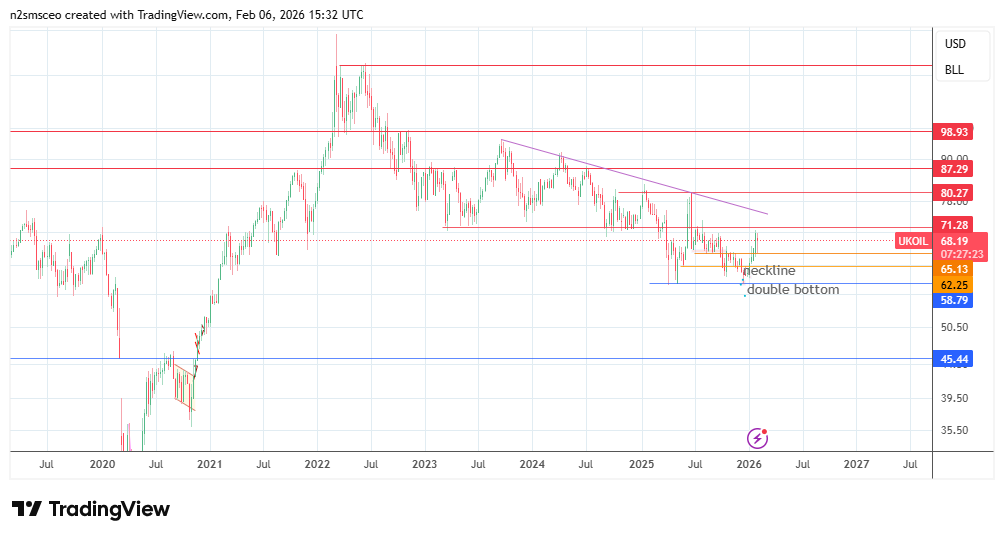
The weekly chart shows that the primary trend has been bearish since the 2022 peak. However, the double bottom (more visible on the daily chart) suggests that base-building is now underway as the bulls aim to reverse the trend. However, the downtrend remains in place as long as the descending trendline remains intact, but the emergence of a clear base since late 2025 via the double bottom indicates a shift from a downtrend to a range.
The daily chart indicates that the present near-term upside push came off the double bottom at 58.79 and a break of the neckline at 62.25. The attainment of 70.58 on 29 January fell just short of the pattern’s measured move at 71.47. A continuation of 71.47 with shallow pullbacks is the expected price move as long as the 65.13 support and the November 2025 high hold. If the bulls uncap 71.47, a march towards the 23 June 2025 high at 80.27 cannot be ruled out.
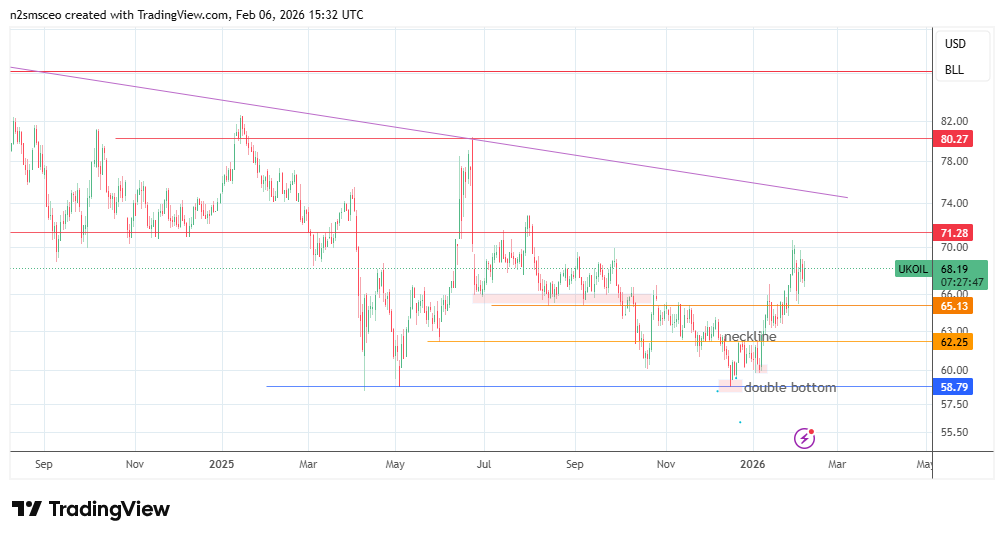
However, if a pullback degrades the 65.13 support, there is a risk of a decline towards 62.25 (neckline) and, further back, to the double bottom base at 58.79, in that order. Only if the bears keep the price below 62.25 can we speak of invalidating the attempted recovery of January 2026.