




- • AI infrastructure stocks continue to outperform the broader market, driven by significantly stronger earnings growth and rising profit expectations.
- • The continued strength in AI-related earnings supports the bullish outlook for the S&P 500, suggesting that any near-term pullbacks may be viewed as consolidation within the broader uptrend rather than a trend reversal.
JPMorgan increased its target for the S&P 500 to 7,800 by the end of the year. The bank’s analysts said that strong spending on AI is supporting gains in the S&P 500, alongside easing tensions between the United States and Iran.
Moreover, JPMorgan raised its profitability forecast for the index to $350 in 2026, representing 29% annual growth. The projected profitability for the index in 2027 is $390. Nevertheless, the bank believes these figures remain below the current market forecasts.
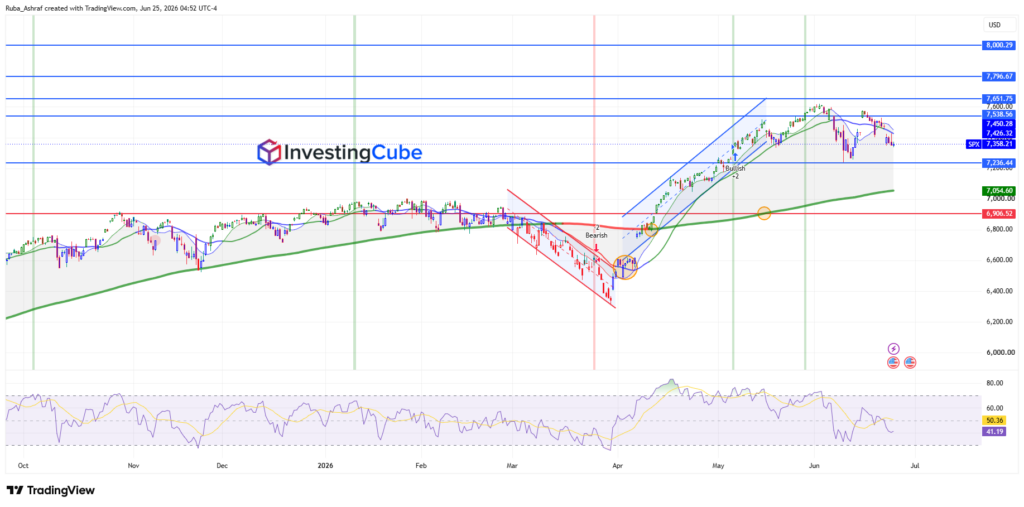
The price action confirms what we anticipated during our last technical outlook for the S&P 500, as the index successfully rebounded from the key support area around 6,500 and resumed its broader bullish trend. The breakout from the descending channel marked the end of the corrective phase and signaled a shift back in favor of buyers, allowing the index to rally sharply toward fresh record highs.
Following the breakout, the S&P 500 established a strong bullish channel and remained comfortably above both the short-term moving averages and the 200-period moving average, highlighting the strength of the underlying uptrend. This bullish momentum carried the index to a peak near 7,650 before profit-taking activity emerged.
More recently, the index has entered a consolidation phase after failing to sustain gains above the 7,538 resistance level. The rejection from this area triggered a pullback toward the support zone around 7,445, where buyers have so far managed to limit downside pressure. At the same time, the RSI has retreated toward the neutral 50 level, indicating that bullish momentum has cooled but has not yet turned decisively bearish.
The broader trend remains constructive as long as the price continues to trade above the 7,236 support level. The price might attempt to break out of 7,538 and 7,652 in the near term. A decisive breakout above these resistance levels could pave the way for an extension toward 7,800 and potentially the psychological 8,000 mark.

On the downside, a decisive break below 7,236 would suggest a deeper correction is underway. This will expose the index to a decline toward the 7,050 support zone, aligning closely with the 200-day moving average. Such a move would likely be viewed as a corrective retracement within the broader uptrend rather than a complete trend reversal unless the 6,906 support level is also broken.
Key Catalysts Behind the S&P 500’s Recent Momentum:
- The AI boom has progressed from theoretical hype into a colossal hardware buildout. The world’s largest tech hyperscalers are significantly accelerating infrastructure spending, with total capital expenditures tracking toward over $750 billion from major institutions like Goldman Sachs Research. This massive spend is acting as a major earnings engine, not just for traditional chipmakers, but also expanding into energy utilities and industrial construction providers.
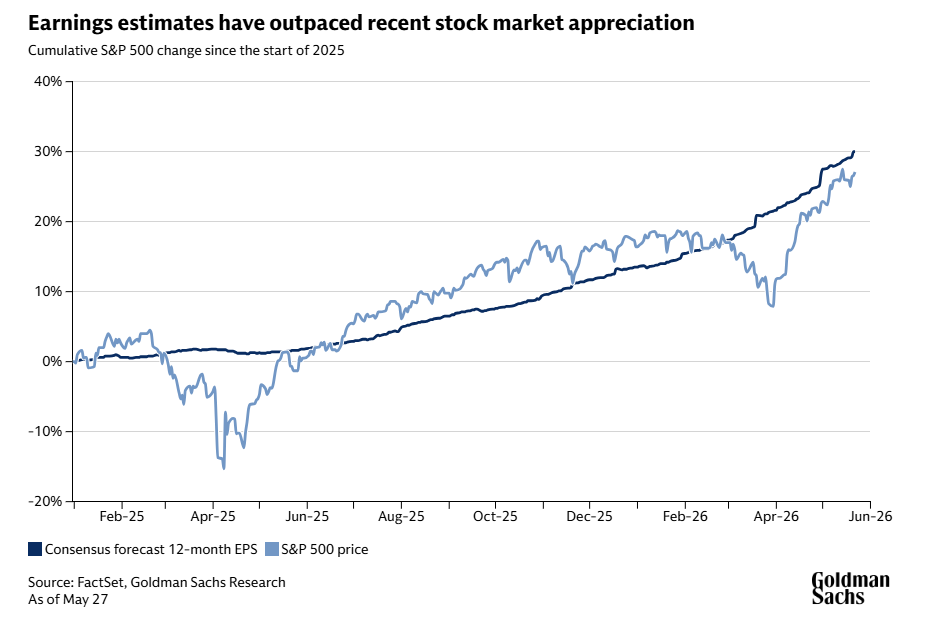
The chart highlights that earnings forecasts have outpaced the S&P 500’s gains since early 2025. This suggests that improving profit expectations are supporting the market rally and helping justify higher stock valuations. Consequently, the index’s upward trend remains backed by strengthening fundamentals rather than sentiment alone.
- First-quarter corporate earnings exceeded initial expectations by a wide margin, pushing full-year index expectations up. Driven by productivity gains and robust cost management, consensus forecasts track corporate earnings per share (EPS) growth at roughly 12% to 24% for the year
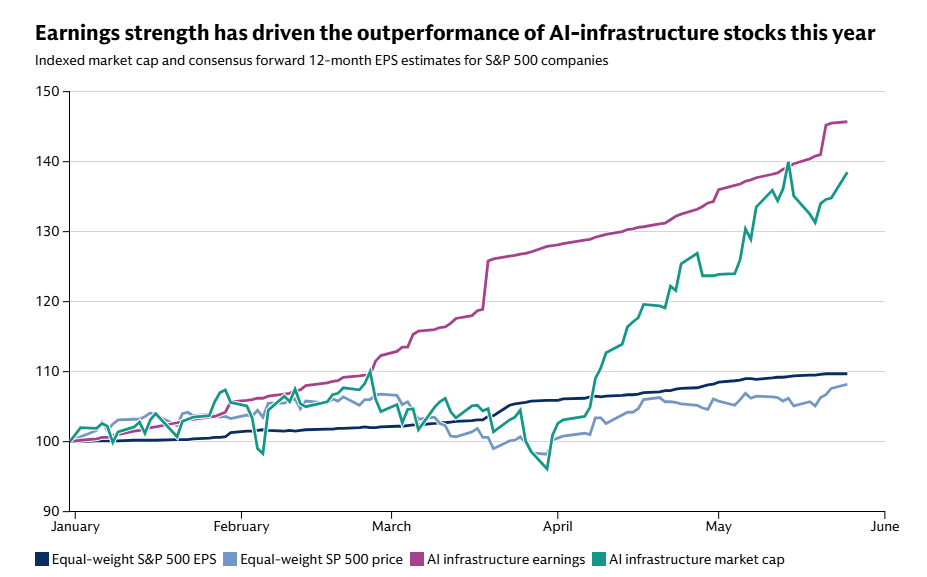
The chart shows that AI infrastructure stocks have significantly outperformed the broader market, supported by rapidly rising earnings expectations. The strong correlation between earnings growth and market capitalization indicates that investor demand for AI-related companies continues to be driven by improving fundamentals rather than speculation alone. As a result, the AI theme remains a key pillar supporting U.S. equity markets.