


- Explore the Hang Seng's technical outlook and discover the reasons behind its underperformance compared to other major Asian indices.
Sharp corrections in the Japanese and South Korean equity markets led to losses in Hong Kong’s technology sector. The Hang Seng has fallen more than 3% and closed lower on Tuesday. Such a decline led to more losses among the other three major indices: Tencent, Xiaomi Group-W, and Meituan-W. Those important indices have fallen almost 4% each before closing on Tuesday.
The Shanghai Composite Index eased 1.4%, and the blue-chip CSI300 index lost 2.8%. The heavy tech index Star 50 dipped 1.7%, while the startup board ChiNext composite index plunged 3.8%. The U.S. rate hike expectations led Asian stocks to ease while oil prices continued to decline, especially after the U.S. waived sanctions on Iran.
Hang Seng Technical Outlook:
The daily chart of the Hang Seng index shows that the structure has turned decisively bearish, particularly after failing to build gains above the 26,300-27,300 range. Currently, the price has broken below several key support levels. Additionally, the price is trading beneath the short-term moving averages, reflecting a significant deterioration in market sentiment.
The short-term moving averages have rolled over and crossed lower. Moreover, the index has fallen below the longer-term 200-day moving average, which had previously acted as dynamic support. This breakdown is technically important as it indicates a potential shift from a medium-term bullish trend into a deeper correction phase.
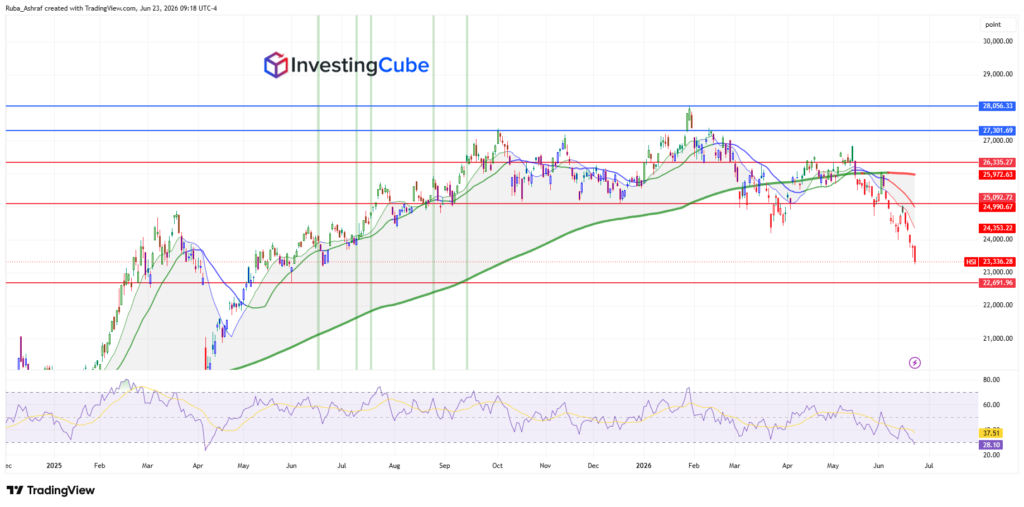
The horizontal levels highlight the extent of the recent weakness. The index has already broken below support at 24,990 and 24,350, opening the door for a test of the next major support around 22,690. If bearish momentum persists, traders may begin focusing on the psychological 22,000 area, while a more extended selloff could expose the longer-term support zone near 20,445.

Momentum indicators reinforce the bearish outlook. The RSI has fallen to approximately 28, entering oversold territory for the first time in several months. While this suggests that selling may be becoming stretched in the short term, oversold conditions alone do not guarantee a reversal. During strong downtrends, the RSI can remain below 30 for an extended period while prices continue to decline. Therefore, the current reading should be viewed as a warning of potential volatility rather than an immediate buy signal.
Why is the Hang Seng Index currently underperforming other major Asian indices?
The Hang Seng Index has fallen to one-year lows as weak economic data from China continues to weigh on investor sentiment. Unlike markets in Taiwan and South Korea, which have benefited from the global AI-driven rally, the HSI is more heavily exposed to financial stocks and Chinese consumer-focused technology giants such as Tencent and Alibaba.
Recent disappointing retail sales data highlighted ongoing weakness in consumer spending, raising concerns about China’s economic recovery. As a result, investors have reduced exposure to sectors tied to domestic demand, leaving the Hang Seng underperforming its regional peers.
The combination of slowing domestic demand, weaker-than-expected economic indicators, and the absence of strong exposure to the global AI-driven rally has left the Hang Seng lagging behind its regional peers.
While other Asian markets are benefiting from enthusiasm surrounding artificial intelligence and advanced chip manufacturing, Hong Kong equities continue to face pressure from concerns over China’s growth outlook and the spending habits of Chinese consumers.
The Hang Seng Index is under pressure as investors adjust to expectations that U.S. interest rates could stay high for longer under Federal Reserve Chair Kevin Warsh. Because Hong Kong’s currency is linked to the U.S. dollar, the Hong Kong Monetary Authority is forced to keep local interest rates elevated as well.
Higher borrowing costs make it more expensive for businesses and consumers to access credit, which can slow economic activity and reduce investor appetite for growth stocks. At the same time, upcoming lock-up expirations from recent IPOs could increase the number of shares available in the market, adding further selling pressure. Together, these factors are reducing market liquidity and weighing on valuations across the Hang Seng Index.