



- The FTSE 100 remains in a broader uptrend, with recent weakness reflecting profit-taking rather than a trend reversal.
- Economic data, central bank expectations, and market sentiment continue to be the key drivers shaping the index’s near-term direction.
The FTSE 100 edged higher by 31.19 points, or 0.31%, as of 26 January 2026 at 17:19 GMT+2. The index closed the trading day up 0.05%, lower than its intraday gains. The main driver supporting the FTSE 100 index is the surge in gold prices, which have exceeded $5000 as a new all-time high.
This article explores the main factors influencing the FTSE 100 index, its connection to rising gold prices, and the index’s technical outlook
Rising Gold Prices and a Higher FTSE 100| Relation Explained:
The FTSE 100 has significant exposure to global mining and commodities companies such as Fresnillo, Endeavour Mining, Anglo American, and Rio Tinto. Gold has extended its rally, breaking above the psychological level of $5000. With such a surge in gold prices, revenue and profit expectations for gold miners improve, and mining stocks tend to rally. This, in turn, can lift the overall FTSE index.
- Spot gold is hovering above $5000 per ounce.
- Year-to-date, gold has gained approximately 20%.
- Rising geopolitical tensions are fueling demand for safe-haven assets like gold.
FTSE 100 | The Key Factors Drive the Index:
- Stronger UK private sector activity indicates an expansion in manufacturing and services, as per January Composite PMI readings, which came at 53.9.
- According to Morgan Stanley research, the increasing adoption of AI in the UK employment indicates that productivity has increased by an average of 11.5% in the past year.
- It also shows an 8% average job loss, which is significantly higher than the global average.
- The UK Retail sector recovery: December retail sales rose 0.4%, rebounding from two months of decline.
- It’s expected to see a gradual downward path in the BOE monetary policy, which could impact investors’ behavior and equity valuations.
- BoE stance on interest rates: Comments from MPC member Megan Greene suggesting the BoE should avoid rate cuts, affecting expectations for borrowing costs and equity market sentiment.

The Technical Outlook for the FTSE 100:
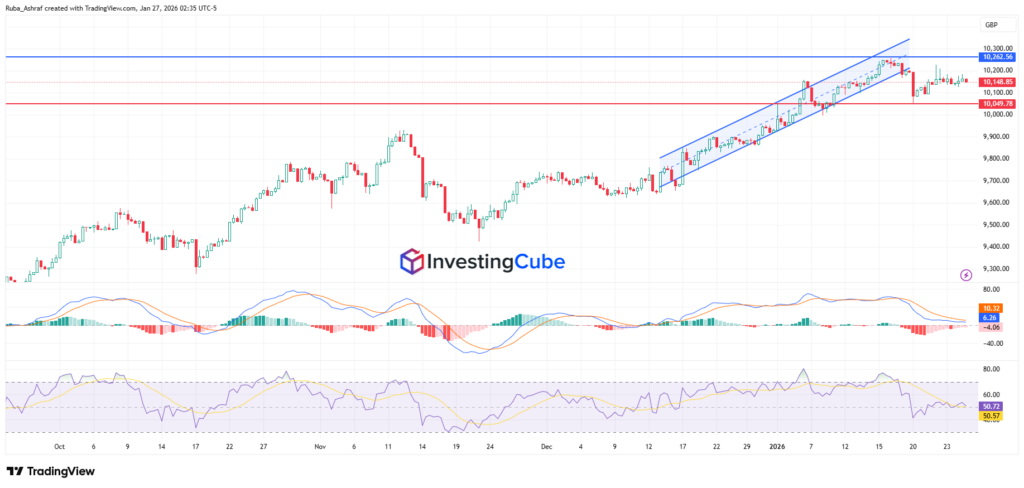
The FTSE 100 chart shows a clear and decisive uptrend, highlighted by a well-defined rising channel. Prices consistently posted higher highs and higher lows, confirming strong bullish momentum in recent weeks.
After reaching the upper boundary of the channel, the index has edged lower due to profit-taking activity. The pullback appears orderly and contained above key support levels, which indicates that buyers remain in control despite the short-term correction.
The MACD has started to soften after a strong bullish phase. It indicates upside momentum in the near term, aligning with the idea of consolidation or a corrective move rather than an aggressive bearish shift.
The RSI has retreated from overbought territory and is now hovering around the neutral 50 level. This move reflects a cooling in buying pressure and supports the view that the index is undergoing a healthy correction after its strong advance.
The FTSE 100 is being influenced by stronger UK economic data, expectations around Bank of England policy, global risk sentiment, and safe-haven flows into assets like gold.
No. The index remains in a broader uptrend, and the recent decline appears to be driven by profit-taking, with momentum indicators suggesting a healthy consolidation rather than a bearish reversal.