



- Dow Jones forecasts could be reshaped as the US and Iran announce a 2-week ceasefire, which paves the way to reopen the Strait of Hormuz.
Live Chart and Current setup
Dow Jones forecasts have been dominated by the same macro events that have impacted other markets, mostly connected to the oil-shock risk premium. The big news of the day has been the 2-week ceasefire announced by both sides in the US-Iran conflict, along with the reopening of the Strait of Hormuz. The macro-sensitive relief rally is not just about oil, US real yields or any geopolitical considerations. The first quarter is done and dusted, and any price moves in the Dow are starting to factor in expectations for company earnings and guidance reports.
Tuesday’s trading session was dominated by risk-off sentiment, with the Dow declining by 0.18% to 46,584.46. However, the Hormuz reopening turned the market into a risk-on environment, leading the Dow to surge initially by nearly 3% on Wednesday, 8 April.
The two-week U.S.-Iran ceasefire announcement and the accompanying drop in Brent crude to as low as $90.40 improved sentiment. US bond yields eased, and the Fed’s easing expectations for a rate cut later in 2026 are back on the table.
That combination matters a lot for the Dow because the index has heavy exposure to cyclicals, industrials, financials, and travel-linked names that respond quickly to changes in growth and inflation pricing.
What’s Driving Recent Dow Jones Forecasts Right Now?
1) Fading Oil shock→ easing inflation fears → equities bouncing
The biggest driver is the sharp reversal in the oil shock story, which came just a day after markets were decidedly risk-off. The Dow had sold off along with global stock markets on 7 April, only for a ceasefire to be announced on 8 April along with the reopening of the Strait of Hormuz. The de-escalatory headlines sent Brent crude sharply lower and have also helped to taper the market’s recent inflation fears. The sharp surge in the Dow is driven by tailwinds from lower energy prices, which improve the outlook for listed stocks.
2) U.S. Yields and Fed expectations
U.S. bond yields have fallen amid easing geopolitical risk premiums. This has also brought Fed rate-cut expectations back to the table. The CME’s Fedwatch tool shows that markets have repriced the odds of a December rate cut higher. This is an important factor for the Dow’s market cap, as lower yields support financial and industrial stocks, which are highly sensitive to rate adjustments.
3) Risk Sentiment

Risk sentiment is an integral part of the macro drivers for the Dow. The Dow thus remains a broad market risk and growth barometer. The price moves that have followed the risk-off headlines of 7 April and the risk-on ones of 8 April will see how the Dow moved in tandem with those headlines. The Dow is no longer just an earnings-led benchmark but a risk barometer of its own.
Dow Jones Price Catalysts for the Week
Three price catalysts for the week are as follows:
1. Oil pathway and ceasefire maintenance: The dominant oil headlines will now center on whether the ceasefire will be durable and if the reopening process of the Strait of Hormuz will continue as planned. Will the Strait stay open? If the Strait stays open and the ceasefire is respected, the Dow Jones will not be pressured by energy-driven inflationary fears. A fraying of the truce will sour sentiment, sending oil prices spiking again and ending the relief rally.
2. Key US inflation data PPI on 14 April: The next US Producer Price Index data set is due for release on Tuesday, 14 April 2026, at 8:30 a.m. ET. Since the oil shock began, the US PPI has overtaken the CPI as the more important of the two inflation reports. Producer prices usually bear the direct brunt of energy price adjustments. In light of the recent de-escalatory headlines, the market is tilting towards softer US producer prices. A hotter-than-expected print would send the Dow into a tailspin.
3. Fed rate pathway pricing: If Fed rate-cut expectations continue to rise and US bond yields remain contained, this is supportive of the Dow. If yields climb back higher, the rally could be short-lived.
Dow Jones Forecast: Scenarios for the Week
Base case: A volatile rebound, albeit in a cautiously bullish environment, is the base-case expectation: Sharp swings are expected to occur around macro headlines.
Bull case: an upside extension is expected if oil prices keep falling and war headlines lean towards a permanent ceasefire. If the Strait of Hormuz remains open without incident, energy-driven inflation fears will dissipate, and the Dow can extend higher. Watch the price action of 8 April; it captured the essence of the bull case.
Bear case: any condition that causes a re-acceleration of the oil shock, such as the unraveling of the ceasefire or upside surprises in PPI data, would revive the “higher-for-longer” Fed monetary policy expectations. This could cause the current rally to unwind. The 7 April price action is a perfect example of what a bear case scenario looks like.
Dow Jones: Technical Outlook
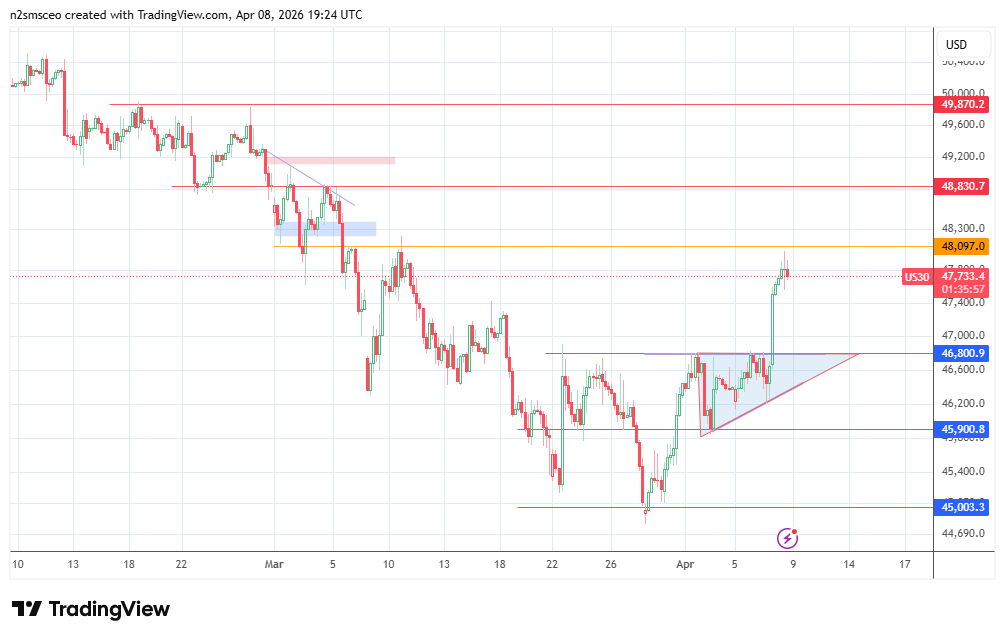
The predominant pattern on the 4-hour chart is the ascending triangle. The breakout from this triangle is the essence of the relief rally. This rally has taken the price towards the 48097 price mark. A further recovery towards 48830 is expected if the bulls uncap this barrier.
However, a loss of upside momentum could see a retest of the 46800 support and the upper triangle border, now acting as a role-reversed pivot. The downward trend only resumes if the 45900 and 45003 pivots are breached.