



- Oil supply disruptions in Kazakhstan have supplied the momentum on CAD, as oil is among Canada's largest exports
- Canada's economy has been resilient, but US trade tariff threats linger and could disrupt growth.
The USD/CAD pair has spent much of January 2026 keeping traders on their toes. After going up since late December, peaking near 1.3925 mid-month, it has recently hit a turbulence. In the last five days, the Canadian dollar has regained ground, pushing the exchange rate down to the 1.3750-1.3800 range.
The pair has declined by 1% in the last five sessions and is down by 0.23% year-to-date. Meanwhile, it is nearing 1.3650, the level at which it previously began its rally. We discuss why this is happening and whether a reversal could emerge imminently.
Why Is the Canadian Dollar Surging?
The Canadian dollar is up against the U.S. dollar because of strong economic data in Canada and rising pressure on the U.S. dollar. Strong Canadian retail sales figures, which surpassed expectations, have bolstered confidence in the economy. The country’s retail sales grew 3.1% year-over -year in November 2025 and 1.1% month over month to C$70.4 billion. Additionally, firm oil prices, driven by supply disruptions in Kazakhstan, have improved Canada’s terms of trade, given its status as a major exporter.
On the other side of the border, the U.S. dollar is facing its own headwinds. The greenback has entered a soft patch early in 2026. There’s growing expectation that the Federal Reserve might cut rates early to protect jobs before the effects of new government spending cause inflation later in the year.
Also, the U.S. saying it won’t go for a military take over Greenland has reduced geopolitical tensions, lowering the demand for the USD as a safe option.
Potential Risk Factors to Consider
Several risks could disrupt the USD/CAD’s downward trajectory. A significant drop in oil prices could hurt the Canadian dollar. If global demand decreases or the current supply issues are resolved quickly, oil prices could fall, removing a key support for the CAD.

Also, increasing geopolitical tensions, like USMCA renegotiations or tariffs hurting Canada, could increase the USD/CAD pair. The uncertainty around the USMCA review this year is a concern. If the U.S. imposes a tariff on Canadian oil, Canada’s terms of trade could weaken. Even if Canada responds with its own tariffs, it could hurt Canadian businesses that rely on U.S. equipment, slowing growth and weakening the loonie.
USD/CAD Prediction
The USD/CAD pair pivots at 1.3710 and will struggle to find upside momentum below that mark. Its immediate support is likely to be at 1.3675, and a break of that level could push the pair lower to test the lower Bollinger Band level at 1.3655.
On the other hand, the RSI at 32 signals entry into oversold conditions. An intraday break above 1.3710 could trigger a momentum swing to the upside, with primary resistance at 1.3735 and secondary at 1.3750.
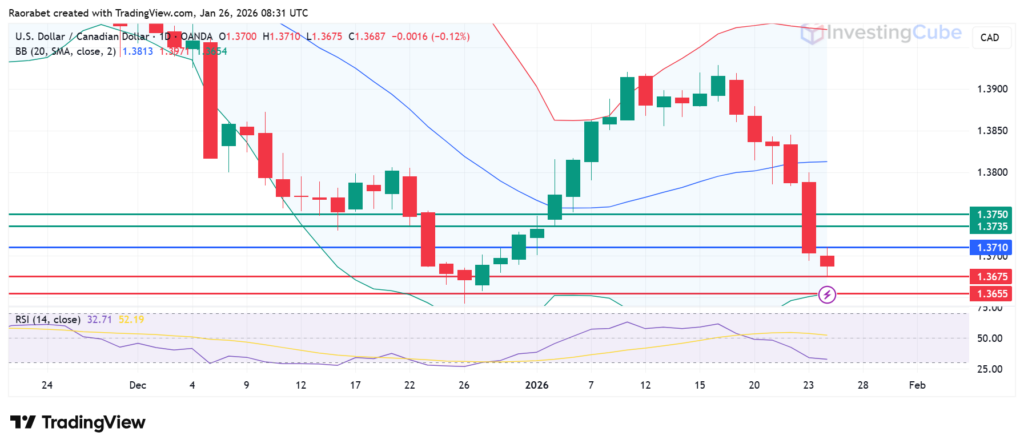
USD/CAD forex pair on the daily chart on January 26, 2026 with key support and resistance levels. Created on TradingView
The drop was mainly due to rising oil prices, which hit a three-month high, and a weaker U.S. dollar as markets anticipated potential Fed rate cuts and reacted to political uncertainty.
Canada exports a lot of oil, so the Canadian dollar is very sensitive to oil prices. When WTI prices go up, the loonie usually gets stronger, causing the USD/CAD rate to fall.
A reversal is possible, with bounces from support and bullish candles suggesting potential bottoms. Medium-term forecasts suggest a continued decline if the U.S. dollar remains weak.