


- Fed and BoJ interest rate decisions in December are the currently the center of focus for USD/JPY exchange rate.
- Potential disruption could come from US-China trade war or weak US economic data which could potentially see the Fed keep rates unchanged.
- Shifts in yields and carry trade reversals also have a substantial implication.
Over the last 10 days, the USD/JPY pair has edged down from a high of 157.075 on November 24 to around 155.22 by December 1. This roughly 1.2% decrease shows the yen is getting a bit stronger, though trading is slow because of the holidays.
This drop lines up with general market caution as investors wait for key central bank announcements. Still, steady U.S. growth and big interest rate differences suggest the downside may not be that big. We discuss the forex pair’s recent behavior and what traders should expect.
Recent Market Movements
From November 22 to December 2, the USD/JPY pair moved within a tighter range, briefly going under 156 on December 1 before finding stability near 155.49. This retreat wiped out gains from early November, as the yen attracted safe-haven flows due to U.S. economic data releases.
The upcoming interest rate decisions from the Federal Reserve (Fed) and the Bank of Japan (BoJ) in December will be very important and could either confirm this recent correction or set off a new reversal.
How Will the Fed and BoJ Rate Decision Impact USD/JPY?
The market is anticipating the Federal Reserve to cut rates by 25 basis points, to a range of 3.50%-3.75%, around December 10, going by CME FedWatch Tool. The decision could put pressure on the dollar, widening the U.S.-Japan yield gap in an inverse way and pushing the yen higher. Forbes analysis suggests this easing, aimed at sustaining growth, might cap USD/JPY upside if inflation cools as expected.
Conversely, the Bank of Japan’s slim-majority forecast for a hike to 0.75% on December 18-19 could bolster the yen significantly, narrowing differentials and prompting unwind of dollar-funded positions. Reuters polls indicate 53% of economists expect this move, driven by persistent 2.8% inflation and wage pressures.
Disruptive Factors at Play
Even if interest rate plans seem clear, some unexpected factors could change things. Political uncertainty, such as U.S. fiscal policies under a new administration and possible Bank of Japan interference, could weaken the yen despite rate hikes. Also, if things get heated between the U.S. and China again, investors might rush to buy yen as a safe investment, which would add downward pressure on the dollar.
Shifts in yield could also amplify carry trade reversals, leading to spikes in volatility. Also, Japan’s fiscal challenges and debt issues, which are often noted in credit ratings reports, could temporarily weigh on the yen, lessening the impact of any hawkish moves by the Bank of Japan.
Technical Analysis
The USD/JPY chart shows that the bulls are in control, with the RSI at 58. The exchange rate is above the 155.31 pivot, currently lying 20-day EMA. The pair will likely meet the first resistance at 156.20. Breaking above that letter could set off a stronger momentum that could go on to test psychological 157.00. On the downside, primary support is at 154.80, but an extended control by the sellers could break below that level and potentially test 154.16.
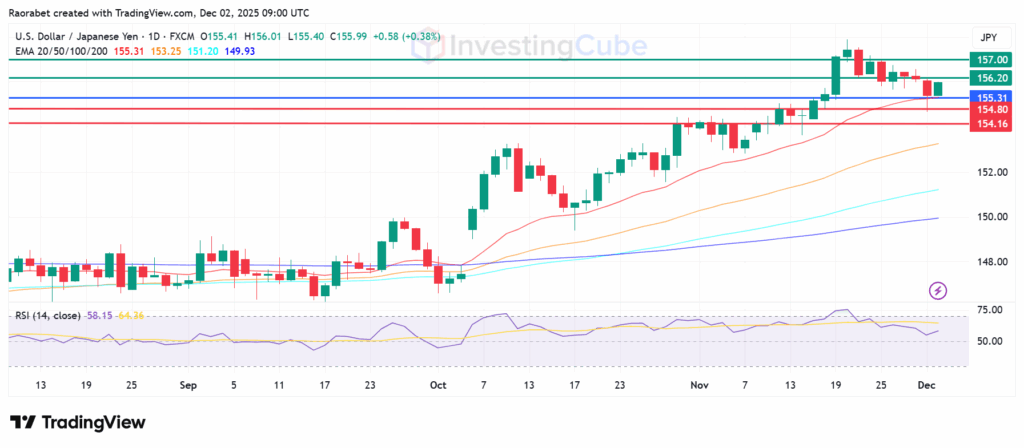
USDJPY daily chart on December 2, 2025 with key support and resistance levels. Created on TradingView
The pair is going down because people think the Federal Reserve might become less aggressive and cut rates. At the same time, the Bank of Japan is thinking about tightening its policy. This would make the difference between US and Japan interest rates smaller.
U.S. spending and tax policies, world events, and changes in carry trades could work against the yen getting stronger. Also, the threat of intervention could make things more unpredictable.
Weaker job numbers, like Non-Farm Payrolls growing more slowly, and lower inflation, as measured by the Consumer Price Index (CPI), are making it seem more likely that the Fed will become less aggressive.