

- Persistent inflation and negative real yields continue to cap the Turkish lira’s upside
- Policy divergence between Turkey and the US remains a key driver of USD/TRY strength
- While short-lived pullbacks are possible, a sustained lira recovery still looks unlikely
USD/TRY remains firmly supported near record highs as the Turkish lira continues to face sustained pressure. The pair is trading around the 43.10–43.15 region, extending the steady advance that has defined price action since late last week. Rather than showing signs of exhaustion, the move higher has been gradual and controlled, pointing to structural demand for the US dollar rather than short-term positioning.
Market sentiment toward the lira remains fragile, with investors showing limited appetite to fade the trend. In the absence of a clear policy catalyst or material shift in inflation dynamics, dollar demand continues to dominate USD/TRY flows.
Persistent Inflation Keeps Pressure on the Lira
Turkey’s inflation dynamics remain a central weakness for the lira. Consumer price growth is estimated to have averaged above 30% in 2025, with official projections pointing to a gradual slowdown toward the mid-teens later in 2026, according to the Central Bank of the Republic of Turkey.
Despite this expected moderation, real interest rates remain deeply negative. Recent rate cuts, including a reduction late in 2025, have widened the policy gap with the United States, where rates are expected to remain restrictive for longer. This divergence has continued to weigh on capital inflows and undermined confidence in the lira.
Currency strategists at MUFG Research have highlighted Turkey’s inflation outlook and external financing needs as key vulnerabilities, projecting USD/TRY to approach 45 by the end of 2026 if current conditions persist.
Fed Policy and Global Risk Sentiment Favour the Dollar
On the US side, the dollar remains supported by resilient economic data and a cautious policy stance from the Federal Reserve. Markets are increasingly skeptical that the Fed will deliver aggressive rate cuts in early 2026, reinforcing the dollar’s yield advantage against high-inflation currencies.
According to Goldman Sachs, the lira’s structural challenges leave it exposed even in a stable global risk environment. The bank expects USD/TRY to continue grinding higher through 2026, citing ongoing policy easing risks and limited foreign investor participation.
Broader geopolitical uncertainty and Turkey’s external financing profile also remain deterrents for long-term capital, as reflected in pricing trends tracked by Bloomberg.
Is a Lira Recovery Still Possible?
Consensus forecasts remain cautious. CoinCodex projects further near-term USD/TRY gains, implying continued depreciation pressure on the lira.
That said, upside risks for the lira cannot be ruled out entirely. A sharp shift in global monetary conditions, or large-scale foreign direct investment tied to energy or infrastructure agreements, could trigger temporary pullbacks in USD/TRY. Any such move, however, would likely require policy discipline and sustained capital inflows to alter the longer-term trend.
USD/TRY Technical Outlook
From a technical perspective, the broader trend remains firmly bullish. On the daily chart, momentum indicators continue to support upside bias. The Average Directional Index (ADX) remains elevated, signaling a strong and established trend.
The 43.00 level acts as a key psychological pivot. As long as price holds above this area, the upside structure remains intact. Immediate resistance is seen near 43.16–43.20. A sustained break above this zone could open the door to further gains.
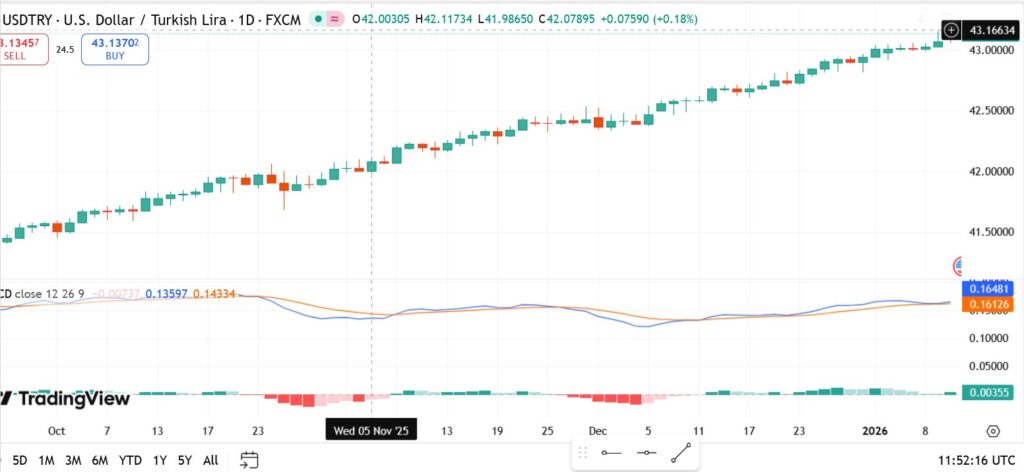
On the downside, initial support lies around 42.94. A decisive move below this level would weaken the bullish bias and shift focus toward the 42.85 region.
Outlook: Trend Intact, Risks Skewed Higher
Overall, USD/TRY continues to reflect a clear imbalance between inflation, policy credibility, and capital flows. While volatility-driven pullbacks are possible, the fundamental and technical backdrop still favours a stronger dollar against the lira through 2026.
Unless there is a material shift in policy direction or a significant improvement in investor confidence, the lira’s downside risks are likely to remain dominant.
Writer’s Trade Idea: My preferred strategy is to buy USD/TRY on pullbacks toward 43.00, targeting a move toward 43.60, while placing a stop-loss below 42.70.
USD/TRY remains elevated due to persistent Turkish lira weakness, high inflation pressures, and sustained demand for the US dollar as a store of value.
Yes. The daily chart shows a clear bullish structure, with higher highs and higher lows supporting the ongoing uptrend.
Key support lies around 42.90–43.00, while upside targets include 43.50 and the psychological 44.00 level if momentum continues.