



- The New York Fed, acting on behalf of the US Treasury, reportedly made enquiries about USD/JPY positions among banks
- Interest rate differentials key to defining the pair's trajectory
- Interventions by BoJ and Japanese government officials could disrupt USD/JPY momentum periodically
After a steady climb through most of January, the USD/JPY pair has suddenly hit a brick wall. The dollar, powered by a strong US economy and a wide interest rate difference, looked unstoppable for weeks. the pair fell sharply from close to 159.00 to the 154.50 area in the last two trading session. We discuss what this implies and whether it could potentially set the stage for a dynamic year ahead.
Why USD/JPY Dropped Recently
The fall seems to come from growing rumours of coordinated currency support from Japan and the US. Reuters reports that the New York Fed checked rates on USD/JPY. This made the market nervous and caused a quick unwinding of positions. The Federal Reserve Bank of New York, acting for the US Treasury, reportedly began asking big banks about their USD/JPY positions.
In currency trading, this is known as a rate check. It is often the last warning before market support. The suggestion of coordinated support made this move so strong. Meanwhile, Japanese officials, including Prime Minister Takaichi, have given stronger warnings against speculative yen weakness.
Japan has often acted alone to support the yen, but the US Fed’s involvement suggests a joint effort to stop the dollar from becoming too strong. This would hurt US trade competition and global financial health.
It’s worth noting that these actions come as Japan faces budget issues, with snap elections and stimulus plans that initially weakened the yen but now face countermeasures.
Is This the Beginning of an Extended Yen Rebound?
While the drop has helped the yen in the short term, opinions differ on how long it will last. If the Bank of Japan tightens policy faster because of budget worries, the yen might start a bigger recovery. But, until domestic policy confidence improves, the yen is more likely to weaken in the short term. This suggests the current rise may be a correction rather than the start of a long-term uptrend.
While the yen has regained ground, there will still be ups and downs. Most experts, including those from Bank of America Securities, think the dollar’s basic uptrend may eventually continue unless the interest rate difference gets smaller. For now, however, the support shadow is keeping the pair in check. Political events, like Japan’s elections, may add to yen pressures, while US strength supports the dollar.

ING Think predicts small yen gains by mid-year. ABN AMRO expects the yen to recover as differences narrow, but Bloomberg notes some see the yen weakening if the Bank of Japan stays careful. These things together suggest the yen may get stronger this year, but be limited by support and a strong US economy.
USD/JPY Forecast
USD/JPY shows downward pressure after reaching nearly 159. The MACD is in the negative and diverging to confirm control by the sellers. The pivot is at the lower Bollinger Band at 154.32, and the sellers will stay in control as long as resistance stays at that level.
Immediate support is at 153.00, a level that matches lows from late 2025. If this fails, the 152.00 level is the next major target. Resistance is now at 155.40, followed by a strong selling area at the middle Bollinger Band at 157.16.
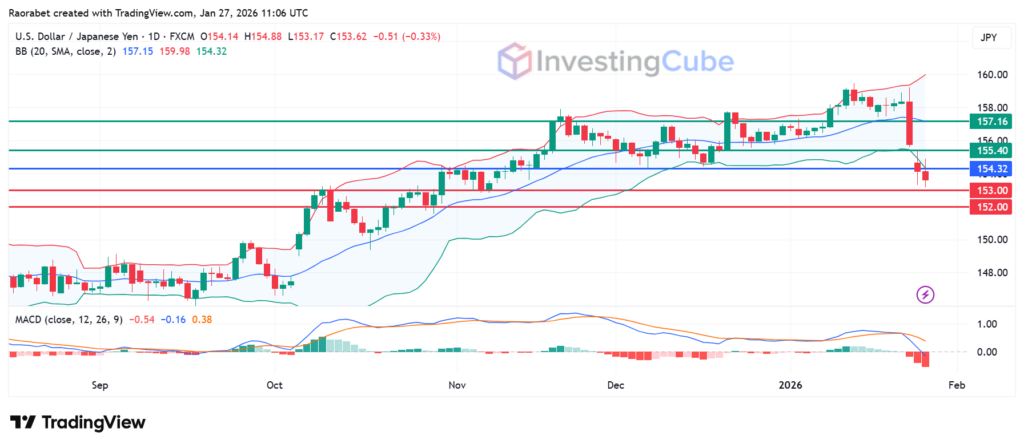
USD/JPY on the daily time frame on January 27, 2026 with key support and resistance levels. Created on TradingView
The drop was triggered by suspected coordinated intervention. Reports that the NY Fed conducted rate checks on behalf of the US Treasury signaled that both Japan and the US are ready to sell dollars to support the yen.
Current market opinion points to a rate increase in mid-2026. The BoJ is concerned that a weak yen is causing lasting inflation through higher import and labor costs.
Possibly, if the Bank of Japan tightens policy faster and yield gaps narrow. But, without big changes, support effects may fade, limiting lasting strength.