



- The Federal Reserve cut interest rates in December, but its hawkish tone leaves the dollar in a stronger position
- The US economy also showed a stronger-than-expected growth in the quarter ending September, raising prospects of higher interest rates
- Foreign Institutional Investors have been taking out money from Indian equities, adding pressure on the rupee
The US dollar has gained ground against the Indian rupee in recent days, after a downtrend in the first three weeks of December. The USD/INR pair rose from around 89.47 to roughly 89.99 at the time of writing on December 29, 2025. This rebound is primarily attributed to changes in monetary policy and capital flows. The rupee had gained some strength earlier in the month, but constant pressures have helped the dollar, pushing the exchange rate up.
Why the Dollar is Rebounding Against the Rupee
The dollar’s strength is mainly due to the strong US economy and the Federal Reserve’s tough stance. Because interest rates are still high to fight inflation, money has moved into US assets, which has strengthened the dollar. According to Reuters, the rupee dropped to a record low above 90 earlier in December because of strong dollar demand and portfolio outflows of over $18 billion.
The Reserve Bank of India’s decision to cut rates and inject liquidity in its December 2025 meeting has weakened the rupee further. MUFG Research notes that this accommodative policy, aimed at supporting growth amid slowing exports, is likely to see USD/INR rise modestly above 90.
Furthermore, Foreign Portfolio Investors (FPIs) have been offloading Indian equities at a rapid clip. Data from Indian exchanges shows that Foreign Portfolio Investors (FPIs) have been selling off Indian stocks fast. Numbers from Indian exchanges show that billions of rupees have left the market in December alone. Investors are looking for safer places to put their money. Because of trade issues and caution, money has been leaving India, weakening the rupee.
USDINR Outlook in 2026
Looking ahead to 2026, most analysts expect the rupee to remain under pressure, though the descent may be more of a “managed crawl” than a freefall. CareEdge Ratings and Bank of Baroda suggest a trading range of ₹90.00 to ₹92.00 for much of 2026. Traders Union anticipates 90.94 by year-end, while CoinCodex sees it at 98.19, citing US economic resilience. However, a softer Fed or stronger Indian reforms could alter this trajectory.

The Reserve Bank of India (RBI) will be key to watch. While they probably won’t stop the rupee from falling if global trends require it, they will step in to make sure the volatility doesn’t hurt Indian businesses.
USDINR Forecast
The USD/INR pair has its pivot at the 10-day EMA at 89.79. The RSI at 54.7 suggests that the buyers are currently in control. The first resistance level is psychological at 90.00, but a stronger hold by the buyers could clear that barrier and target 90.20. If the price stays above 90.00, it could attract more buying. On the downside, 89.57, beloe which the upside narrative will be invalid. Such an action could send the USD/INR pair lower to test a stronger support at the 50-day EMA at 89.33.
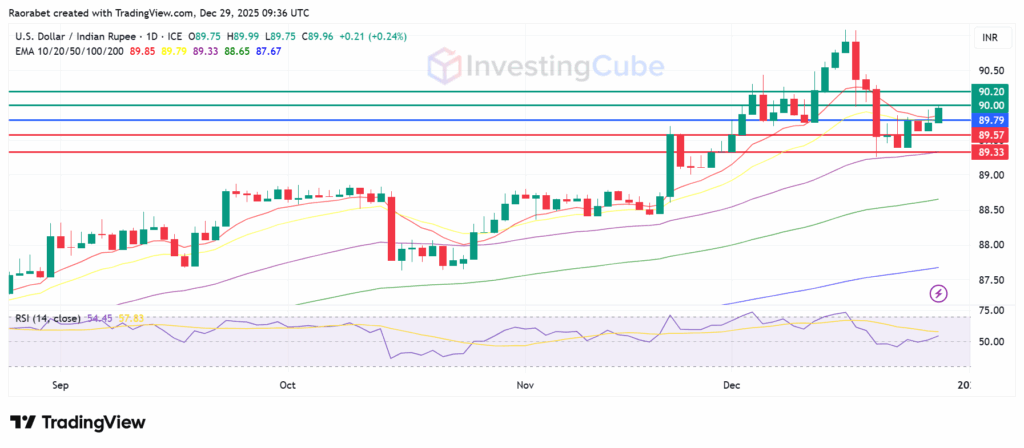
USD/INR daily chart with key support and resistance levels. Created on TradingView on December 9,2025
Although the Fed lowered rates in late 2025, they seem to think U.S. returns will stay fairly high compared to other developed countries. This idea that rates will stay higher-for-longer stops the dollar from getting too weak, which puts stress on currencies from developing countries like the rupee.
India’s strong GDP growth, estimated at 6.6%–8.2% and a possible rise in Foreign Direct Investment (FDI) in 2026 could inject fresh propulsion in the market.
The Fed’s tough stance, keeping interest rates high, has drawn investment to U.S. asset, making the dollar stronger. This is different from what the RBI is doing since they are cutting rates, which makes the gap between policies wider and puts strain on the rupee.