

- USD/IDR trades near multi-month highs as the rupiah remains under pressure
- Bank Indonesia confirms continued intervention to defend the currency
- Fiscal concerns and broad US Dollar resilience keep downside risks elevated
USD/IDR remains elevated during Asian trading hours, holding near the 16,850–16,900 zone as the Indonesian rupiah struggles to regain stability. While the pair has pulled back modestly from recent peaks, overall price action continues to reflect persistent pressure on the rupiah amid external headwinds and domestic fiscal concerns.
The latest move follows confirmation from Bank Indonesia (BI) that it will continue intervening across onshore and offshore FX markets to ensure the rupiah trades in line with fundamentals. Despite these efforts, USD/IDR remains close to levels last seen during periods of heightened market stress, underscoring the fragile sentiment surrounding the currency.
Indonesian Rupiah Under Pressure as Bank Indonesia Intensifies FX Intervention
According to Reuters, Bank Indonesia has been actively intervening in spot, bond, and non-deliverable forward markets in Asia, Europe, and the United States. Officials said recent rupiah weakness largely mirrors regional pressure driven by geopolitical tensions and broader concerns over central bank independence in developed economies.
However, domestic factors are also weighing on sentiment. Analysts have pointed to Indonesia’s 2025 budget deficit of 2.92% of GDP, one of the widest in over two decades and close to the statutory ceiling. Concerns that President Prabowo Subianto’s fiscal agenda could keep deficits elevated into 2026 have added to investor caution.
While Finance Ministry officials maintain that strong economic fundamentals and incoming capital flows should stabilise the rupiah, markets remain wary, particularly as global risk appetite stays selective.
US Dollar Strength Caps Rupiah Recovery
The broader US Dollar backdrop has also played a role. Recent analysis from Reuters suggests that expectations of a sustained dollar reversal have faded, with US growth resilience and stable interest-rate assumptions supporting the Greenback.
This environment has made it difficult for emerging market currencies like the rupiah to stage meaningful recoveries, even as local authorities step in to smooth volatility. As long as the US Dollar remains firm, USD/IDR is likely to stay supported on dips.
USD/IDR Technical Outlook
From a technical perspective, the daily chart maintains a constructive bias for USD/IDR:
- Price continues to trade above the 20-day and 50-day moving averages
- Bollinger Bands show upward expansion, signalling sustained volatility
- MACD remains in positive territory, with momentum holding above the signal line
Key levels to watch:
- Support: 16,700, followed by 16,550
- Resistance: 16,900, then the psychological 17,000 level
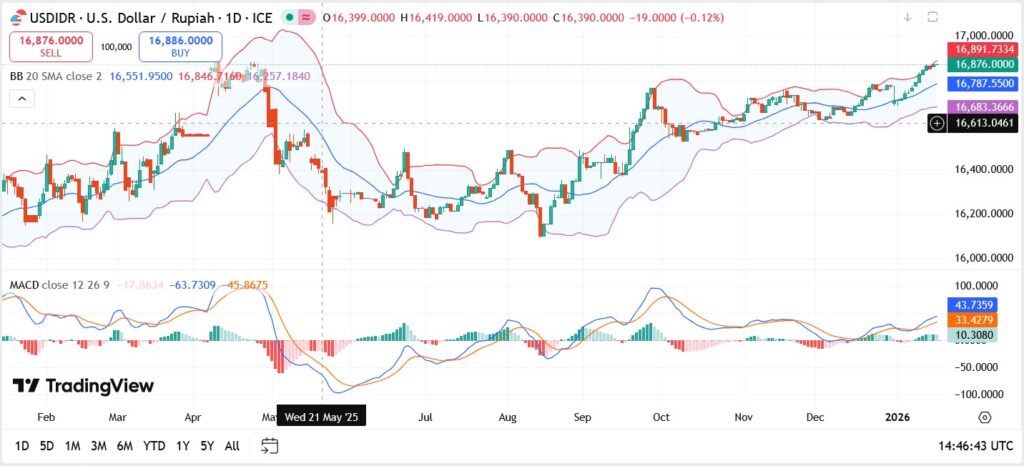
A sustained break above 16,900 would likely expose the 17,000 handle, while a deeper pullback below 16,700 would be needed to ease near-term upside pressure.
USD/IDR Outlook
In the near term, USD/IDR is likely to remain elevated as long as Bank Indonesia’s intervention limits volatility rather than reverses the trend. Fiscal uncertainty, firm US Dollar conditions, and cautious global sentiment continue to tilt risks toward further consolidation at high levels.
Unless global risk appetite improves meaningfully or domestic confidence strengthens, any rupiah recovery may remain gradual and fragile.
Writer’s Trade Idea: My preferred strategy remains buying dips toward 16,700, targeting a move toward 16,950, while placing a stop-loss below 16,550.
USD/IDR remains elevated due to rupiah weakness driven by fiscal concerns, global risk pressures, and a resilient US Dollar.
Yes. Bank Indonesia has confirmed ongoing intervention across spot, bond, and NDF markets to stabilise the rupiah.
Support lies near 16,700 and 16,550, while resistance is seen at 16,900 and the psychological 17,000 level.