

- The US dollar lost more than 9% of its value against the Canadian dollar in 2025-its largest in eight years
- Both the Fed and the Bank of Canada have recently indicated adoption of a pause to their interest rate regimes
- CAD is a commodity-based currency and declining oil prices will add downward pressure to it
USD/CAD has been on a bit of a hot streak lately. After dropping from around 1.40 in late November 2025 to about 1.367 by Christmas, it’s bounced back a bit with four straight up days into early January 2026, trading at 1.3771 right now. While this rise is good news for dollar fans, whether it lasts is still up in the air.
Making Sense of the Loonie’s Drop
The US dollar fell over 9% against the Canadian dollar in 2025, the biggest drop in eight years. But it stabilized in late December, and as markets reopened in 2026, it edged up a bit. This was partly because global sentiment was weak and oil prices weren’t helping the Canadian dollar as much. Oil is important for Canada, and prices have gone down, which hurts the loonie and helps USD/CAD go up.
Will USD/CAD Stay Up in Q1 2025?
If forecasts are correct, USD/CAD probably won’t keep going up through the first quarter of 2026. Analysts at RBC Capital Markets and National Bank estimate that USD/CAD will drop to 1.35 or even 1.32 by the end of the year. They say the US dollar is generally weak because the Federal Reserve is easing up.
How the central banks act will really shape where the USD/CAD pair goes. Both are likely to wait and see. The difference in yields between Canada and the US might get smaller as the Fed cuts rates, which usually helps the Canadian dollar.
Also, oil, which is key for the CAD, isn’t looking too strong as we enter 2026. The US Energy Information Administration (EIA) thinks there will be too much oil around, potentially pushing Brent and WTI prices down to the mid-to-low $50s. If oil prices collapse under the weight of oversupply, the CAD will likely lose its footing, potentially fueling a more sustained USD/CAD rally.
Also, US-Canada trade relations are a concern. RSM Canada highlights ongoing US-Canada frictions could dampen growth if extended for a long time. ING Think suggests H2 2026 could favor CAD if tensions ease and sentiment improves. While Canada has largely been shielded by CUSMA exemptions so far, any new trade frictions or “trade-reconfiguration” costs could stoke Canadian inflation, potentially forcing the BoC to consider rate hikes sooner than the market currently expects.
In short, the rebound feels like a breather amid broader downtrends. If you’re trading, watch upcoming US data for clues. Medium-term, bets lean bearish on USD/CAD, but surprises like oil spikes could flip it
USD/CAD Forecast
USD/CAD looks uncertain after breaking its long-term uptrend in late 2025. The 14-day Relative Strength Index (RSI) is around 43, which suggests the trend is currently negative, but a bullish divergence is forming as the RSI makes higher lows while prices make lower lows. The pair is near 1.3769, and the immediate resistance is at the 20-day EMA at 1.3776. If it breaks above that, it could test the next barrier at 1.3805. Primary support is at 1.3688, below which the upside narrative will be invalid. Also, such a move could clear the path to retest recent lows near 1.3640.
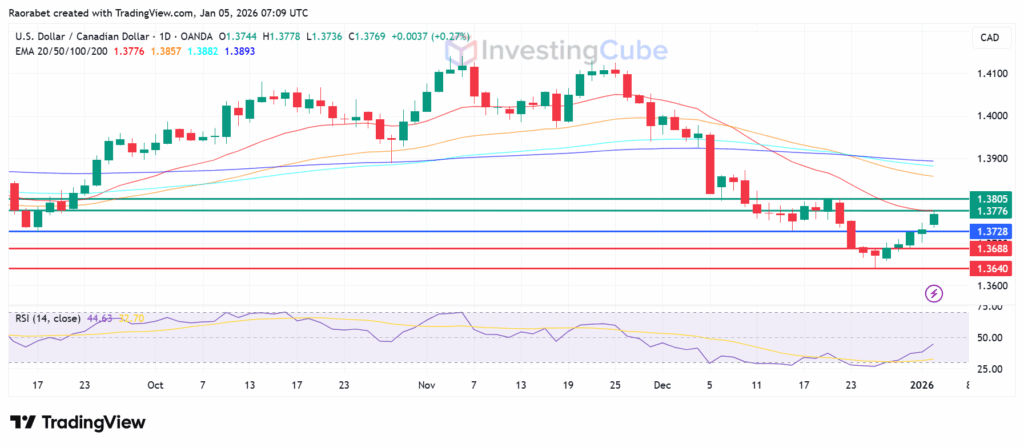
USD/CAD daily chart with key support and resistance levels on January 5, 2026. Created on TradingView
The jump back is mostly because it was technically oversold. The Federal Reserve is also being a bit more careful (hawkish), while the Bank of Canada is staying put. This has also shifted the sentiment a bit.
Energy experts think there will be an oversupply of oil worldwide in 2026, which could push prices down to around $50 a barrel. Since the CAD’s value is tied to commodities, cheaper oil usually makes it weaker, pushing the USD/CAD higher.
It’s uncertain. The USD is strong right now, and smaller interest rate differences and Canada’s strong job market mean the CAD could still hold its own. This might mean the USD/CAD stays about the same for most of 2026.