


- The Australian dollar has been on the uptrend against the US dollar since late November 2025
- The AUD/USD pair has recently risen to its highest level since October 2024
- A rebound in Chinese manufacturing growth gels well for AUD amid a hawkish monetary policy by the Reserve Bank of Australia
The Australian dollar has been doing remarkably well against the US dollar Since late November 2025. The AUD/USD pair went from about 0.6421 to around 0.6767 on January 7, 2026. That’s an increase of about 5.3%, propelling it to the highest level it’s been since October 2024.
Why AUD Has Strengthened Against USD
A key behind AUD/USD’s weak standing is the divergence in monetary policies between the Reserve Bank of Australia (RBA) and the Federal Reserve. The RBA has maintained a hawkish stance, with no immediate rate cuts on the horizon and even discussions of potential hikes.
Even though inflation in Australia slowed to 3.4% in November, it’s still higher than the RBA’s target of 2–3%. This has caused the RBA to keep a tight policy. Analysts at National Australia Bank (NAB) and Commonwealth Bank (CBA) estimate there might even be a rate increase in February or May 2026, which could make the AUD more appealing to investors wanting better returns.
Also, the AUD has been helped by a better sentiment in global markets, since Australia is tied to commodity markets and China. In late 2025, Chinese manufacturing picked up unexpectedly. Because China buys a lot of exports from Australia, like iron ore and copper, a stable Chinese economy is a good sign for Australia.
AUD/USD 2026 Outlook
The AUD/USD might keep going up in 2026 if the divergent policies stay in place. Goldman Sachs recently said that metals used in industry are gaining from the AI race because copper and rare earths are needed for data centers. Australia sells these commodities, so its currency is becoming a way to bet on global tech infrastructure.
While the trend looks bullish for AUD, it is not without hurdles. The primary risk remains a sudden “risk-off” sentiment in global markets, often triggered by geopolitical tensions. If conflicts in the Middle East or Eastern Europe escalate, investors typically flock back to the “safe-haven” US dollar, regardless of interest rate differentials.
Furthermore, if the RBA does pivot to rate cuts sooner than expected due to a sharper-than-forecast drop in Australian consumer spending, the AUD’s recent gains could evaporate just as quickly as they appeared
USD/AUD Prediction Today
Technically, the AUD/USD pair is in a confirmed medium-term uptrend. The Relative Strength Index (RSI) is currently pushing toward 68, signaling strong bullish momentum but approaching the “overbought” threshold of 70, which may precede a minor consolidation.
The next barrier level to watch is 0.6770, then 0.6800. If the price closes above 0.6811 in a week, it could go up to 0.6950. There’s primary support at the Volume Weighted Moving Average (VWMA) near 0.6673, below which the upside narrative will be invalid. Also, an extended control by the sellers could end the action lower and test 0.6645.
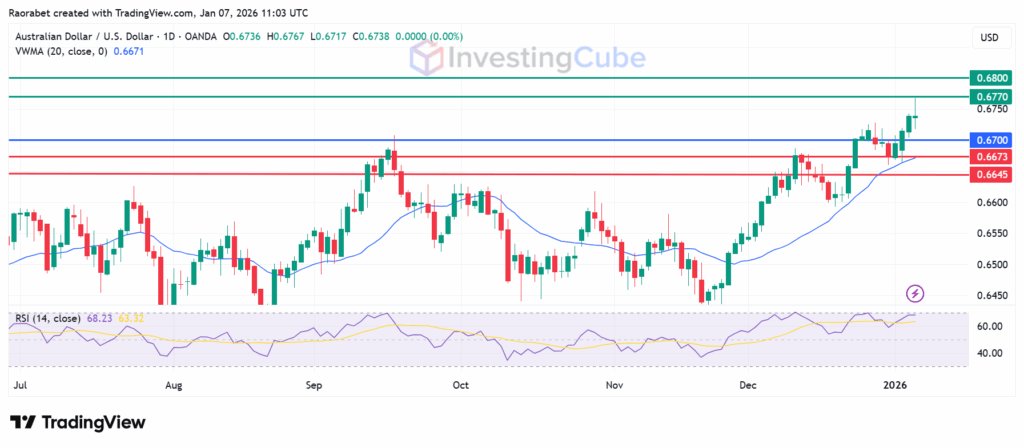
AUD/USD daily chart on January 7, 2026 with key support and resistance levels created on TradingView
The main reason is policy divergence. The US Federal Reserve has been cutting interest rates and could continue to do so due to cooling inflation. On the other hand, the RBA remains hawkish, potentially raising rates to combat persistent domestic price pressures.
As Australia’s top trading partner, China’s manufacturing recovery boosts demand for Australian commodities. When Chinese factory activity expands, the Australian dollar usually rises because it increases Australia’s trade surplus.
Yes. They include stronger US data, RBA rate cuts if inflation eases, or shifts in global sentiment, potentially reversing some of the recent gains.