


- The Federal Reserve's FOMC members voted 10-2 to keep interest rates between 3.50%-3.75%, striking a hawkish tone
- US military buildup in the Middle East has raised the prospect of a conflict that could boost the yen's safe haven appeal
- USD/JPY also faces an underlying pressure from renewed trade tariff war fears
The USD/JPY pair is at an interesting point, influenced by central bank decisions, geopolitical issues, and trade concerns. After the Federal Reserve kept interest rates at 3.50%–3.75% on January 28, 2026, and the Bank of Japan also paused at 0.75% last week, the impact of the difference in interest rates between the two countries is shrinking. We look at the likely trajectory of USD/JPY following the Fed’s announcement, while considering the US military buildup in the Gulf and renewed trade tariff fears.
The Fed’s Steady Hand and USD/JPY Outlook
For several months, the USD/JPY pair has been trading around the 158–160 level, but things changed last Friday. There were rumors that the New York Fed was checking rates on behalf of Japanese authorities, which made the markets nervous. These checks often happen before actual intervention.
The Fed’s recent meeting had a 10-2 vote, with some members wanting a rate cut, showing disagreements that could worry investors. Fed Chair Powell said that current rates are suitable, but the markets saw this as less aggressive than expected, causing a slight drop in the dollar’s value. This suggests that USD/JPY will likely continue to be unstable.
Geopolitics and US Military Buildup in the Gulf
The U.S. military buildup in the Gulf, including sending a carrier strike group to discourage Iranian actions, has added a risk premium to the USD/JPY setup. Usually, when there are tensions in the Middle East, the Japanese yen becomes the go-to safe haven currency.
This dynamic likely exerts mild downward pressure on USD/JPY. Even though Japan imports a lot of oil, investors tend to move their money back to Tokyo during conflicts. If the military presence in the Gulf leads to a direct fight, we could see a shift to safer investments that could push USD/JPY lower.

Trade Tariff Fears Undermine Dollar Strength
Adding to the mix, President Trump’s recent talk about tariffs is bringing back fears of trade wars. If the U.S. imposes tariffs on partners, the resulting global instability usually helps the yen. Renewed trade tensions suggest that USD/JPY might decline in the near term, with a chance of recovery if things calm down.
USD/JPY Prediction
USD/JPY is showing bearish momentum, trading below key SMAs like the 10-day at 155.97 and 50-day at 156.37. The RSI at 34.96 is near oversold conditions but strengthening bears. Immediate support is currently sitting at 152.10, with the second one at 150.70, aligning with year-to-date lows. An extended bearish control could open the path to the psychological floor at 150.00. Looking at recovery, if the pair manages to go above the 153.71 pivot (100-day SMA), it will likely face strong resistance at 154.34, followed by the 50-day SMA at 156.37.
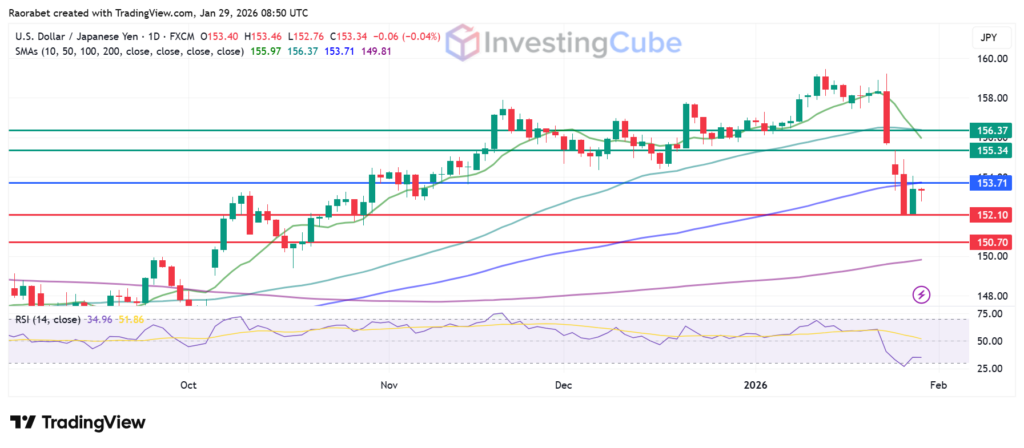
USD/JPY FX pair on the daily chart on January 29,2026 with key support and resistance levels. Created on TradingView
The Fed’s decision to keep rates the same, along with a more relaxed view on inflation, has slowed the dollar’s rise. Traders are now paying attention to the shrinking gap between U.S. and Japanese interest rates.
The reemergence of trade war fears creates global economic uncertainty. Markets often see aggressive tariff policies as causing inflation and destabilizing the U.S. economy, leading investors to move away from the dollar toward the yen.
It strengthens the yen’s safe-haven status amid Iran tensions, exerting mild bearish influence on USD/JPY. A spike in oil prices could further support the yen via Japan’s imports.