


- Dovish Reserve Bank of New Zealand and hawkish Federal Reserve policies have merged to deny NZD its yield attraction
- The RBNZ slashed in Official Cash Rate (OCR) by a massive 2.25% to stimulate the economy, but it is yet to bear much fruit
- Economic slowdown in New Zealand has dampened investor confidence
After a brief rebound earlier in the new year, the New Zealand dollar is again falling against the US dollar, staying within a downward channel since late December 2025. The NZD/USD pair, often called the Kiwi, hasn’t been able to break out and is around 0.5767 as of January 8, 2026.
Making Sense of the Kiwi’s Decline
Since December 24, 2025, the NZD/USD has dropped about 1.45% after testing its 200-day moving average. The Reserve Bank of New Zealand’s (RBNZ) easy money policies, like earlier rate cuts, have hurt the currency.
The RBNZ acted strongly in late 2025, cutting the Official Cash Rate (OCR) to 2.25% in November 2025 to help a slow economy. Economies.com points out that the short-term trend is down, with continued negative pressure.
What the NZD Needs for Recovery
For the NZD/USD forex pair to return to winning ways, it needs more than just a weak US dollar. It needs proof that the worst of the economic slowdown is over. Better domestic economic numbers, like stronger GDP and retail sales, would show a good rebound. Kiwibank’s Thrive HQ expects an economic recovery in 2026, which could help the NZD. The currency needs dairy prices to stabilize and the RBNZ to signal an end to rate cuts.
As a commodity-linked currency, the Kiwi thrives when global investors are optimistic. Currently, US/Venezuela geopolitical tensions and uncertainty surrounding China’s industrial output are keeping the NZD on the defensive.
Looking ahead into 2026, it will likely be a year of uneven recovery. Official government forecasts say New Zealand’s GDP might grow to 1.8% this year, but there are still underlying issues. The pair’s direction will likely depend on which between the Fed and the RBNZ will be more dovish; if the Fed cuts rates faster while the RBNZ stays steady at 2.25%, we might see a rise to 0.6000.
Also, global growth, commodity prices linked to New Zealand’s exports, and the broader risk sentiment could keep the downtrend going or cause a breakout. The upcoming general election in October 2026 might limit any big gains because of local political uncertainty.
NZD/USD Forecast
The daily chart shows the NZD/USD losing strength, with the Relative Strength Index near 45. This suggests a negative outlook and not much buying interest. The downtrend will likely persist if resistance stays at 0.5780. Primary support is around the 50-day SMA at 0.5729, and could go down to test 0.5700 if the selling momentum extends. Resistance is between 0.5800 and 0.5815, and breaking above that could lead to 0.5850, around three-month peak.
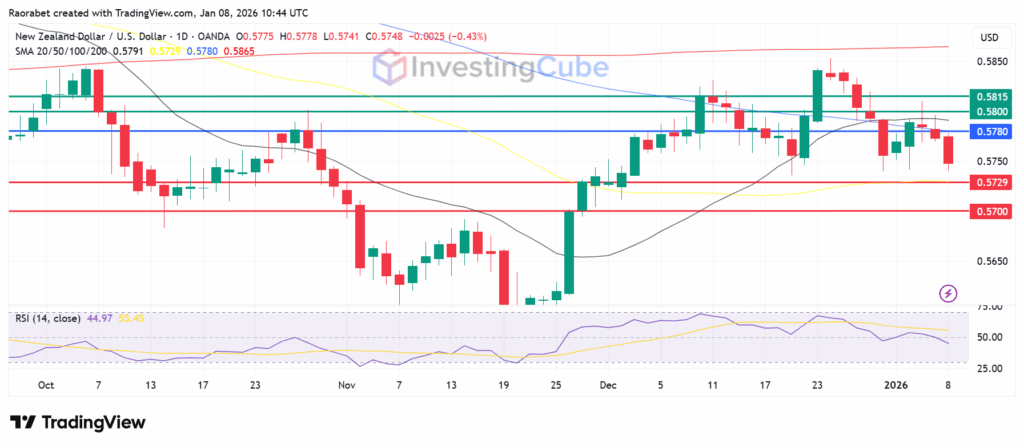
NZD/USD daily chart on January 8, 2026 with key support and resistance levels created on TradingView
The RBNZ’s sharp interest rate cuts, bringing the OCR down to 2.25%, caused the pair to drop. This created a wider interest rate difference with the U.S., making the New Zealand dollar less appealing to investors looking for returns.
Better economic figures from New Zealand, such as GDP, a less lenient RBNZ, a weaker USD because of Fed cuts, and better global investor confidence could all assist.
The main things to watch are how fast the Federal Reserve cuts interest rates compared to the RBNZ’s actions, China’s need for dairy exports, and what the political scene looks like before New Zealand’s general election in October 2026.