


- JPY/VND is trading near multi-month lows as the Japanese yen remains under pressure
- Thin liquidity in the pair is amplifying price moves and downside volatility
- Broader risk stabilisation has reduced safe-haven demand for the yen
- Technical indicators continue to point to a bearish bias while below key resistance
JPY/VND remains under pressure during Asian trading hours, trading around the 166.30–166.40 region as the Japanese yen continues to weaken against the Vietnamese dong. The pair is hovering just above its 52-week low, with downside momentum supported by light trading volumes and a lack of strong demand for the yen.
Recent price action suggests that subdued market participation is playing a key role. With volumes well below historical averages, even modest selling pressure has been sufficient to push JPY/VND lower, leaving the pair vulnerable to further declines in the absence of a meaningful catalyst.
Japanese Yen Weakens as Safe-Haven Demand Eases
The Japanese yen has struggled to attract inflows as global market conditions remain relatively stable. Reduced risk aversion has limited the yen’s appeal as a defensive currency, allowing higher-yielding and more stable regional currencies to outperform.
At the same time, expectations around gradual policy normalization in Japan have failed to provide near-term support, particularly as domestic data continues to show mixed signals. This combination has kept the yen on the back foot, especially in less liquid crosses such as JPY/VND.
Low Trading Volume Amplifies JPY/VND Price Volatility
One notable feature of recent JPY/VND trading has been exceptionally low volume. Thin liquidity conditions tend to exaggerate directional moves, increasing the risk of sharp swings even in the absence of major news. This dynamic helps explain the steady drift lower toward long-term support despite a relatively calm broader FX environment.
As long as participation remains limited, price action is likely to remain choppy and biased toward the prevailing trend.
JPY/VND Technical Outlook
From a technical perspective, the daily chart maintains a bearish structure. JPY/VND continues to post lower highs and lower lows, with price now trading below former support levels that have turned into resistance.
Immediate support is located near 166.20–166.00, an area aligned with the recent 52-week low. A decisive break below this zone would expose further downside toward 165.50, followed by the 164.80 region.
On the upside, initial resistance is seen around 167.10–167.50. A sustained move above this zone would be needed to ease immediate downside pressure and signal a potential stabilization phase. For now, momentum indicators such as the MACD remain in negative territory, reinforcing the bearish bias.
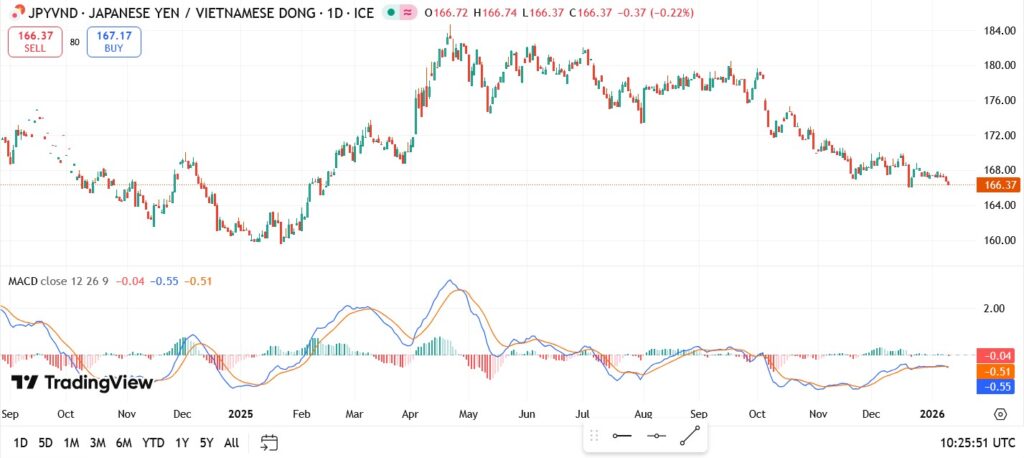
Overall, the technical picture suggests that JPY/VND remains vulnerable to further weakness unless price can reclaim key resistance levels and trading activity improves.
JPY/VND Outlook
In the near term, JPY/VND is likely to remain pressured as long as yen sentiment stays soft and liquidity conditions remain thin. While short-term pauses or minor rebounds are possible, the broader bias continues to favor the downside unless a clear shift in risk sentiment or policy expectations emerges.
Writer’s Trade Idea: My preferred strategy remains selling rallies toward 167.10, targeting a move toward 165.50, while placing a stop-loss above 167.80.
JPY/VND is under pressure due to ongoing yen weakness, reduced safe-haven demand, and exceptionally low trading volume that amplifies downside moves.
Yes. Thin liquidity can exaggerate price swings, making the pair more sensitive to small shifts in sentiment or order flow.
Key support lies near 166.00, followed by 165.50 if selling continues. Resistance is located around 167.10 and 167.50, with a break above needed to stabilize the outlook.