

- British Prime Minister Keir Starmer said he would not yield to Donald Trump on his opposition to U.S. demands to acquire Greenland.
- Trump’s tariff threats have added fresh political risk to the British pound.
- Markets remain focused on the risk of a broader US–Europe trade escalation, with traders favouring the US dollar as risk sentiment stays fragile.
GBP/USD steadied near 0.7430 on Wednesday, January 21, 2026, shortly after President Donald Trump’s address at the World Economic Forum in Davos, where he renewed tariff threats toward European countries over Greenland. The comments quickly spilled into FX markets, injecting fresh political risk into sterling sentiment and capping any near-term recovery in the pound.
The pair was already consolidating above its short-term support zone when follow-up headlines emerged from London. UK Prime Minister Keir Starmer, speaking to the media at 10 Downing Street, said Britain would not yield to U.S. pressure over Greenland despite Trump’s stance. Reuters reported that Starmer rejected any attempt to force a change in Britain’s position through tariff threats, calling instead for calm dialogue and warning against escalation.
GBP/USD Holds Firm as UK–US Tensions Over Greenland Weigh on Sterling
Sterling remains vulnerable as markets reassess the risk of a broader U.S.–Europe trade confrontation. Reuters reported that Trump has threatened to ramp up tariffs unless European allies, including Britain, support U.S. demands linked to Greenland. Starmer pushed back strongly, stating that the future of Greenland should be decided by its people and Denmark, not under economic coercion.
While no immediate trade measures have been enacted, the rhetoric has unsettled FX markets, particularly for currencies sensitive to geopolitical headlines. For GBP, the concern is not direct exposure to Greenland, but spillover risk from EU-U.S. trade tensions and potential disruption to UK-U.S. relations.
Starmer acknowledged the importance of maintaining close security and defence ties with Washington but warned it would be “foolhardy” to sacrifice principles under tariff threats, according to Reuters.
US Dollar Holds Firm as Risk Sentiment Remains Fragile
On the U.S. side, the dollar continues to draw support from global risk aversion and uncertainty surrounding trade policy. Trump’s comments at Davos reinforced concerns that trade disputes could widen beyond Europe, keeping demand elevated for the greenback despite modest pullbacks.
This backdrop has limited sterling’s ability to recover meaningfully, even as UK domestic data remains relatively stable.
GBP/USD Technical Outlook
From a technical perspective, GBP remains range-bound but biased higher:
- Price action is holding above the 20-day moving average near 0.7430, keeping the short-term structure intact
- Immediate resistance is seen around 0.7480, aligned with recent Bollinger Band highs
- A sustained break above 0.7500 would expose the November highs
- Support sits near 0.7380, with a deeper floor at 0.7330
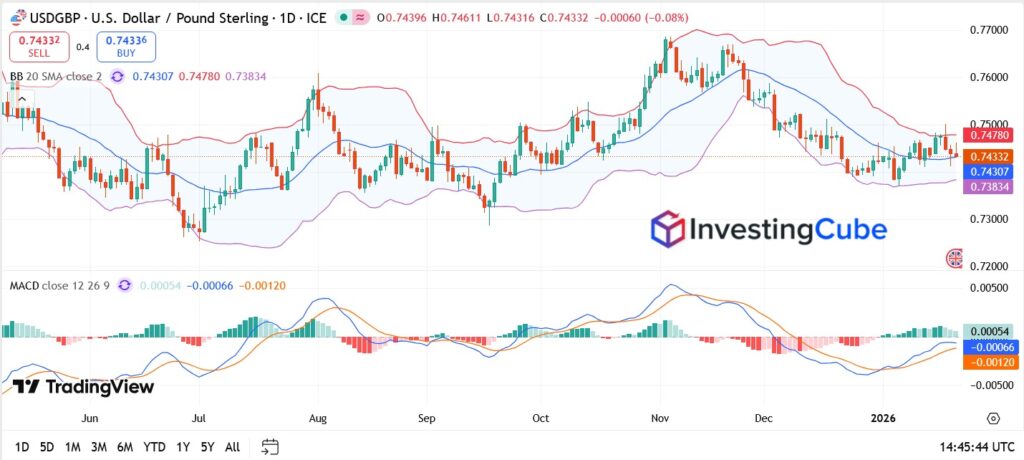
Momentum indicators remain neutral, suggesting consolidation rather than trend exhaustion.
Outlook: Politics, Not Data, Driving Near-Term GBP Moves
For now, GBP/USD is being driven more by geopolitics than macro data. As long as U.S.–Europe trade rhetoric remains elevated and political risk dominates headlines, sterling is likely to struggle for sustained upside.
Any de-escalation in Greenland-related tensions could offer temporary relief for GBP, but until then, the pair is likely to remain supported above key technical levels.
President Donald Trump wants to acquire Greenland primarily for strategic, security, and resource reasons. Greenland sits at a critical Arctic crossroads, offering military positioning advantages, access to rare earth minerals, and control over emerging Arctic shipping routes as ice melts.
The proposal has reignited debate over US influence in the Arctic and raised geopolitical tensions with Europe and Denmark, which currently governs the territory.
A full US–UK trade war is not imminent, but risks have clearly increased. Tensions escalated after Trump threatened tariffs on Britain and other European countries in response to resistance over Greenland. While UK Prime Minister Keir Starmer has called for calm dialogue, markets are pricing in headline-driven volatility as trade rhetoric intensifies.
No. The United States has no legal authority to force Europe or Denmark to sell Greenland. Any transfer of sovereignty would require approval from Denmark and Greenland’s government, as well as respect for international law and self-determination principles. Legal experts widely view the proposal as politically symbolic rather than enforceable.
Trump’s tariff threats have weighed on sterling sentiment, increasing downside risk for the British pound. Trade uncertainty typically weakens currencies tied to open economies like the UK, especially when paired with risk-off market conditions. If tariffs are implemented or tensions escalate further, GBP could remain under pressure against the US dollar.