



- GBP/USD price forecasts mostly see a ranging pair for 2026, with two-way volatility between both ends of the range.
GBP/USD price forecasts for 2026 are not set in stone due to shifting fundamentals that are causing these forecasts to be repriced. What happened to the GBP/USD on Tuesday, 11 February 2026? The pair fell 0.3% after the US Dollar gained strength across the board. Additionally, UK risk premia were repriced by market participants as political uncertainty in the UK heightened.
Ahead of key US data this week, the US Dollar held steady against its peers, allowing the GBP to get dragged down by UK-specific macro drivers.
GBP/USD Live Chart
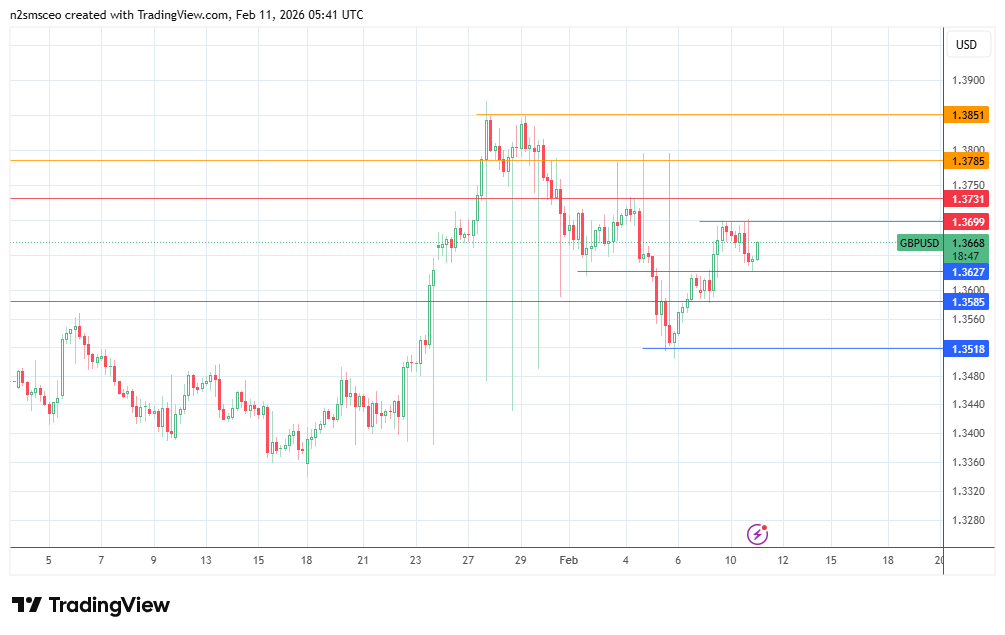
The Non-Farm Employment Change came in at 130K (consensus 66K, previous 48K), with unemployment improving from 4.4% before 4.3%. Average hourly Earnings also came in at 0.4%, higher than the consensus of 0.3% and the revised prior number of 0.1%. The upbeat employment data caused GBP/USD to lose all its earlier gains from Wednesday, 11 February, effectively establishing a price range before Friday’s US CPI data.
GBP/USD Price Forecasts: Macro Drivers Currently at Work
The current macro drivers that are pushing GBP/USD price forecasts for 2026 are:
- UK political risk premium
- The rate differential between the Fed and the BoE
- UK Growth Expectations
1. UK Political/Fiscal Risk Premium
Currently, the near-term driver. Even with a softer USD, UK political risk premia can cap any GBP upside. This was what played out on Tuesday, 10 February.
2. Risk Differential
Fed easing expectations remain intact, but Fed independence continues to pose a risk to the bank’s credibility and any further easing expectations. A new Fed pick who is a Trump supporter feeds into these fears. On the flip side, the BoE is expected to cut rates, but not at a fast-enough pace to retain a positive differential vs the Fed. This much is clear from the UBS’s policy table, which forecasts an end-2026 UK interest rate of 3.25 vs the Fed’s 3.38.

3. UK Growth
For UK growth to be a true macro driver, there has to be aggressive Fed easing and UK growth data that blows estimates out of the water. Otherwise, the best that can be expected is a choppy state.
GBP/USD Price Forecasts for 2026: Institutional Targets
Most of the available forecasts are end-2026 levels from institutional publications. UBS has a price target of 1.35 by the end of 2026, while MUFG has a 2026 GBP/USD price forecast of 1.3780.
However, many street-style blogs have a price cluster of 1.35-1.38 by the end of 2026, which forecasts a moderate downside to the range from current price levels as of mid-February 2026. This outlook is negated only if UK growth data surprises or the US Dollar’s downtrend accelerates.
Base case: The GBP/USD will range, producing two-way volatility. In other words, price is expected to oscillate between 1.35 and 1.38, creating an opportunity to fade rallies at supply zones and buy any pullbacks. This is mostly because the current expectations for the pair are not set in stone and could evolve rapidly as the year progresses.
Bull case: The bull case scenario relies on faster, more aggressive Fed easing, along with a calmer UK geopolitical environment. This allows the pair to break above the 1.38 cap and push the uptrend further.
Bear case: A radically dovish repricing is expected if the BoE leans towards aggressive rate cuts and UK political risks intensify. It would also require the Fed’s easing expectations to be repriced hawkishly, allowing the USD to hold ground amid higher real yields.
GBP/USD Technical Outlook
The hourly chart shows the pair remains within the range defined by the 1.3627 support and 1.3699 resistance. The support mark is now under pressure, and a breakdown of this level allows the bears to push towards Monday’s lows at 1.3585. Below this mark, additional support is seen at 1.3518. This 5 February low becomes visible on a more aggressive decline.
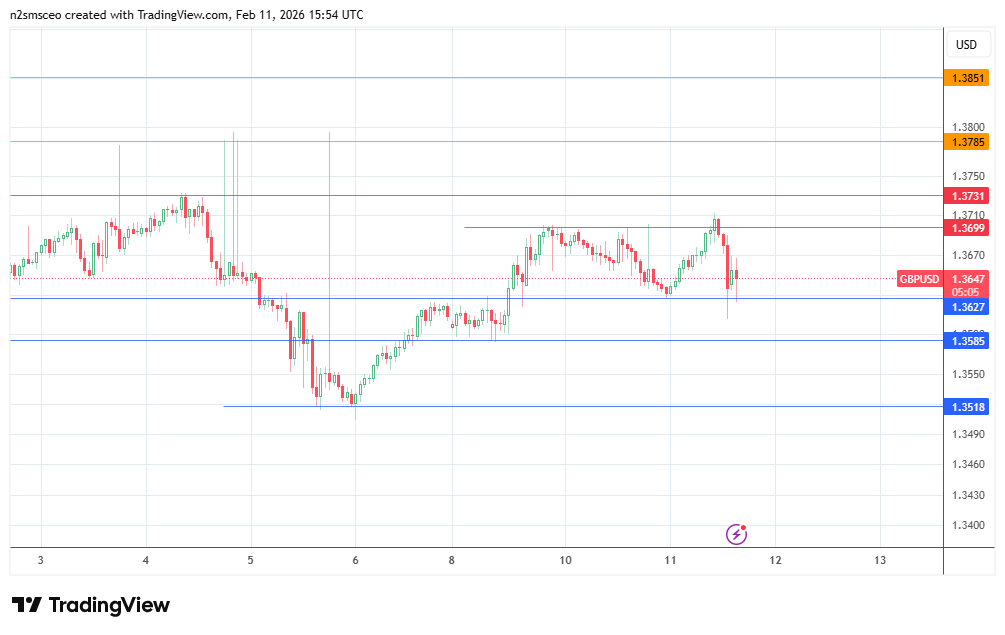
On the flip side, the bulls need to defend the 1.3627 support and uncap the upper boundary of the range to push the near-term uptrend towards the 4 February high at 1.3731. Above this level, the 1.3785 price mark and the current monthly high form the next near-term upside target.