



- Ahead of Friday's Core PCE Price Index data, the GBP/USD saw Monday's brief rally capped and the downside march to 1,317 resumes.
Current Setup and Live Chart
GBP/USD came under pressure from a combination of central bank-related factors. The hawkish repricing of Fed rate expectations and a cautious tone from the Bank of England allowed the greenback to surge at the expense of the cable. However, the Pound saw some brief relief after the resignation of UK Prime Minister Keir Starmer. The relief proved temporary, as renewed USD strength has persisted for the second day in a row.
The pair is trading around 1.3204 as of writing, inching closer to two-month lows as a combination of dollar strength and the bearish move post-BoE has taken hold. The pair is currently being traded with an emphasis on USD fundamentals rather than those of the Pound.
Macro Drivers of the GBP/USD This Week
1) Fed Expectations
Last week’s Fed meeting effectively opened the door for Fed tightening in late 2026. This expectation has been bolstered by strong US data that point to an economy outperforming expectations and in no need of support from lower interest rates. US bond yields have risen as Fed tightening expectations have increased, proving to be a major cap on any attempts at GBP rallies.
2) BoE Caution
The Bank of England’s tone after its policy meeting last week was more measured and cautious than that of the BoJ or the ECB. Elevated UK inflation is not being matched by an aggressive rate hike, even as growth concerns in the UK economy are emerging. The rate outlook favors a BoE pause till the end of the year. Furthermore, Scotiabank notes that the PMI and CBI data from the UK were largely disappointing, a factor that capped Monday’s gains versus the US Dollar.
3) UK Geopolitics
The resignation of UK Prime Minister Keir Starmer on Monday points to more political uncertainty ahead in the UK. Presently, this is not a primary driver of Sterling’s price action, but this could change in the days ahead. A Reuters report indicates that the domestic geopolitical landscape is a key reason Sterling is not trading higher, as investors are reluctant to bet on the asset while USD fundamentals are in play.

GBP/USD Weekly Forecast Scenarios
Base Case: the bias is for the pair to remain mildly bearish, with the 1.31-1.33 price range being the expected consolidation region. This is a result of dollar strength, driven by the hawkish repricing of Fed rate expectations. This is expected to outweigh any supportive push from the UK’s geopolitical situation, given the slight Pound strength that followed the Starmer resignation announcement.
Bull Case: The pair could bounce if Friday’s Core PCE Price Index data shows softer inflation. This data piece is the Fed’s inflation barometer, and if the result underwhelms market expectations, it cuts back on the hawkish Fed expectations. In this scenario, the GBP/USD could get a relief bounce towards the 1.34-1.35 price range. A stubbornly high UK inflationary situation would also help support the pair.
Bear Case: a strong Core PCE data print reinforces the Fed’s increasingly hawkish stance and could lead to a breakdown of the current support at 1.317. This scenario could expose downside targets towards 1.30 in the near term.
Takeaway
The GBP/USD is being driven by the divergence in interest rate expectations between the Fed (increasingly hawkish) and the BoE (cautious). The current macroeconomic environment is USD-positive, and stronger-than-expected U.S. data support this position. Any rallies in the pair are likely to meet resistance just above current price levels, as the technical outlook indicates.
Only softer U.S. data could force a rethinking of the macroeconomic narrative.
GBP/USD Technical Outlook
The GBP/USD remains in a medium-term consolidation. Following the initial breakdown of the trendline on the 18 June daily candle, the price bounced off the 1.3173 support (30 March low) and met resistance at the broken trendline, which is now acting in a role reversal. The renewed downside move looks set to retest the 1.3173 support. A breakdown of this support unlocks access to the next downside pivot at 1.3012, the 5 November 2025 low.
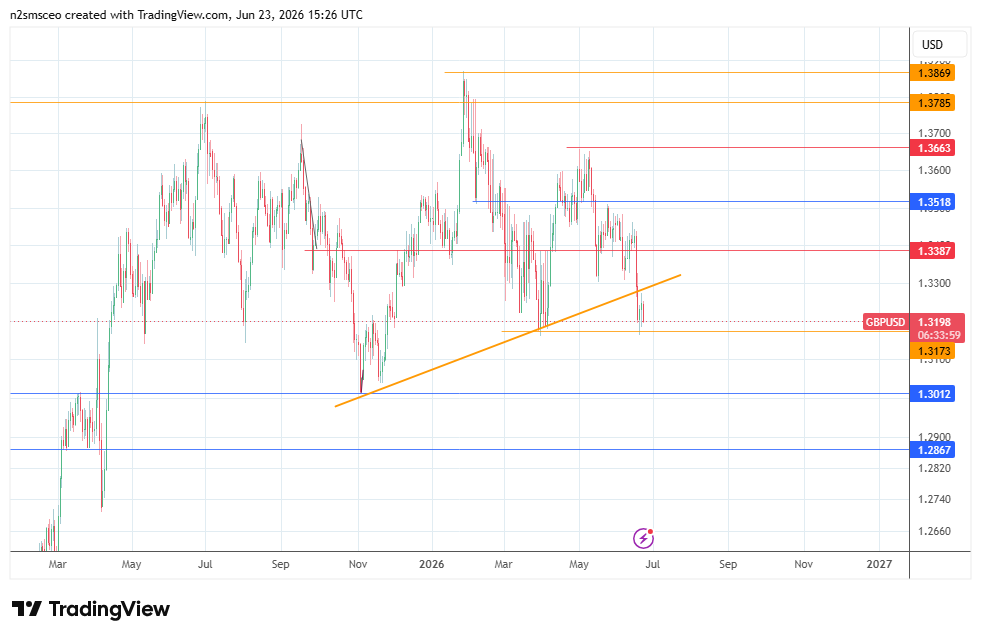
On the flip side, if the bulls defend 1.3173 once more and enable a break of the trendline, the 1.3387 resistance is the next upside barrier. if this is uncapped, a further push towards the 1.3518 and 1.3663 (8 May 2026 high) price barriers could be on the cards.