

- EUR/ZAR weakens as South Africa’s greylist exit and a credible SARB policy stance strengthen the rand
- Carry trade flows favor ZAR over EUR amid high rates and strong gold and platinum prices
- Euro pressure from weak growth and geopolitical risks keeps downside bias intact for EUR/ZAR
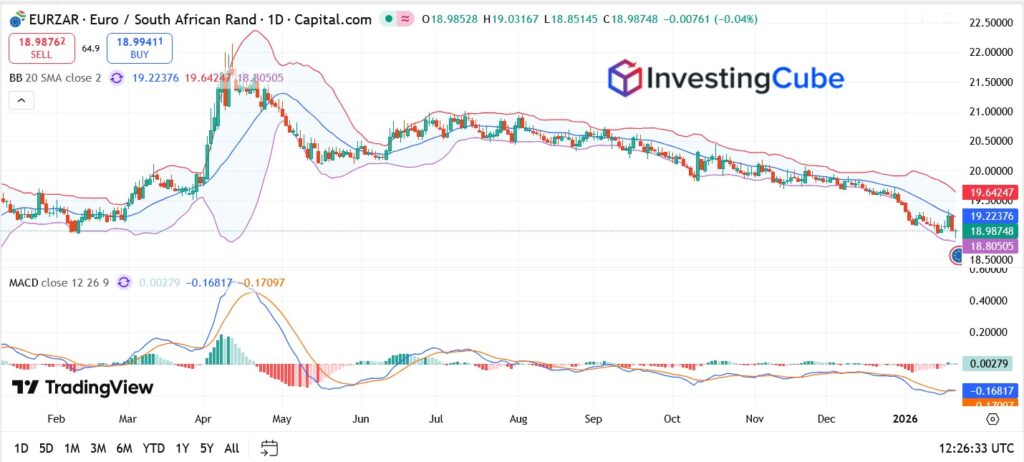
EUR/ZAR traded at 18.98 on Thursday, January 22, 2026, with the day’s range so far at roughly 18.85 to 19.03. The bigger story is not “random volatility” but a clear shift in narrative: South Africa is being repriced as a lower-risk destination, while Europe is dealing with fresh geopolitical and trade uncertainty.
South Africa Rand Strength: Greylist Exit and EU De-Listing Are Changing the Risk Premium
The rand has real tailwinds right now, and the market is treating them as structural, not temporary.
- South Africa’s exit from the FATF greylist in late 2025 has already improved sentiment, but the bigger near-term catalyst is Europe.
- On January 13, 2026, the EU removed South Africa from its “High-Risk Third Country Jurisdictions” list, cutting transactional friction for trade and finance flows. With the change taking effect on January 29, 2026, markets are positioned for a cleaner channel for European capital and business activity into South Africa.
- The SARB’s move to a flat 3% inflation target has also helped anchor expectations. For FX, that matters because it supports credibility, real-rate pricing, and demand for South African bonds.
This reflects a stronger rand narrative built on reduced compliance drag, tighter macro anchoring, and improving investor confidence.
Euro Headwinds: Greenland Friction and European Geopolitics Keep EUR Volatile
On the EUR side, the problem is uncertainty stacking up.
- Trade and diplomatic tensions tied to the US–Europe friction around Greenland continue to sit in the background as a risk-off overhang for Europe.
- When Europe faces policy noise and tariff risk, the euro can lose its “steady currency” appeal at the margin, especially versus higher-yield and commodity-linked currencies when global investors are in carry mode.
That contrast, improving South Africa risk perception versus European geopolitical friction, is a big reason why EUR/ZAR has struggled to hold rallies.
EUR/ZAR Technical Analysis: Sellers Still Control Below 19.22
The chart structure is still rand-favourable.
- Price action: EUR/ZAR is trading below the 20-day Bollinger midline near 19.22, which keeps the near-term bias tilted lower.
- Immediate resistance: 19.03 (today’s high) is the first ceiling, then 19.22, and then the upper band near 19.64.
- Key support: 18.85 (today’s low area), then the lower band near 18.80. A clean break below 18.80 would put fresh downside levels back in play.
What to Watch Next in EUR/ZAR
The next few weeks are critical for EUR/ZAR as markets transition from sentiment-driven moves into policy-driven pricing. The most immediate catalyst is the EU’s formal implementation of South Africa’s de-listing on January 29, which is expected to reduce compliance friction for European capital flows into South African assets. If early inflows materialise as expected, the rand could receive further structural support rather than just short-term momentum.
At the same time, elevated gold and platinum prices continue to improve South Africa’s external balance and terms of trade, reinforcing the rand’s appeal in carry and risk-on strategies. This contrasts sharply with the euro, which remains vulnerable to headline-driven volatility tied to transatlantic trade friction and broader European political uncertainty. Any renewed escalation on tariffs or geopolitical rhetoric would likely pressure the euro side of the pair faster than it impacts the rand.
EUR/ZAR Outlook: Rand Strength Looks Fundamentally Backed, Not Just Tactical
The broader outlook for EUR/ZAR now favours continued downside bias, rather than a sharp rebound. South Africa’s improving macro credibility, anchored inflation targeting by the SARB, and easing regulatory constraints suggest the rand’s recent strength is grounded in fundamentals.
Unless European risks ease meaningfully or global risk appetite deteriorates sharply, rallies in EUR/ZAR are likely to remain corrective rather than trend-changing. The balance of risks still points toward a gradual grind lower, not a sustained euro recovery against the rand.
EUR/ZAR FAQs
The rand’s strength is being driven by South Africa’s exit from the FATF Greylist and the SARB’s firm commitment to a flat 3% inflation target. That policy credibility has lifted demand for ZAR assets, especially as the euro struggles with weak growth momentum in Germany and France.
Yes, but selectively. The rand offers a clear yield advantage over the euro, making EUR/ZAR attractive for carry strategies. The risk is that ZAR remains highly exposed to commodity prices, particularly gold and platinum, meaning sharp pullbacks can occur if the global risk backdrop shifts.
The rand can remain firm in early 2026 due to higher South African interest rates and improved investor confidence after the FATF greylist exit. However, further gains will depend on global risk sentiment, commodity prices, and whether Europe’s growth outlook continues to weaken.