


- The Fed left rates unchanged, but Warsh's first meeting as chair delivered a clear hawkish message: inflation risks remain elevated, rate cuts are no longer the base case, and policymakers are increasingly open to higher rates if price pressures fail to ease.
- ECB officials cited rising inflation risks linked to the ongoing conflict in the Middle East, highlighting concerns that higher energy prices and supply disruptions could complicate the inflation outlook. The decision reinforced the ECB's commitment to keeping inflation under control, even as growth concerns persist across the euro area.
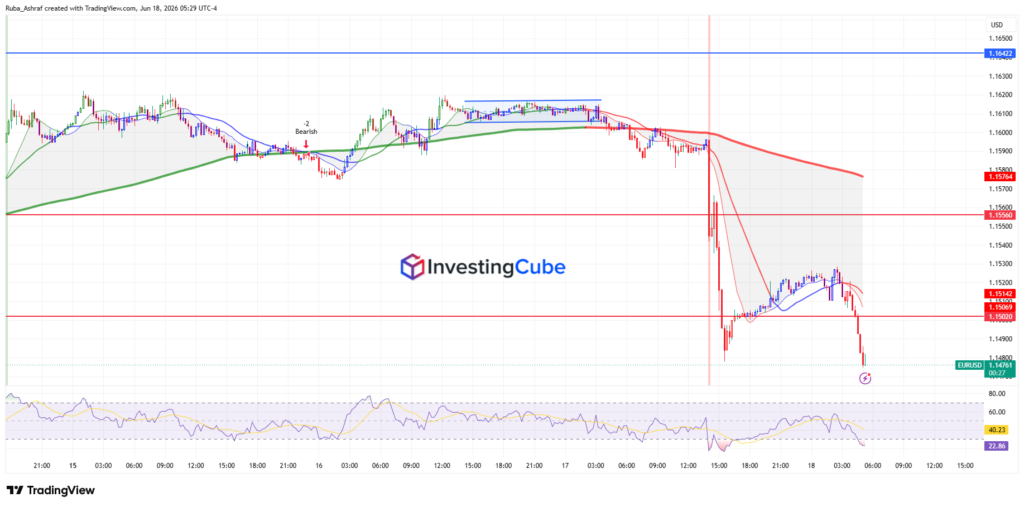
The 15-minute EUR/USD chart shows a consolidation zone where EUR/USD spent a considerable amount of time trading sideways between approximately 1.1605 and 1.1617. During this phase, buyers and sellers were relatively balanced, with price repeatedly testing both boundaries without establishing a decisive trend.
The upper blue horizontal line near 1.1620 represents a key resistance level. Despite several attempts, buyers were unable to break above this ceiling, signaling a lack of bullish conviction. The lower blue boundary around 1.1605 acted as support throughout the consolidation period.
Eventually, the market broke below the lower boundary of the range. This breakdown is significant because it transformed former support into resistance. Notice how subsequent rallies struggled near the 1.1600–1.1605 area, confirming that sellers had taken control.
During the consolidation phase, the price remained largely above the medium- and long-term averages, indicating that the broader trend was still constructive. The recent rebound toward the moving averages was rejected, indicating that these averages are now acting as dynamic resistance rather than support.
The red horizontal line near 1.1591 is acting as immediate support. Price recently bounced from the lower red support around 1.1585, but the rebound lacked strength and stalled below the former range support near 1.1600.
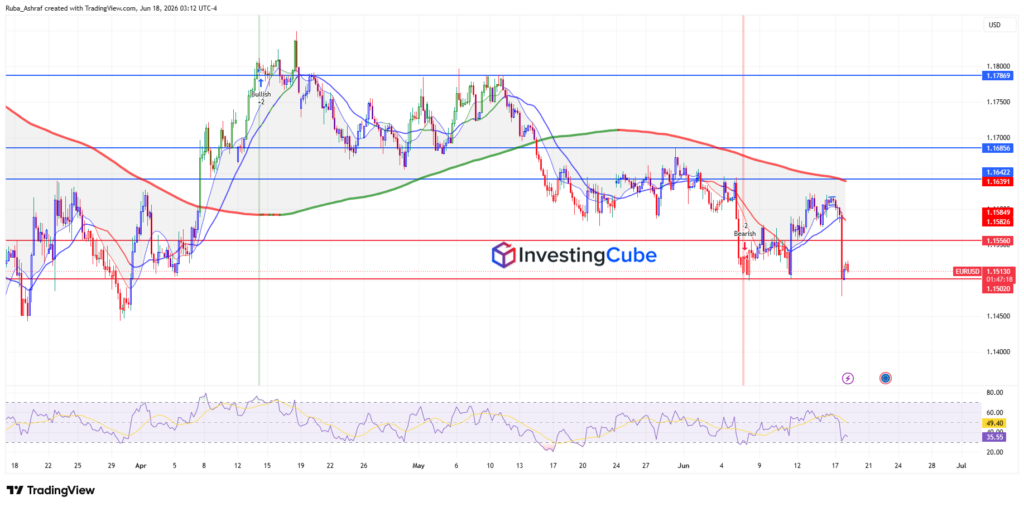
The EUR/USD chart is showing that the bearish scenario we had been monitoring has now started to materialize. The key development is the decisive break below the 1.15020 support level. This level was acting as the lower boundary of the recent consolidation range.
This breakdown has already occurred on the 15-minute timeframe, confirming a short-term bearish breakout. Now, it appears to be extending into the 4-hour timeframe, suggesting that sellers may be gaining broader control of the market.
Looking at the price structure, EUR/USD had been trading within a sideways range between 1.15020 and 1.15560 after the sharp selloff. The subsequent recovery failed to establish a higher high and instead stalled below the key resistance zone around 1.15800-1.16000. This indicates that the rebound was corrective rather than the start of a new bullish trend.
The shorter-term moving averages have rolled over and are beginning to point lower, while price has fallen back beneath them. This suggests that short-term momentum has shifted in favor of sellers. Meanwhile, the longer-term trend remains negative as the price continues to trade well below the descending 200-period moving average.

The RSI indicator provides additional confirmation. RSI has now dropped sharply toward the oversold area and is trading below the 40 level. This indicates strengthening bearish momentum.
EUR/USD Potential Scenarios:
- As long as EUR/USD remains below the broken support at 1.15020, the breakout remains valid. A sustained move below this level could open the door for a deeper decline toward 1.14700 and potentially 1.14500. Continued weakness in momentum indicators would further support this scenario.
- For sellers to lose control, buyers would need to quickly reclaim 1.15020 and push the pair back inside the previous consolidation range. A recovery above 1.15560 would be the first indication that the breakdown may have been a false breakout, while a move above 1.15800–1.16000 would significantly improve the bullish outlook.
EUR/USD Fundamental Updates:
The Federal Reserve kept interest rates unchanged at 3.50%-3.75%, as widely expected. The Fed removed its easing bias, dropping language that previously suggested future rate cuts were under consideration. Policymakers upgraded their assessment of the economy, citing strong job growth, solid productivity, and continued capital investment.
Hawkish Shift in the Fed’s Outlook:
The updated Summary of Economic Projections (SEP) showed a major shift in expectations:
- The median 2026 policy rate forecast rose to around 3.8% from 3.4%, effectively changing the outlook from a rate cut to a potential rate hike.
- Nine Fed officials now expect at least one rate hike before year-end, compared with no hike expectations previously.
- Inflation projections were revised sharply higher:
- 2026 PCE inflation forecast increased to 3.6% from 2.7%.
- Core PCE forecast rose to 3.3%.
Market Reaction:
Markets interpreted the meeting as a hawkish surprise, with traders rapidly shifting from pricing future rate cuts to considering the possibility of a rate hike as early as September.
The U.S. Dollar Index (DXY) rallied sharply, while EUR/USD and GBP/USD came under pressure as Treasury yields moved higher.
Meanwhile, the European Central Bank delivered a surprise hawkish signal last week by raising interest rates for the first time since September 2023, ending a streak of seven consecutive meetings without a policy change.
ECB officials cited rising inflation risks linked to the ongoing conflict in the Middle East, highlighting concerns that higher energy prices and supply disruptions could complicate the inflation outlook. The decision reinforced the ECB’s commitment to keeping inflation under control, even as growth concerns persist across the euro area.