


- EUR/USD slides below 1.1700 as rate expectations and bearish momentum weigh, with RSI and MACD pointing to further downside pressure.
EUR/USD continues to slide below 1.1700 as investors await fresh catalysts, with attention centred on interest rate expectations in both the Eurozone and the US. The European Central Bank has signalled a steady-rate stance for now, citing stable economic conditions and inflation close to target, while ECB President Christine Lagarde has stressed that elevated uncertainty limits the scope for forward guidance.
On the US side, the dollar remains supported by relative yield dynamics as markets continue to reassess the timing and depth of easing from the Federal Reserve. With no immediate macro catalyst to reverse positioning, EUR/USD has remained under pressure, slipping further below a key psychological level.
EUR/USD Technical Outlook: Break Below 1.1700 Shifts Focus to Key Supports
From a technical perspective, the move below 1.1700 marks an important short-term breakdown. The pair is now trading around 1.1685, with sellers in control as price probes the next layer of support.
Immediate downside focus is on the 100-day simple moving average near 1.1660. A clean break below this level would expose the 50-day SMA around 1.16335, followed by the 1.1615 horizontal support zone. Beyond that, a deeper pullback could draw price toward the short-term rising trendline support near 1.1580, a level that may act as a decision point for whether the move remains corrective or extends further.
Momentum Indicators Reinforce Near-Term Bearish Bias
Momentum studies continue to favour the downside. On the daily chart, the Relative Strength Index (RSI) has slipped below the 50 threshold, reflecting weakening bullish momentum. At the same time, the MACD remains below its signal line, with a mild downward slope, indicating that bearish pressure has yet to fully exhaust.
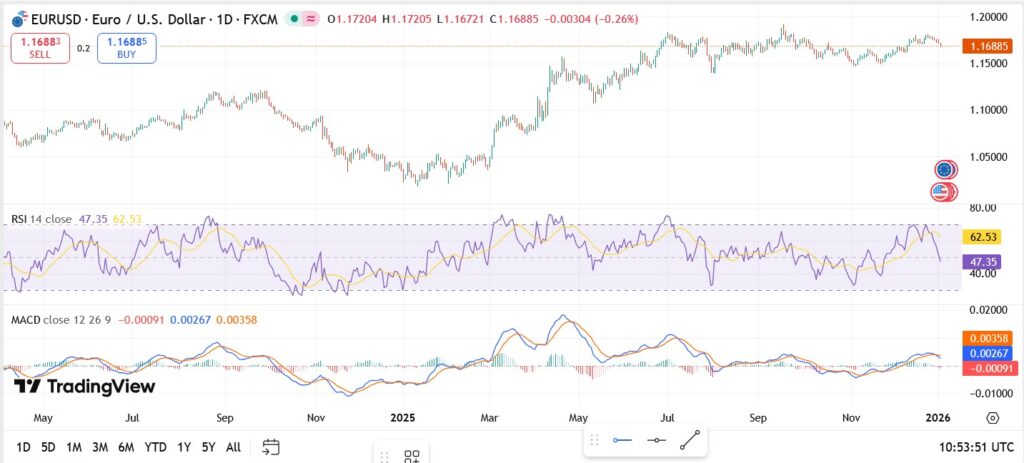
As long as RSI fails to recover above 50 and MACD remains capped, rebounds are likely to be shallow and vulnerable to renewed selling.
Resistance Levels: What EUR/USD Bulls Need to Reclaim
On the upside, the 1.1700 level now acts as initial resistance rather than support. A sustained recovery back above this zone would be required to stabilise sentiment and ease immediate downside pressure.
If reclaimed, attention would turn toward the recent two-and-a-half-month high near 1.1807, followed by resistance around 1.1820. Without a clear move back above 1.1700, however, upside attempts are likely to be viewed as corrective within a weakening short-term structure.
EUR/USD Outlook: Downside Risks Persist While Below 1.1700
The near-term EUR/USD outlook remains tilted to the downside as long as the pair trades below 1.1700 and momentum indicators remain negative. Support between 1.1660 and 1.16335 is now critical in determining whether the decline stabilises or extends toward 1.1615–1.1580.
A sustained recovery above 1.1700 would be needed to shift the technical bias back toward consolidation and higher resistance levels. Until then, risks remain skewed toward further losses as markets wait for clearer policy and macro signals.
EUR/USD is falling as interest rate expectations favour the US dollar, while weak momentum and a break below 1.1700 have triggered technical selling.
Yes. EUR/USD shows a near-term bearish bias, with RSI below 50 and MACD pointing lower after the pair lost key support at 1.1700.
Key support lies at 1.1660 and 1.1633, while resistance is now at 1.1700 and 1.1807 if the pair rebounds.