



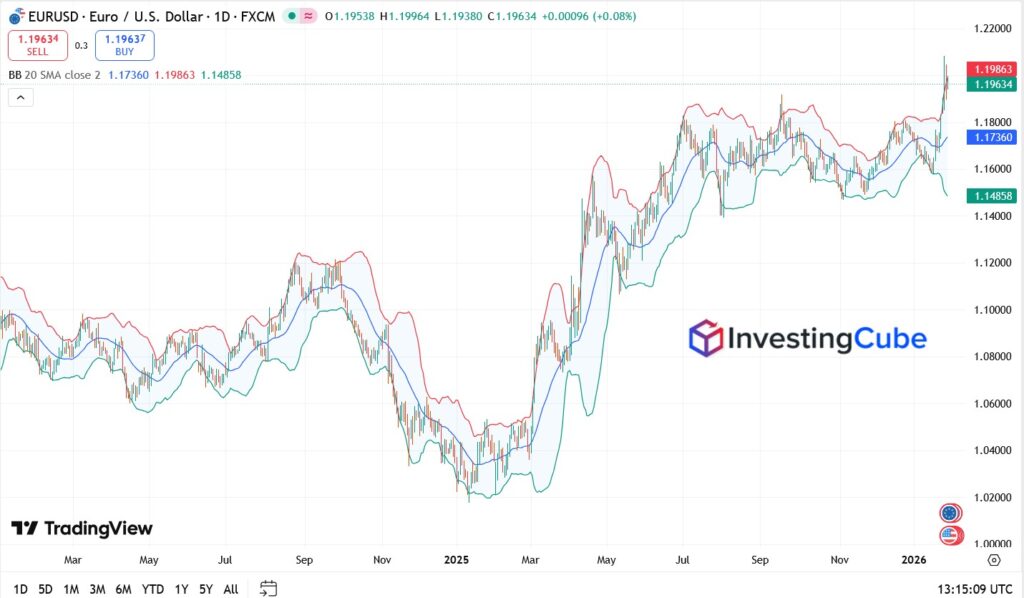
- EUR/USD spiked as high as 1.2081 late Tuesday and continues to hover near the psychological 1.20 handle today, marking its strongest performance since June 2021.
- Trump’s Dollar Commentary: President Trump’s remark that he likes the recent dollar decline and can make it move "like a yo-yo" has turbocharged the Greenback’s sell-off.
- January 30 Shutdown Deadline: The US Dollar remains under intense pressure as Democrats vow to block a budget bill, raising the risk of a partial government shutdown tomorrow.
- "Sell America" Momentum: A loss of confidence in US fiscal and trade stability has seen the Dollar Index (DXY) hit a four-year low of 95.56.
The Euro (EUR) has become the primary destination for traders fleeing US-centric political and fiscal risks, scaling four-year highs this Thursday. The pair staged a massive intraday breakout that briefly cleared the 1.2080 mark, the first time the Euro has consistently tested these levels in over three years.
Trump’s “Yo-Yo” Remarks and the 1.20 Breakout: A Turning Point for EUR/USD?
The most significant catalyst for today’s volatility came from President Trump’s recent commentary on the Greenback’s decline. Late Tuesday, Trump described the Dollar’s recent drop as “great” and stated he could have the currency go “up or down like a yo-yo,” effectively signaling that the administration welcomes a weaker dollar to boost US exports.
These comments arrived during low-liquidity trading hours, triggering a high-momentum spike in EUR/USD all the way to 1.2081. While the price has since stabilized near 1.1960–1.2000, the “Mar-a-lago accord” framework, which favors a weaker dollar to make US goods more competitive, is now being actively priced in by global markets.
January 30 Shutdown Risk: Democrats Vow to Oppose Budget Bill
Adding fuel to the fire is the looming January 30 funding deadline. The US government is heading toward a partial shutdown after Senate Democrats, led by Chuck Schumer, vowed to oppose a budget bill that includes specific appropriations for the Department of Homeland Security.
Historically, investors respond to this level of fiscal deadlock by selling the US Dollar. Unlike previous “safe-haven” cycles, the current “Sell America” trade is being driven by geopolitical jitters and tariff wars, with the Euro serving as the secondary reserve currency of choice for institutional managers.
ECB vs. Fed: The Policy Divergence Supporting the Euro
While the Federal Reserve is expected to leave interest rates unchanged at its meeting this week, the European Central Bank (ECB) is entering 2026 with a more balanced outlook.
- Fed Stance: Markets anticipate an “extended pause” from the Fed that could run through the end of Chair Jerome Powell’s term in May.
- ECB Outlook: Eurosystem staff projections see headline inflation averaging 1.9% in 2026, allowing for a stable policy “plateau” that is currently attracting capital seeking higher relative yields and political stability.
EUR/USD Technical Analysis: Testing the 1.2081 Ceiling
Today’s price action shows a pair in a massive “breakout and retest” phase:

- The 1.20 Psychological Barrier: After briefly spiking to 1.2081, the pair is now fighting to hold a daily close above 1.2000.
- Long-Term Trend: The Dollar Index (DXY) has corrected approximately 10% from its early 2025 highs, confirming a structural bearish shift for the Greenback.
- Support Levels: Immediate structural support for EUR/USD now sits at 1.1900, followed by the 1.1850 pivot zone.
Key Levels to Watch:
- Support: 1.1900, followed by 1.1850.
- Resistance: 1.2000 (Psychological), followed by 1.2081 (Recent Spike High).
Conclusion: Can the Euro Sustain the Multi-Year High Above 1.20?
The EUR/USD forecast for the remainder of Q1 2026 is heavily dependent on the resolution of the January 30 US government shutdown. As long as the Trump administration continues to signal its desire for a “yo-yo” dollar and fiscal deadlock persists in Washington, the path of least resistance for the Euro remains upward. While overbought signals suggest a temporary cooling, the breakout to 1.2081 has officially reopened the door for a challenge toward 1.2140, a level not seen in nearly five years.
EURUSD FAQs
The move was triggered by President Trump’s comments that a weaker dollar is “great” and his suggestion that the currency’s value could move like a “yo-yo,” signaling a shift toward an export-led currency strategy.
If Congress fails to fund the government by tomorrow, a partial shutdown will occur. This typically leads to a weaker US Dollar as investors flee political instability in favor of the Euro and Gold.
While current staff projections see inflation stabilizing at 1.9% in 2026, a significantly stronger Euro could dampen exports, leading some analysts to believe the ECB might keep interest rates at 2.00% through mid-2026 to manage the economy.