


- EUR/USD is struggling to regain traction below the 1.1700 handle after reversing from late-December highs
- Weak German inflation and softer Eurozone services data continue to weigh on the euro
- Market volatility remains muted ahead of key US employment releases, including ADP and JOLTS
- The technical picture points to a corrective downtrend with momentum indicators lacking conviction
EUR/USD remains subdued during European trading hours, hovering around the 1.1670–1.1680 region, with the bearish bias from late-December highs still intact. Price action has remained range-bound, reflecting a cautious market tone as investors position ahead of a busy US macro calendar.
Despite heightened geopolitical headlines, including developments around Venezuela, FX markets have remained largely unfazed as reported by the Economic Times. Instead, traders are increasingly focused on upcoming US labour market data, which is expected to shape near-term expectations for monetary policy from the Federal Reserve.
US Jobs Data in Focus
Attention is now firmly on US employment indicators, starting with the ADP Employment report and JOLTS Job Openings data. These releases are seen as key inputs ahead of Friday’s Nonfarm Payrolls report and could influence expectations around the timing and pace of future US rate adjustments.
While recent US data has shown signs of cooling, markets remain cautious about drawing firm conclusions, keeping EUR/USD confined to a narrow range for now.
EUR/USD Technical Outlook
From a technical perspective, EUR/USD remains in a corrective downtrend after failing to sustain gains above the 1.1800 region in late December. The pair is currently holding above short-term support near 1.1650, an area that has so far limited deeper losses.
Momentum indicators on the 4-hour chart reflect indecision rather than strong bearish conviction. The MACD is hovering close to the zero line, signalling a lack of directional momentum, while the RSI remains below the 50 level, consistent with a mild negative bias.
On the downside, a break below 1.1650 would expose the 1.1615 zone, which aligns with early-December lows. On the upside, recovery attempts continue to face resistance below 1.1700. A sustained move above this level would bring the descending trendline resistance near 1.1735 into focus, followed by the 1.1740 area.
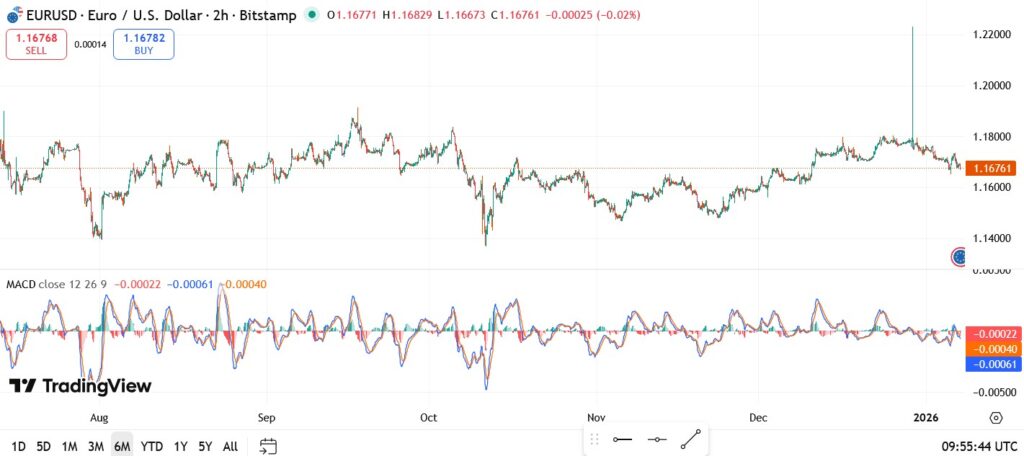
Overall, the technical picture suggests consolidation within a broader corrective phase, with traders awaiting a catalyst from US data to drive the next directional move.
Writer’s Trade Idea: My preferred strategy remains selling rallies toward 1.1700, targeting a move back to 1.1620, while placing a stop-loss above 1.1740.
Short-term price action is mainly driven by US economic data, Federal Reserve expectations, and relative growth and inflation signals between the US and the Eurozone.
The pair is facing pressure from weak Eurozone data and a lack of clear downside momentum in the US dollar, keeping price capped below key technical resistance.
In the near term, technical levels are dominating as markets wait for fresh macro direction from US labour data and central bank guidance.