



- EUR/USD is supported by the ECB's reluctance to raise interest rates despite January inflation being at 1.7%, below its 2% target
- Weakness in delayed US data has added doubt over the dollar's strength
- The return of confidence in the AI industry following strong tech earnings has strengthened the prospects if dollar recovery
The EUR/USD pair struggled in late January, falling to around 1.1625 as the dollar gained strength. But since last Friday, it’s bounced back, with a year-to-date gain of over 1%, trading near 1.1900 on February 10. Let’s break down what’s driving this, especially since most market watchers expect the euro to gain moderately through 2026.
Where Has the Euro Gotten Its Newfound Strength?
The euro’s comeback is due to a weaker US dollar. This comes from lower Treasury yields and changes in what people expect from the Fed on rate cuts. Even though Eurozone inflation dropped to 1.7% in January, below the 2% goal, ECB officials like Joachim Nagel have said they’re not rushing to cut rates further. The ECB is keeping its deposit rate at 2%, which creates a yield floor. That makes the Euro more attractive compared to a dollar that’s getting weaker.
Across the Atlantic, some U.S. government shutdowns have put off official reports. Recent private-sector numbers, like the JOLTS job openings, are at their lowest since 2020. This suggests the U.S. economy might be cooling off. This could push the Fed to cut rates more aggressively in 2026.
Odds of Euro Outperforming USD in 2026
Currently, the market generally sees the Eurozone as stable in 2026. UBS analysts recently upped their growth predictions for the zone to 1.3%. Still, it’s wise to be a little cautious. Much of this growth hinges on fiscal support from Germany that hasn’t completely happened yet. If the U.S. jobs situation is stronger than the delayed data shows, or if energy prices jump again, the euro’s upswing might not last. The euro might do better in 2026 not because Europe is booming, but just because the U.S. is slowing down faster.
The odds favor moderate euro outperformance, with NAGA’s forecast seeing EUR/USD at 1.25, driven by Eurozone recovery, though others like LongForecast estimate 1.1680–1.3510. ING Think’s article projects global growth stability supporting carry, tilting toward euro. However, OANDA MarketPulse’s January 16, 2026, overview notes dollar strength defying bearish forecasts due to US dominance in AI and tech, challenging consensus dollar decline.

EUR/USD Forecast
After going past 1.1850, the pair dipped to find support and has since bounced back, hitting an intraday high of 1.1920. The main target is 1.2000, but it will likely meet initial resistance at 1.1928 and 1.1970. Immediate support is around the Volume Weighted Moving Average (VWMA) at 1.1819, with a stronger floor at the 1.1766 downtrend line.
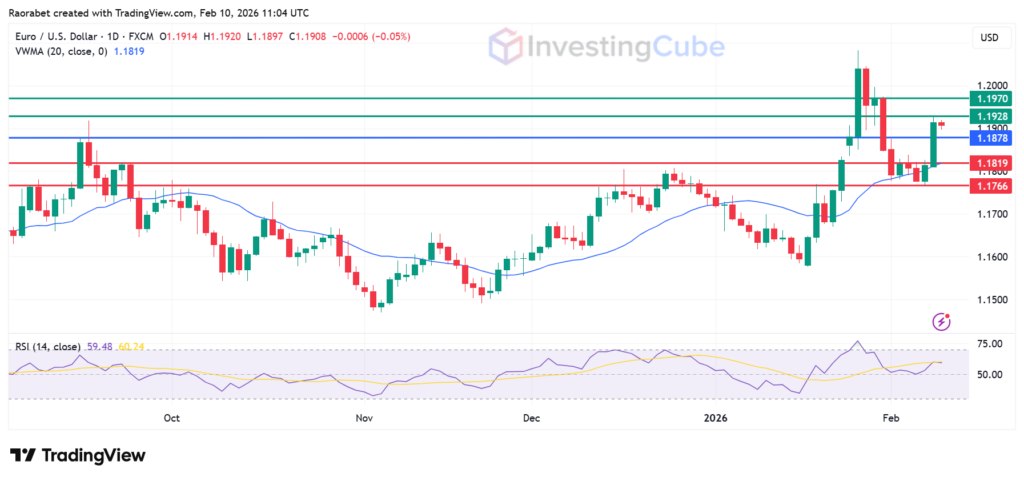
EUR/USD daily chart on February 10, 2026 with key support and resistance levels. Created on TradingView
If you’re thinking of getting in on this, a position size of 1.5-2% of your account is smart. Place a stop-loss at 1.1790 to allow for minor volatility while protecting against a trend reversal.
Weaker U.S. jobs numbers and delayed government reports made markets think the Federal Reserve would cut rates faster than the steady ECB.
It’s possible. If the U.S. economy slows down while the Eurozone gets a boost from German support and stable 2% rates, the Euro could climb as high as 1.25.
Likely if divergences persist with ECB hold and Fed cuts; challenges optimistic consensus, warning tariff disruptions could reverse if US growth accelerates