

- This article examines the EUR/AUD 2026 forecast and how the current fundamental drivers and technical outlook influence these forecasts.
This article examines the EUR/AUD forecasts for 2026 and how the fundamental price drivers and technical outlook marry into the prevailing sentiments. The pair ended 2025 higher. However, a price decline came in December 2025 as the Reserve Bank of Australia hinted at the possibility of hiking interest rates in 2026 if inflation risks remained.
EUR/AUD Live Chart
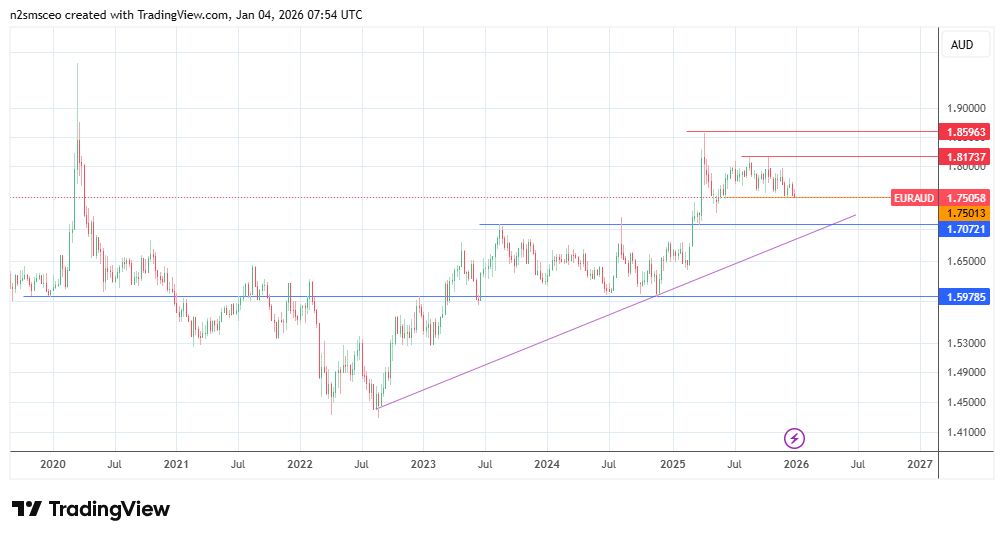
The pair remains in a long-term uptrend. However, recent price action indicates that the uptrend may have stalled after the RBA’s hawkish hints.
The EUR/AUD pair is currently trading at 1.7505, a significant support level for H2 2025. This price level is crucial as it could provide a pivot for a renewed bounce to the upside, or it could usher in a period of decline in a pair that is not only sensitive to the monetary policy trajectory of Europe and Australia, but also sensitive to China, global risk appetite, and the commodities market dynamics.
EUR/AUD Forecast: What are the Fundamental Drivers?
There are four key fundamental drivers behind the EUR/AUD forecasts for 2026. These are:
- ECB vs RBA monetary policy divergence
- Australian commodity channels
- China’s growth data
- Europe’s growth mix
1. ECB vs RBA Monetary Policy
A Reuters report on the recent RBA minutes indicates that the apex bank will keep rate hikes on its table for 2026 if inflationary risks remain. Any market repricing that sees rates staying higher for longer, or signals a new rate hike, will be supportive of the Aussie Dollar. This will pressurize the EUR/AUD.
Bearish EUR/AUD forecasts will also be reinforced if the European Central Bank maintains its “hold” bias. The most recent Flash Manufacturing data from Germany and the Eurozone (December 2025) were underwhelming. Growth activity was more substantial than expected, which could leave the ECB with room to maintain a neutral interest rate stance.
Policy divergence such as is currently playing out, will influence EUR/AUD forecasts in 2026.
2. Australia Commodity Channels
The Reserve Bank of Australia has long recognized that commodity prices, particularly LNG and iron ore, are significant influences on Australian terms of trade. Changes in export prices feed directly into AUD demand and relevant exchange rates. Commodity price dynamics will be crucial for EUR/AUD 2026 forecasts.
3. Chinese Element
China is Australia’s largest trade partner. Resource exports to China, such as LNG and iron ore, remain a key contributor to the Australian economy. Therefore, China’s growth and trade cycles into Australia’s economic activity and the Aussie Dollar. This exposure makes the Australian Dollar sensitive to Chinese growth and trade data, which, in turn, influences EUR/AUD forecasts for 2026.
Global risk-on sentiment, driven by Chinese demand and commodity price trends, can lead to a firming of the Australian Dollar. This dynamic influences EUR/AUD forecasts, making the audience aware of how market mood impacts currency movements.
Global risk-off appetite and Chinese slowdown fears will driver underperformance in the AUD, driving bullish EUR/AUD forecasts.
4. Eurozone Growth Data
According to the latest ECB staff projections, Eurozone growth may slow in 2026 due to weaker global trade. However, domestic demand, especially from defense spending, is expected to support the economy. Recognizing this helps the audience understand the resilience of Eurozone factors in EUR/AUD forecasts.
Current EUR/AUD Forecasts 2026
The prevailing bank-driven EUR/AUD forecasts for 2026, based on current assumptions, see a range-to-lower EUR/AUD. This is derived from an expectation of an ECB stable policy outlook versus a hawkish RBA stance. EUR/AUD weakness will be driven by a stronger global cycle, resilience in commodity prices, upbeat Chinese data, and further hawkishness by the RBA.
The bearish base case is only negated by global risk-off events, disappointing Chinese data, or a sharp slump in commodity prices. For example, a sudden escalation in geopolitical tensions or unexpected Chinese economic slowdown could cause spikes in the EUR/AUD.
NAB’s October 2025 FX forecast update projects that the Australian Dollar will gain ground against the Euro. The implied EUR/AUD forecast sees the pair trading at 1.70 in mid-2026 and at 1.72 in late 2026. This indicates a 300-500-pip downside.
Economists from UBS, Westpac, and CBA are also weighing in on the situation with their own EUR/AUD forecasts. Westpac’s EUR/AUD forecast sees a 1.754 target in March 2026, 1.724 for June 2026, and 1.695 for September and December 2026.
The Commonwealth Bank of Australia’s EUR/AUD forecast of 1.587 for March 2026, 1.563 for Q2 and Q3 2026 and 1.538 by end-2026 is a bearish outlook.
UBS’s EUR/AUD forecast is derived as a cross of its EUR/USD (1.20) and AUD/USD (0.70) targets listed in its recent FX reports. This implies a EUR/AUD forecast target of 1.714 for 2026, supporting your strategic outlook.
EUR/AUD Forecast: Technical Outlook
The daily chart reveals various price levels, with the most notable being the 1.8152 and 1.7501 price levels. These are the borders of the medium-term range that has been intact since June 2025.
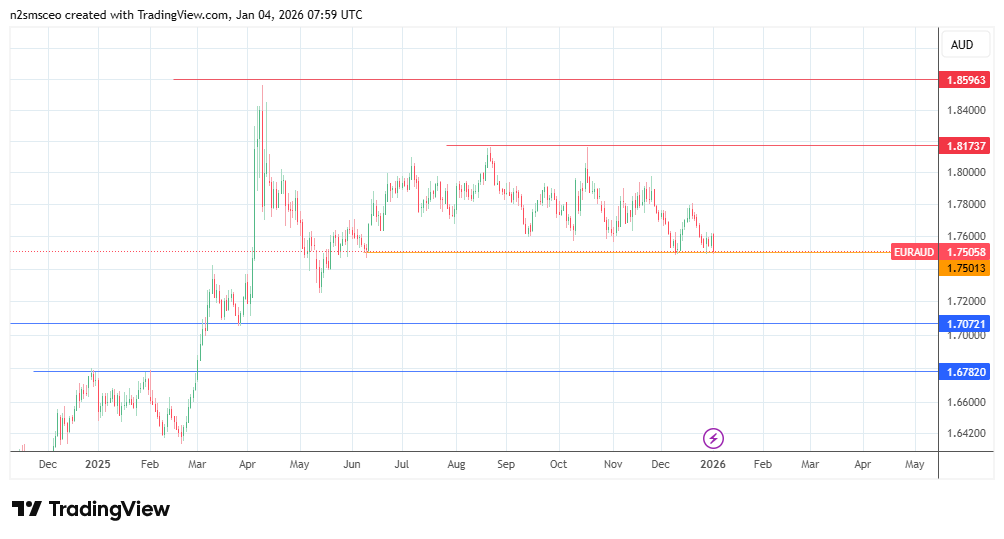
The 1.7501 support is under pressure. Further AUD strength could buckle this support, ushering in a decline towards the 1.7072 significant support and the prior low of 26 March 2025. The 13 May low at 1.7253 is an intervening barrier and could be the initial pitstop.
However, a defence of the 1.7501 support by the bulls could initiate a bounce that needs to clear the descending trendline and the 1.7800 resistance (18 December high), which would serves as the neckline of the double bottom.
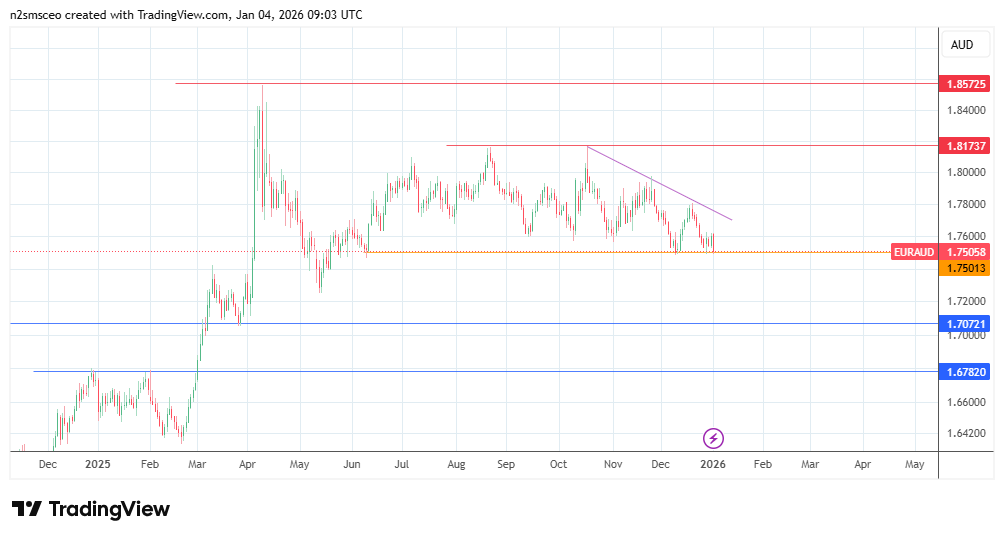
Successful clearance creates access to the 1.8000 psychological resistance (highs of 23 June and 25 November 2025). This leaves the 1.8173 resistance and the upper-range border formed by the prior highs of 21 August and 17 October 2025 as the next resistance target. Only a breach of this barrier ushers in a long-term continuation of the uptrend towards the 9 April high at 1.8572.
FAQ
What is EURAUD exchange rate today?
Answer: The closing price on Friday 2 January 2026 was 1.7505.
What are the current EUR/AUD forecasts for 2026?
Answer: Most bank sources project a weakening of the EUR/AUD based on ECB vs RBA monetary policy divergence and an expectation of a stronger commodity cycle for 2026.