



- December interest rate cut by the Fed and Bank of Canada's hawkish stance have strengthened CAD further
- Recovery of crude oil prices in 2026 could favour CAD against USD in 2026
- Harsh US tariffs against Canadian goods could limit gains by the loonie
The US dollar hit a rough patch against the Canadian dollar (CAD) near the close of 2025. After a good run in the broader year, the greenback recently lost about 2.5% against its northern neighbour in the last month, sending USD/CAD to trade at 1.37 as of this writing.
Why the Canadian Dollar Is Rallying Against the Dollar
The USD/CAD pair’s drop has been quite noticeable. A narrowing interest rate gap is a big reason. The U.S. Federal Reserve cut rates by 25 points in December because the job market cooled, while the Bank of Canada (BoC) surprisingly kept rates steady. This difference made Canadian assets more appealing to investors seeking returns.
Fiscal worries and less faith in US trade policy also hurt the dollar, as Morningstar pointed out. In Canada, strong job numbers, like lower unemployment and steady wage growth, helped the loonie. Yahoo Finance says this data increased expectations for a Bank of Canada rate increase, putting more downward pressure on USD/CAD.
These events stand in contrast to earlier trends. The US is dealing with cooling inflation, but Canada’s strong job market has attracted investors, worsening the dollar’s slide.
Is a Near-Term Recovery By the US Dollar Possible?
A near-term rebound for the USD appears possible but limited. BNP Paribas warns that meaningful upside is constrained by tariff concerns. Analysts at Morgan Stanley, suggest that while the dollar might drift lower through the second quarter of 2026, a rebound is likely in the latter half of that year. Traders need to weigh the upcoming FOMC decisions; a hawkish tone could spark recovery; though broader weakness persists.
USD/CAD Outlook 2026
For 2026, interest rate differences will be key. The BoC is expected to cut rates slower than the Fed, drawing investment to Canada. The National Bank of Canada predicts a target of 1.32 by the end of 2026 but notes that volatility from US policy risks could make the path uneven.

This forecast assumes stable global trade and strong commodity prices, especially oil, which helps Canada’s exports. Risks include rising US tariffs under the current administration, which could hurt Canadian exports and reverse loonie gains. On the other hand, a strong Canadian job market and higher oil prices could speed up the decline
USD/CAD Chart
The USD/CAD pair is showing downward momentum, trading at 1.3683 with negative pressures. The 14-day RSI is below 30, meaning the pair is oversold. While sellers have control, this often leads to a bounce. Immediate support is at 1.3646, the recent five-month low level, and breaking below this could expose 1.3611,, corresponding to the lower Bollinger Band. On the upside, primary resistance will likely come at 1.3700, above which the downside narrative will be invalid. The next barrier will likely be at 1.3756, and action past that level could clear the path to retest 1.3804, currently aligning with the middle Bollinger Band.
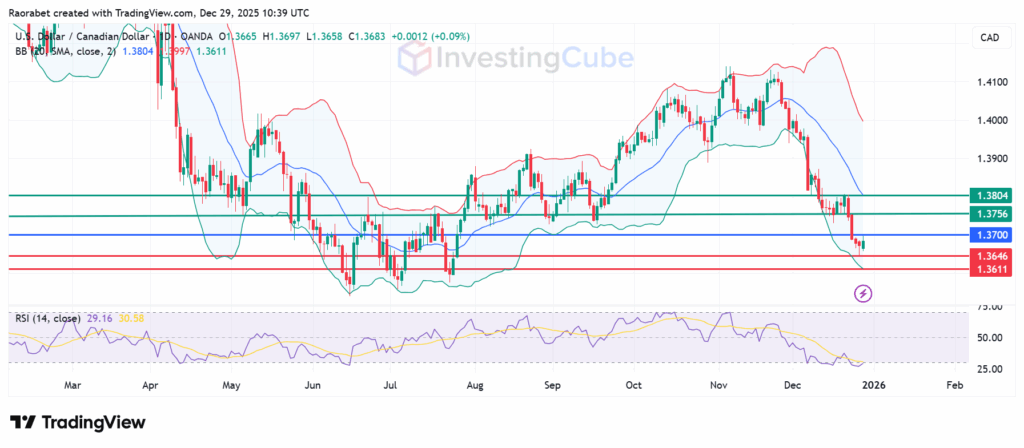
USD/CAD daily chart on December 29, 2025 with key support and resistance levels created on TradingView
The main reason is the difference in central bank actions. The U.S. Federal Reserve lowered rates in December 2025, but the Bank of Canada didn’t change theirs. This made the Canadian dollar more attractive to investors as the U.S. dollar’s interest rate advantage decreased.
Most predictions, like those from Morgan Stanley, suggest an uncertain path. The dollar might weaken further in the first half of 2026 as the Federal Reserve keeps easing, but it’s expected to recover in the second half as the U.S. economy becomes more stable.
Stronger employment figures, including lower unemployment and wage growth, have strengthened the CAD.