
- The Bank of England (BoE) maintained the Bank Rate at 3.75% on February 5, but a surprisingly narrow 5-4 vote split signaled an aggressive shift toward future easing.
- UK PMI data reveals the longest period of job shedding in the services sector in 16 years, fueling concerns of a cooling labor market.
The Bank of England’s Dovish Pivot: A 5-4 Internal Crisis
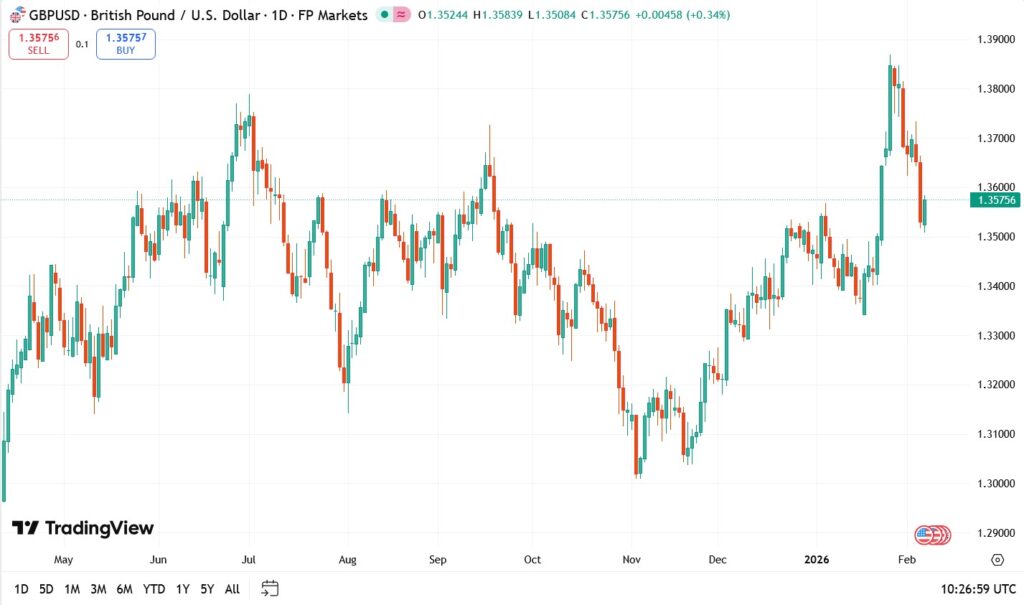
Since mid-January 2026, the GBP/USD pair has experienced a sharp reversal, tumbling from a multi-year peak of 1.3870 to around 1.3560 as of February 6. This represents a more than 2% decline in just over a week, effectively wiping out the “Sterling surge” seen at the start of the year.
While other major currencies like the Australian Dollar are finding support from surprise hawkish pivots at the RBA, the British Pound is buckling under the weight of a domestic policy split. What is causing this sudden unraveling of the “Cable,” and can the Pound maintain its footing above 1.3500?
This narrowest of margins, where four members of the Monetary Policy Committee (MPC) campaigned for an immediate cut, officially marks the BoE as the “reluctant dove” of 2026. Governor Andrew Bailey, who cast the deciding vote to hold, acknowledged that while the disinflation process is running ahead of schedule, the bank must ensure inflation stays at the 2% target. For traders, the message was clear: a rate cut at the March 19 meeting is no longer just a possibility; it is now a 50/50 toss-up.
Why GBP/USD Is Falling Despite the Pullback Stabilization
Normally, a “hold” on rates might support a currency, but the “Sterling Slump” is being driven by a deteriorating economic foundation. After peaking on January 27 at its highest level since September 2021, the GBP/USD pair has entered a period of “bullish exhaustion”. The rally has run into a wall of US Dollar strength, fueled by Fed Governor Lisa Cook’s recent hawkishness.
Cook emphasized that she is more concerned about “sticky” inflation than a cooling labor market, suggesting the Fed may sit on its hands while the BoE begins to buckle.Furthermore, the UK’s growth momentum is visibly fading. The economy is expected to flatline in Q4, and with CPI rising to 3.4% in January, the BoE is trapped between rising prices and a stalling engine.
This divergence in central bank trajectories, where the Fed remains “mildly restrictive” and the BoE is looking for the exit, is creating a fundamental “cap” on any GBP/USD recovery attempts near the nine-day EMA of 1.3626.
UK Services and the 16-Year Job-Shedding Trend
The “hidden anchor” on the Pound is a dramatic cooling of the UK labor market. While business activity in the service sector rose to a five-month high of 54.0 in January, the employment subcomponent tells a grimmer story. The sector has now endured the longest period of job shedding in 16 years, a trend that began in October 2024 as reported by Reuters.

Firms are increasingly turning to automation rather than new hires to offset rising payroll costs and squeezed margins. With unemployment creeping up to 5.1%, the BoE is under immense pressure to prioritize growth over inflation.
This “job-market decay” is stripping the Pound of its yield-premium, as investors realize that the BoE cannot keep rates at 3.75% for long if the backbone of the UK economy, the services sector, is actively shedding workers.
GBP/USD Technical Forecast: The 1.3500 “Line in the Sand”
From a technical standpoint, the daily chart has turned into a high-stakes battlefield for bulls and bears.
- Immediate Support: The pair is currently Defending the lower boundary of an ascending channel around 1.3520.
- Resistance Levels: Buyers need a daily close above this short-term average to unlock a move toward 1.3869. If momentum returns, a break above the upper channel boundary near 1.4050 could open a fresh leg toward the April 2018 highs of 1.4248.
Conclusion: Awaiting the Next Macro Pivot
The current 1.3560 level represents a precarious equilibrium for the Cable. The BoE’s 5-4 split has introduced a “dovish virus” into the Pound’s narrative, while the US Dollar remains revitalized by a Fed that isn’t ready to let go of its restrictive stance.
Unless the upcoming UK GDP data shows a surprising surge in productivity, the 1.3500 support level will remain under immense pressure. Traders should keep a close eye on US initial jobless claims (expected at 212K) as any sign of American labor strength will only further embolden the USD bulls and threaten the Pound’s ascending channel.
The BoE held rates at 3.75%, but the 5-4 vote split shocked markets. Four members wanted a rate cut, signaling that the bank is much closer to easing than previously thought.
The 16-year high in job shedding in the services sector suggests the economy is cooling. This puts downward pressure on wages and gives the BoE more “cover” to cut rates, which is fundamentally Pound-negative.