- The USD/ZAR pair is down by more than 4% YTD, extending a downtrend that began in April 2025
- Interest rate differentials and strong commodity prices have provided strong support for the rand
- The trend will likely continue unless commodity prices drop or South Africa domestic political rifts weigh in
Since April 2025, the USD/ZAR pair has steadily dropped from around 19.93 to about 16.19 as of February 6, 2026. This is a more than 12% decrease over the past year and a 2% dip since the start of the year. Because of this, the South African rand is one of the strongest emerging market currencies against the US dollar. What’s causing this and will the rand stay strong?
Why the USD/ZAR Pair is On An Extended Decline
The drop is largely because the dollar is generally weak and South Africa is doing better. However, intriguingly, the ZAR has outmuscled the USD even in risk-off environments. The downtrend has continued even when risk aversion has risen around the world, denoting a stronger underlying attractive force towards the rand.
A big factor is the interest rate differentials between the United States and South Africa. The Federal Reserve (Fed) lowered rates in 2025 to strengthen the US economy amid labour market weakness, but the South African Reserve Bank (SARB) was careful to keep rates higher. With inflation low at around 3%, the SARB made it appealing for investors to keep their money in rand.
This carry trade has really helped the rand.Also, higher prices for commodities like gold and platinum have boosted South Africa’s trade. Plus, changes in the country, like fiscal responsibility under the Government of National Unity (GNU) and reduced political worry after elections, have attracted foreign investment, which strengthens the rand. For example, Standard Bank says that better electricity and logistics are starting to show results. When the power stays on, investors feel more confident.
How Likely Is A USD/ZAR Trend Reversal?
While some might say this is all about the dollar, South Africa’s dependence on commodities means it’s susceptible to volatility. The USDZAR drop might be because investors are too hopeful about South Africa’s recovery and are not paying attention to problems like budget deficits and the need to fund state-owned enterprises.
If these risks set in, the USD/ZAR pair could fall even further to 15.50 before it goes back up. The market might still be factoring in risks that haven’t happened. The International Monetary Fund (IMF) is warning about slow growth in the long run, but for now, things are moving because of liquidity and a short squeeze on those betting against the rand.If the US dollar index (DXY) keeps falling to 94.00 as Morgan Stanley predicts for the second quarter of 2026, the USD/ZAR pair could drop even more.

USD/ZAR Forecast Today
The USD/ZAR pair has its primary support at 15.91. If it goes below that, it could head to the 15.75 level. On the upside, it will likely face resistance at the 50-day EMA at 16.46. The downside narrative will be invalid beyond that level and the resulting momentum could carry USD/ZAR to test 16.67.
Consider short positions on rallies toward resistance, sizing at 1-2% of capital to manage volatility. Place stop-losses at least 150-200 pips away from entry, above the recent swing high if you are shorting.
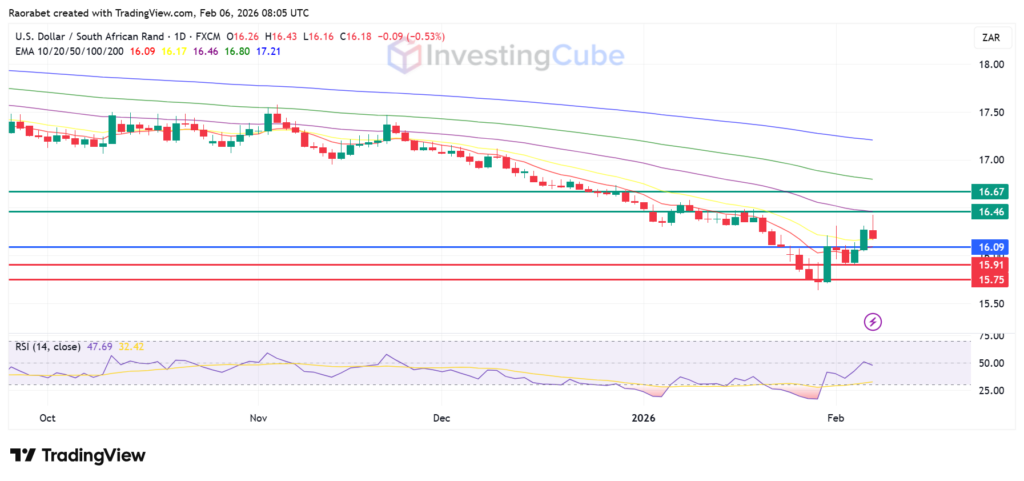
USD/ZAR pair on the daily chart on February 6, 2026 with it’s key levels of support and resistance. Created on TradingView
The pair has been declining because the Fed has been cutting rates, which weakens the USD, while interest rates in South Africa have remained high, with it’s economy in a relatively better shape, which makes investors more confident and supports a good interest rate carry trade.
Investors have been borrowing US dollars at low rates and buying rands to earn higher South African interest. This has kept the pressure on the dollar and could keep the rand going up, as long as the SARB doesn’t cut rates too much.
The biggest risks are a sudden global crisis, US inflation rising again and forcing the Fed to raise rates, or problems within the South African government that threaten fiscal changes.