


- NVIDIA has retreated roughly 23% from its early January peak, despite anticipation for record-breaking Q4 data center revenue.
- A landmark shift in U.S. export policy now allows H200 chip sales to China, though a mandatory 25% revenue cut to the U.S. Treasury creates a new fiscal hurdle.
The “January Hangover”: Decoding the 23% Drop
While 2025 was a “victory lap” for NVIDIA, the first five weeks of 2026 have been a reality check. After hitting a peak in early January, the stock has slid 23%. This crimson-tinted sell-off has left many wondering why a company reporting record data center demand is losing steam.
The answer lies in valuation fatigue. Trading at a forward P/E of over 37x, the market is no longer rewarding “good” news, it demands “perfect” news. The current dip reflects investor anxiety over whether the Blackwell chip ramp-up can meet the astronomical expectations set for the February 25 report.
NVIDIA China Sales Face New Revenue Tax Under US Export Rules
Authorities are closely monitoring a major policy shift from the Trump administration. Effective mid-January 2026, NVIDIA received the green light to export its advanced H200 AI chips to approved Chinese customers, including ByteDance and Alibaba.
However, this “win” comes with a sting: The 25% Revenue Cut. Under a new executive proclamation, NVIDIA must pay a 25% “fee” on the value of every H200 unit sent to China. While this reopens a market that CEO Jensen Huang once valued at $50 billion annually, the mandatory revenue sharing acts as a de facto tax, potentially squeezing the record-high 75% gross margins that investors have come to expect.
The “Physical AI” Frontier: Moving Beyond the Chatbot
To understand why NVIDIA remains a favorite despite the price drop, one must look at its February 3 announcement with Dassault Systèmes. This partnership isn’t about software; it’s about building “AI Factories.”
By integrating NVIDIA’s Omniverse with virtual twin technology, the company is pivoting toward Physical AI, AI that understands the laws of physics. This allows industries to simulate entire manufacturing plants or biological systems in a virtual world before building them in the real one. With the digital twin market projected to hit $328 billion by 2033, NVIDIA is positioning itself as the “operating system” for the next industrial revolution.
The Provenance Risk: Why “Shadow Libraries” Threaten NVIDIA’s Valuation
Beyond macro headwinds, a significant legal “wildcard” emerged in late January 2026 that could force a costly re-rating of NVIDIA’s software AI. An amended class-action lawsuit, led by authors including Abdi Nazemian, alleges that NVIDIA knowingly bypassed legal channels to train its Large Language Models (LLMs). The core of the accusation involves “Shadow Libraries”, massive, unlicensed digital repositories like Anna’s Archive that host millions of pirated books and research papers.
For investors, the risk isn’t just a fine; it’s the potential for a “model purge.” If courts rule the training data was illicit, NVIDIA might be forced to delete and retrain its models using licensed content. As National Crowdfunding & Fintech Association (NCFA Canada) has noted, moving from “free” scraped data to paid licensing deals could permanently squeeze the high profit margins that currently support the stock’s premium.

Nvidia Technical Forecast: The February 25 Countdown
From a technical lens, NVDA is testing a critical support zone.
- Support Level: $165.00. A break below this could signal a slide toward the $150 psychological floor.
- Resistance Level: $188.00. The stock needs to reclaim this pivot to invalidate the current downtrend.
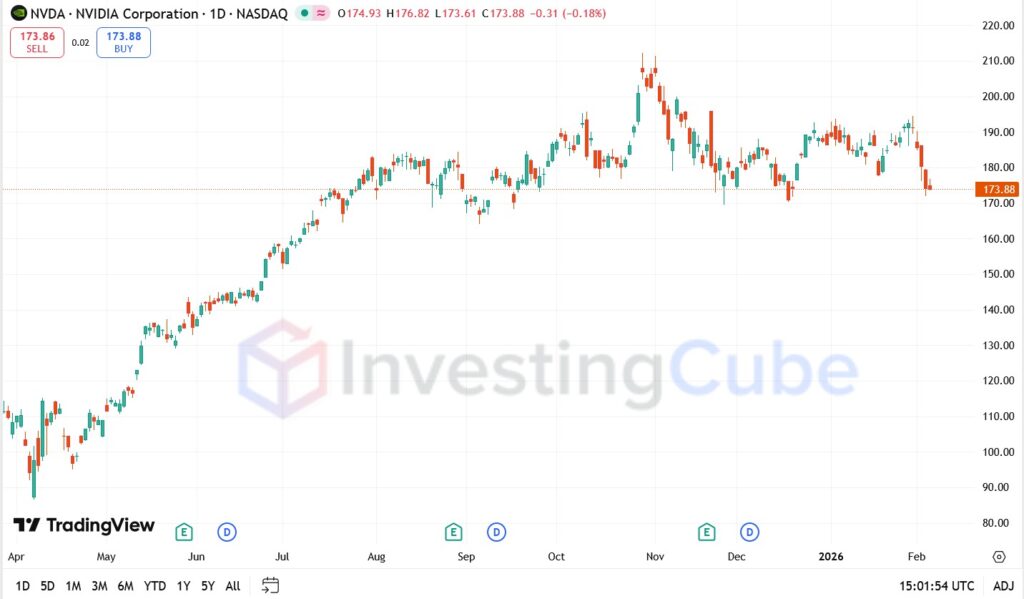
The Verdict: The 23% drop is a classic “reset.” If NVIDIA confirms that Blackwell demand is outstripping supply on Feb 25, the current discount may be viewed as the best entry point of the year. However, if the 25% China “tax” or legal hurdles overshadow the guidance, the correction may have more room to run.
Conclusion: The February 25 Verdict
NVIDIA’s 23% slide is a high-stakes “reset” that has washed out much of the 2025 hype. While the 25% China revenue cut and Anna’s Archive legal battle present genuine headwinds, the fundamentals of the “Physical AI” shift suggest the company is far from reaching its ceiling.
For investors, the February 25 earnings call will be the ultimate litmus test: if NVIDIA can prove that its Blackwell margins can survive these new regulatory and legal costs, the current dip may be remembered as a classic “buy-the-rumor” opportunity before the next leg up.
NVIDIA FAQs
Wall Street analysts expect NVIDIA to report Q4 revenue of approximately $65 billion, a 66% year-over-year increase. The “make or break” metric for investors will be the gross margin, projected to hit 75%.
Additionally, CEO Jensen Huang is expected to provide critical guidance on the production ramp-up for the Blackwell architecture and the newly announced “Physical AI” industrial partnerships.
Many institutional analysts, including those at Goldman Sachs, maintain a “Buy” rating with price targets as high as $250, citing NVIDIA’s forward P/E of 40.7 as an attractive entry point compared to its 10-year average.
However, technical indicators like the RSI (35) suggest the stock is nearing oversold territory, making the current $165–$175 range a critical “accumulation zone” for long-term investors before the next growth cycle.
NVIDIA’s 23% slide from its January peak is primarily driven by valuation fatigue and technical profit-taking ahead of its February 25 earnings report.
Despite record demand, the market is pricing in new headwinds, including the 25% revenue “tax” on H200 chips exported to China and a significant class-action lawsuit involving the use of pirated training data from shadow libraries like Anna’s Archive.